A reference image can be extremely useful when planning a tattoo, but it does not need to become the final design.
That distinction matters.
People often save a photo, illustration, tattoo, flower, animal, symbol, or piece of handwriting because something about it feels right. The image may capture the subject, mood, shape, or >
A better approach is to treat the reference as a source of direction.
Start by identifying what actually matters
Before thinking about the final tattoo, look at the reference and ask which parts you care about most.
It could be:
- the subject
- the silhouette
- a specific flower or symbol
- the movement of the composition
- the overall mood
- the amount of detail
- the line >
- one small element inside a larger image
You do not need to preserve everything.
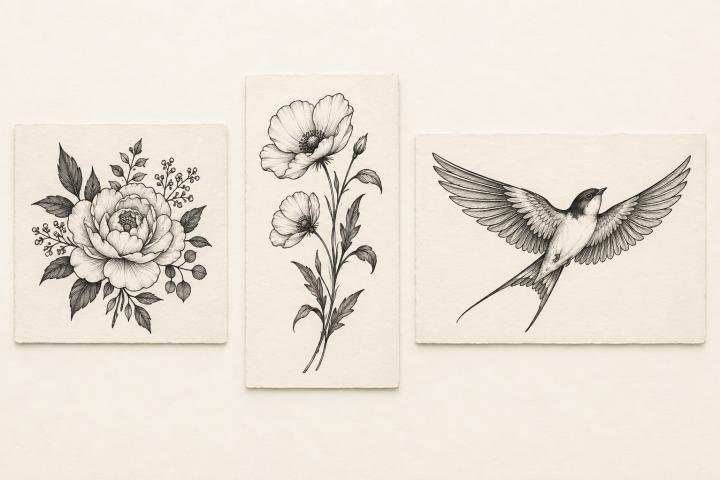
For example, someone might save a photograph of a bird because they like the wing position, but not the background. Another person may like the shape of a flower but want the final tattoo to be much simpler. A handwritten note may matter because of the actual handwriting, while everything around it can change.
Separating the essential parts from the flexible parts makes the next steps easier.
Translate the reference into a tattoo direction
A photograph and a tattoo do not work the same way.
Photos can contain tiny textures, subtle lighting, complicated backgrounds, and details that may not make sense at tattoo scale. A tattoo concept often needs clearer shapes, stronger visual hierarchy, and enough negative space to remain readable.
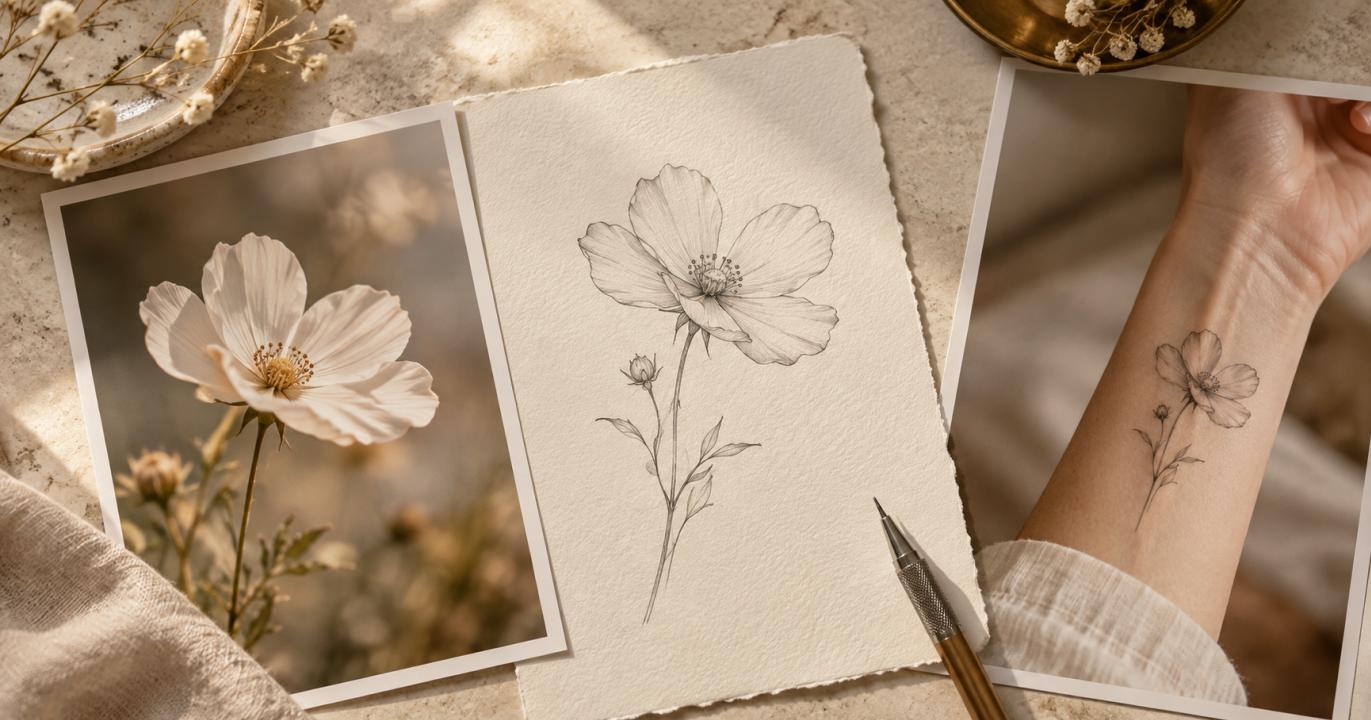
This is where it can help to turn a reference image into a tattoo concept rather than trying to reproduce the source exactly.
The goal is not to create a finished stencil. It is to explore how the important parts of the image could work as a tattoo.
A realistic reference might become a black and grey concept. A complicated object might become a simpler fine-line version. A photo may work better as a cropped composition instead of a full scene.
Size changes what is possible
A tattoo that looks good at a large size may not work when reduced to a few inches.
Small tattoos usually need fewer details and simpler shapes. Larger tattoos can support more texture, shading, secondary elements, and background work.
This is why size should be considered before the design feels “finished.”
If the concept includes several small symbols, thin lines, tiny lettering, or dense shading, reducing the size may force some of those elements to be removed.
That is not necessarily a problem. Simplification can often make the tattoo stronger.
Placement can change the composition
A reference image is usually flat and rectangular.
The body is not.
A forearm, shoulder, calf, chest, rib area, or thigh each creates different proportions and movement. A design may need to become taller, narrower, curved, or more open depending on where it will be placed.
Before becoming attached to one exact layout, it can be useful to preview the design on the body and see whether the proportions make sense.
This does not replace an artist’s placement advice, but it can reveal obvious issues early. A design that looks balanced on a square canvas may suddenly feel too wide on the forearm or too small on the upper arm.
Keep room for the tattoo artist
One of the biggest mistakes in tattoo planning is treating a digital concept as a fixed final answer.
A professional tattoo artist may need to redraw parts of the image, change line weight, simplify details, adjust spacing, alter the composition, or adapt the design to the body.
That is part of the process.
The strongest reference is usually one that communicates your preferences clearly while still leaving room for professional judgment.
Instead of saying, “This exact image must be tattooed,” it is often more useful to say:
“I like this subject.”
“I want this kind of movement.”
“This detail matters most.”
“I prefer this level of simplicity.”
“I want it around this size.”
“I am considering this placement.”
That gives the artist useful information without locking them into a design that may not translate well to skin.
A reference is a planning tool
A tattoo reference does not have to be perfect.
It does not have to include every detail.
It does not have to be ready to tattoo.
Its job is to make your direction easier to understand.
A practical workflow can be as simple as:
reference image → identify the important elements → explore a tattoo concept → simplify or refine → check size and placement → discuss with an artist
That process usually gives you something more useful than simply trying to copy the original image.
The final tattoo may end up looking different from the first reference, and that is often a good thing. The reference helped define the idea. The artist helps turn that idea into something that works on the body.