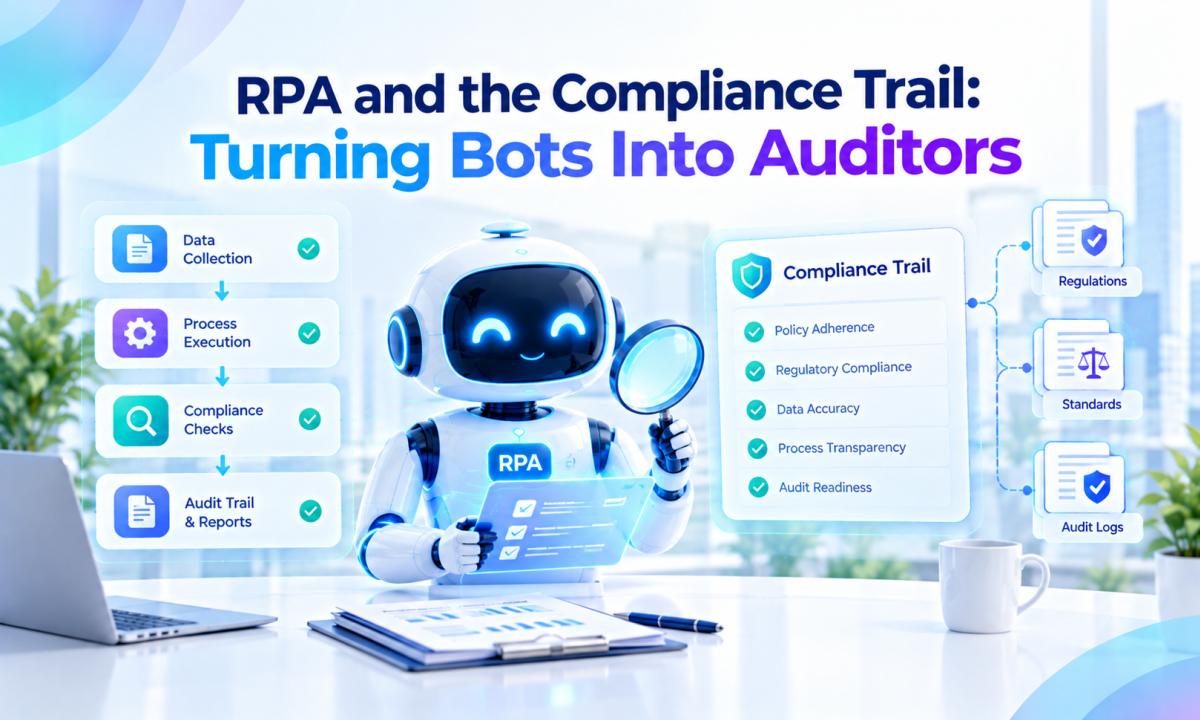
RPA has evolved from simple repetitive data entry and repetitive tasks to a broader application of automation technology. With the evolution of RPA, businesses can establish a more robust compliance log, ensuring that automated processes are more easily monitored, reviewed, and audited. If they are set up properly, RPA bots can capture the activities of a process, record decisions, and even ensure that a business has consistent records throughout its processes.
This transition makes automation a valuable compliance management tool rather than just a productivity tool. Organizations can also combine automation with AI development services to strengthen monitoring, data analysis, and compliance workflows.
What Is an RPA Compliance Trail?
An RPA compliance trail is a document that records the activities carried out by automated bots. It can reveal what action was taken, when it happened, which data was processed, and whether it was done by following predefined rules.
Bots can capture activities automatically, whereas documentation can be different in manual workflows. This provides a sound basis for internal review and external audits.
A quality trail can have:
A report that lists the time and date of each automated action.
The role or identity of the workflow owner, whether it is a user or a system.
Records accessed or modified.
Processing rules applied.
Exceptions and errors that were experienced.
Approvals and the results of workflows.
These records can be used to establish that essential processes have been carried out in line with organizational policies.
Why Is RPA Important for Compliance?
Following a routine can be the key to compliance. Procedures might be applied in various ways by employees. They might forget to document activities, or they could make errors in repetitive tasks. By running predefined workflows the same way each time, RPA can decrease these variations.
For instance, a bot that processes employee onboarding can validate necessary paperwork, update a variety of systems, log onboarding times, and flag missing information. Rather than maintaining multiple manual records, there will be a central history of activities.
This does not mean the process is automatically compliant. Instead, it offers enhanced transparency and provides guidance on areas where controls might be strengthened.
Organizations implementing intelligent automation may also use artificial intelligence development services to analyze large volumes of compliance data and identify patterns that require attention.
How to Implement RPA Bots as Digital Auditors
RPA bots can assist with auditing by monitoring transactions on a continuous basis against defined criteria. Organizations can automate routine compliance checks and pass unusual cases for human review instead of manually reviewing each record.
Think about an accounts payable process. A bot can match invoices to purchase orders, look for missing fields, find duplicate invoices, and ensure that approval levels have been met.
In case of an exception, the bot can log the problem and pass it on to the relevant employee.
This results in a process in which repetitive checking is automated while judgment-based decisions are made by people. When combined with AI app development services, automated workflows can also support more advanced analysis and decision-support capabilities.
Setting Up an RPA Workflow to Be Audit-Ready
Enabling a useful compliance trail isn't just about turning on activity logs. From the outset, organizations need to plan for audit requirements when designing automation.
Identify what activities need evidence. They can be financial transactions, access to customer data, approvals, regulatory checks, or alterations to vital records.
Then, specify what the bot should take a screenshot of at each step. The information should be specific enough that it can be reviewed and reproduced without unnecessary information.
Retention and access policies should also be defined for the organization. Audit logs can include sensitive business or customer data and should be secured through proper permissions and security measures.
Organizations may also consider an AI development solution when they need intelligent analysis of compliance records alongside rule-based automation.
The Use of Exceptions as Compliance Signals
An important benefit of automated monitoring with RPA is that it allows for rapid exception detection.
A bot isn't just able to complete a workflow but can also check the entire workflow to mark any deviations from business rules. That way, compliance teams can prioritize cases that need to be investigated.
For instance, the monitoring bot could alert when:
A transaction goes beyond the exact amount set as a limit and needs to be rejected.
Approvals are missing.
There are unusual changes to records.
Data is repeated or conflicting.
Activities occur outside allowed workflows.
As time goes on, exception patterns can also indicate flaws in current processes. These insights can help organizations improve controls rather than simply responding to individual compliance issues.
RPA, Human Oversight, and Accountability
Compliance processes should not be automated out of the hands of humans. If the rules are poorly designed, the bot will perform the same action over and over again, leading to consistent but incorrect results.
Human interpretation is still required for unusual cases, reviewing policy changes, and assessing whether controls are effective.
One way to do this is to split responsibilities between automation and individuals. Bots can gather evidence, conduct routine checks, and keep records, while compliance professionals can investigate exceptions and make decisions that require context.
This helps improve compliance by better automating routine processes while keeping appropriate human oversight in place. Organizations seeking to expand these capabilities can also use RPA development services to design workflows around their specific compliance and auditing requirements.
Improving Transparency and Auditability With RPA
Compliance activities can be made more transparent with the help of RPA, as all activities can be recorded in the same way. With well-defined controls, effective logging, secure access, and human oversight, bots can enhance both efficiency and auditability.
The aim is not to get bots to act like auditors. It is to make automated workflows easier to understand, verify, and investigate.
The compliance trail will become more critical as more business-critical processes are automated. RPA can help provide visibility that explains what happened, uncover exceptions, and show that appropriate controls were in place and adhered to.