C5ISR market: Defense investment shifts toward AI,
resilient networks and multi-domain systems
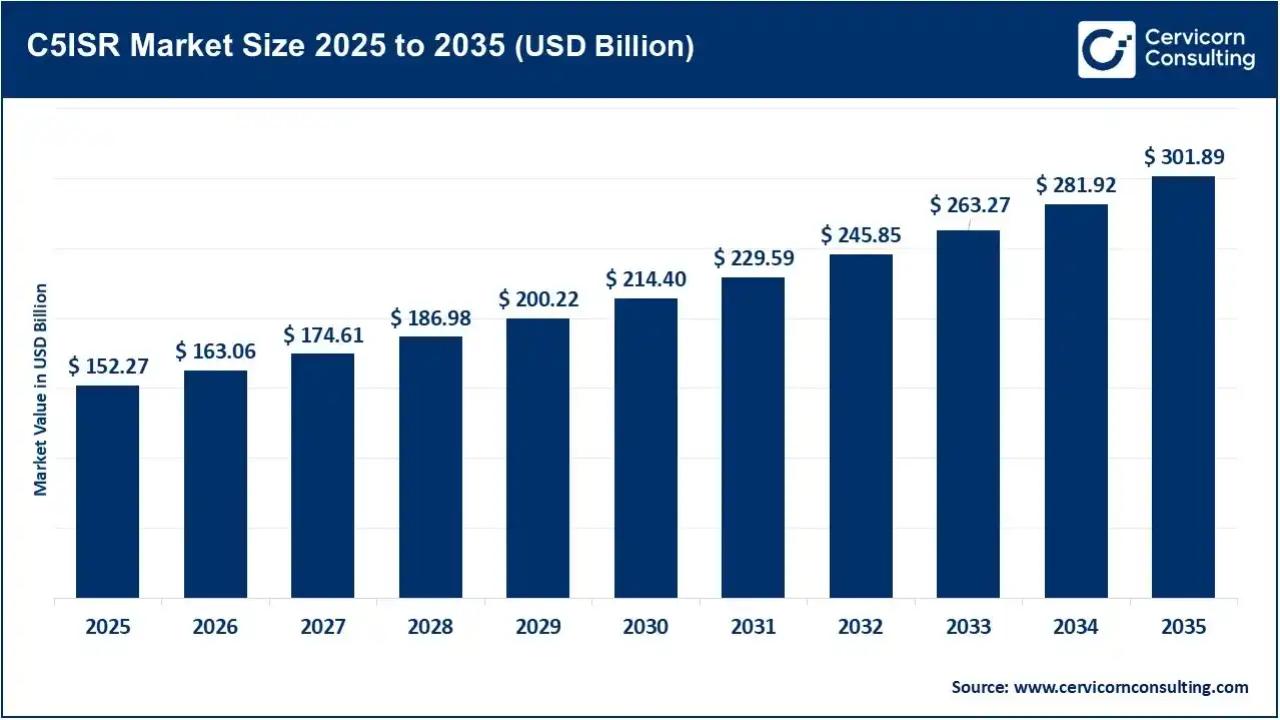
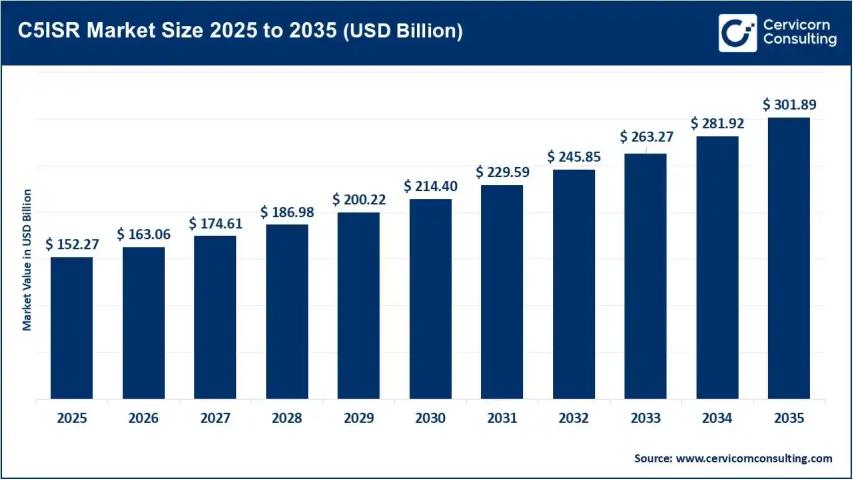
The global C5ISR market was valued at USD 152.27 billion
in 2025 and is projected to surpass USD 301.89 billion by 2035, growing at a
CAGR of 7.08% from 2026 to 2035. North America accounted for 36% of the
market in 2025, while command and control represented the largest application
segment with a 48% revenue share. Land systems accounted for 37% of the market,
while products represented 57% of revenue.
U.S. C5ISR spending reaches $42.7 billion
The U.S. remains a major source of C5ISR investment as
defense forces modernize communications, intelligence, electronic warfare and
battlefield decision systems. The U.S. Department of Defense requested USD
42.7 billion for C5ISR-related programs in FY2026, representing an 11.4%
increase from FY2025, according to Frost & Sullivan. Investment is
increasingly directed toward AI-enabled decision support, open architectures,
resilient communications, edge computing and multi-domain operations.
The U.S. Army is also maintaining substantial procurement
channels for C5ISR services. Its RS3 contract has a USD 37.4 billion ceiling
over a 10-year ordering period, covering engineering, R&D, testing,
logistics, acquisition and strategic planning for C5ISR missions.
Get a Free Sample: https://www.cervicornconsulting.com/sample/3026
Army increases investment in resilient battlefield
communications
Recent Army activity highlights the shift toward C5ISR
systems capable of operating in contested electromagnetic environments. In
2026, the Army's C5ISR Center conducted its Radio Rodeo testing program
to evaluate vehicle-mounted communications technologies under denied,
disrupted, intermittent and limited-bandwidth conditions. The initiative
supports the Army's Next Generation Command and Control effort and is designed
to accelerate industry technologies into operational capabilities.
Counter-UAS is another growing area. In July 2026, the
Army's C5ISR Center conducted industry collaboration and testing focused on
technologies designed to detect and counter increasingly capable unmanned
aircraft systems, reflecting the growing integration of sensing, electronic
warfare and command-and-control capabilities.
Large contract opportunities are emerging
The Army's FY2026 C5ISR planning includes several major
contract opportunities. Planned actions include approximately USD 600–620
million for Defensive Cyber Operations II, USD 175–190 million for
Counter-UAS & Emerging Threats Solutions, and approximately USD
590–600 million for Modeling and Simulation Systems Engineering. These
opportunities demonstrate continuing government demand for cybersecurity,
counter-UAS, modeling, systems engineering and mission integration
capabilities.
The U.S. Department of Defense is also investing in open
C5ISR architectures that combine communications, electronic warfare, signals
intelligence and positioning technologies. A recent Navy CMOSS-related contract
was valued at approximately USD 18.37 million, supporting edge-aligned
electronic-warfare systems designed for contested environments.
India expands airborne ISR capabilities
India is also increasing investment in intelligence,
surveillance and reconnaissance capabilities. In July 2026, DRDO signed
contracts with AI Engineering Services Limited and Adani Defence Systems and
Technologies for the AEW&C MKII program. The program involves
converting six A321 aircraft and developing mission systems for India's
airborne early-warning and control capability.
In August 2026, India's Ministry of Defence signed a ₹1,943
crore contract with General Atomics Aeronautical Systems to lease two MQ-9B
SeaGuardian high-altitude long-endurance remotely piloted aircraft systems for
the Indian Navy for 30 months. The systems are equipped with advanced sensors
and payloads intended to strengthen maritime-domain awareness and persistent ISR
coverage.
AI and electronic warfare are reshaping C5ISR
requirements
C5ISR investment is increasingly moving beyond conventional
communications and surveillance equipment toward AI-enabled analytics, edge
processing, autonomous systems, cyber resilience and electronic warfare.
Military networks must increasingly operate when GPS, communications and
conventional sensing systems are degraded or actively targeted.
This is increasing demand for open architectures that allow
different sensors, communications systems, electronic-warfare capabilities and
software to operate together. AI-enabled processing at the tactical edge is
also becoming important because forces cannot always depend on uninterrupted
connections to centralized cloud infrastructure.
The market is shifting toward integrated capabilities
The latest government spending and contract activity
indicates that C5ISR is becoming an increasingly integrated technology market
rather than a collection of standalone defense systems. Command and control,
secure communications, cyber defense, ISR, electronic warfare, edge computing,
AI and counter-UAS capabilities are increasingly being developed as
interconnected systems.
For defense contractors and technology suppliers,
opportunities are expanding across AI-enabled intelligence processing,
tactical networking, electronic warfare, cybersecurity, resilient
communications, autonomous systems, sensor fusion, counter-UAS technologies and
open-system architectures.
The key commercial opportunity is therefore shifting toward
technologies that can deliver real-time situational awareness and
decision-making in contested, distributed and communication-degraded
environments. As defense modernization programs move toward multi-domain
operations, C5ISR infrastructure is likely to remain a major area of government
procurement and private-sector investment.
Explore the Full Market Report: https://www.cervicornconsulting.com/c5isr-market