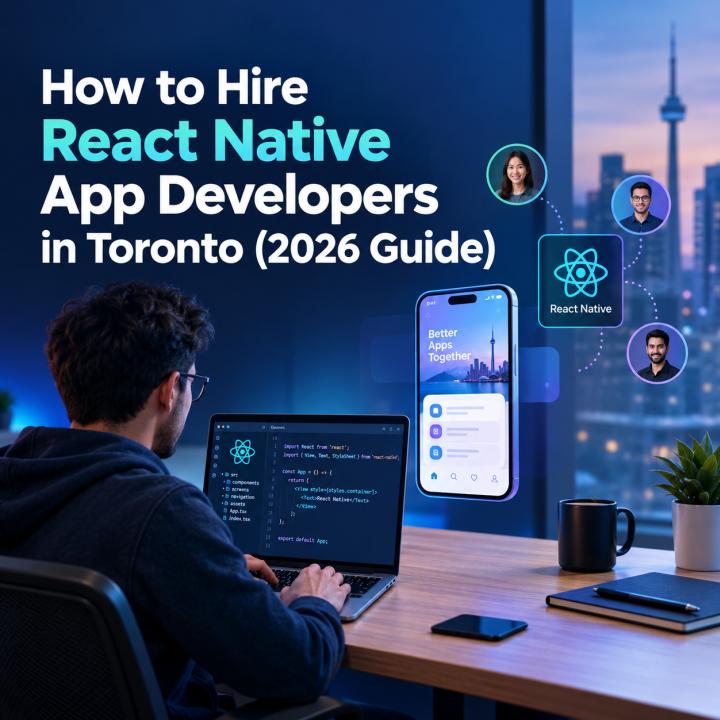
Choosing the right developer can make a significant difference to the quality, performance, and scalability of a mobile application. For Toronto businesses, the hiring decision is even more important because the local technology market includes freelancers, dedicated development teams, software companies, and agencies with different levels of experience and expertise.
React Native remains a practical option for businesses that want to build applications for both iOS and Android while maintaining a shared codebase. However, finding developers who can turn a product idea into a reliable, production-ready application requires more than searching for someone who lists React Native as a skill.
This 2026 guide explains what to look for, where to find developers, how to evaluate candidates, and which questions to ask before making a hiring decision.
Why Hire React Native Developers in Toronto?
Toronto has a strong technology ecosystem with developers working across fintech, healthcare, retail, logistics, education, real estate, entertainment, and other industries. Businesses can therefore find professionals with experience in different application types and technical environments.
One of the main advantages of React Native is the ability to share a substantial portion of application code between platforms. This can help development teams maintain consistent functionality across iOS and Android while reducing duplicated development work.
Businesses can also benefit from Toronto-based developers when their projects require regular communication, collaboration with local stakeholders, or an understanding of the Canadian market.
The key is to evaluate developers based on their ability to solve your specific product and technical requirements rather than choosing solely by location or hourly rate.
1. Define Your Project Requirements First
Before looking for developers, create a clear project brief.
Start by documenting:
- The purpose of the application
- Target users
- Required platforms
- Core features
- Third-party integrations
- Backend requirements
- Authentication requirements
- Payment functionality
- Push notifications
- Real-time functionality
- Expected launch timeline
- Post-launch maintenance needs
You should also determine whether you need a developer for a new application, an existing application, or a migration from another technology.
A detailed project scope allows you to compare candidates more accurately and prevents misunderstandings during development.
2. Decide What Type of Developer You Need
Not every project requires the same type of React Native professional.
For a small project, an experienced individual developer may be sufficient. More complex applications may require several specialists, such as a React Native developer, backend developer, UI/UX designer, QA engineer, and project manager.
You can generally choose between:
Freelance Developers
Freelancers can be suitable for smaller projects, individual features, bug fixes, or short-term development requirements. However, you may need to manage additional responsibilities such as project coordination, quality assurance, and continuity.
In-House Developers
Hiring an in-house developer provides closer integration with your internal team. It can work well for companies planning continuous product development, but recruitment, salaries, benefits, equipment, and other employment costs should be considered.
Dedicated Development Teams
A dedicated team can provide access to multiple technical skills without requiring you to build an entire engineering department internally. This approach can be useful when developing a larger application or maintaining an existing product.
Remote Developers
Businesses can also hire remote professionals when local hiring does not provide the right combination of skills, availability, or budget. If you decide to hire remote React Native developers, establish communication expectations, working hours, documentation standards, and project management processes from the beginning.
3. Check React Native Experience
A developer's resume may mention React Native, but that alone does not demonstrate practical expertise.
Ask candidates about applications they have actually built and determine what responsibilities they handled.
Look for experience with areas such as:
- React and React Native
- JavaScript or TypeScript
- State management
- REST and GraphQL APIs
- Native modules
- Push notifications
- Authentication
- Payment integrations
- Maps and location services
- App performance optimization
- Automated testing
- App Store and Google Play deployment
For experienced candidates, ask them to explain technical decisions from previous projects. Their answers can reveal whether they understand the underlying architecture or have simply worked from existing code.
4. Review Their Portfolio and Previous Projects
A portfolio can tell you much more than a list of technologies.
Look for applications that are similar to your planned product in terms of complexity, industry, user volume, or functionality.
For example, if you are developing a logistics application, experience with live location tracking, driver workflows, notifications, and map integrations can be more valuable than general mobile development experience.
If possible, install applications from the developer's portfolio and evaluate their usability, responsiveness, navigation, and overall experience.
Also ask what the developer personally contributed to each project. This helps distinguish individual expertise from the capabilities of an entire previous team.
5. Evaluate Technical and Problem-Solving Skills
Good React Native development involves more than writing UI components.
During the interview, present a practical scenario and ask how the candidate would approach it.
For example:
"An application works correctly during testing but becomes slow when users load a large amount of data. How would you investigate the problem?"
A strong candidate should be able to discuss profiling, rendering performance, API response times, memory usage, network requests, caching, and other potential causes.
You can also ask about application architecture, reusable components, error handling, testing strategies, security considerations, and release management.
The goal is not simply to test whether the developer knows terminology. You want to understand how they think when facing real development problems.
6. Assess Communication Skills
Technical ability is important, but communication can determine whether a project progresses smoothly.
During the hiring process, observe whether the candidate:
- Understands requirements before proposing solutions
- Explains technical concepts clearly
- Communicates project risks
- Provides realistic estimates
- Responds consistently
- Documents important decisions
- Accepts and incorporates feedback
This becomes particularly important for distributed teams. Establish communication channels, meeting schedules, reporting expectations, and escalation procedures before development begins.
7. Discuss Development Tools and Workflow
Ask developers how they typically manage the development lifecycle.
A professional workflow may include version control, code reviews, issue tracking, testing environments, continuous integration, and release management.
You should clarify:
- Git and branching practices
- Code review procedures
- Testing responsibilities
- Development and production environments
- Build and deployment processes
- Bug tracking
- Documentation
- Performance monitoring
- Post-launch support
Understanding these processes early can prevent technical and operational problems later.
8. Consider Security and Scalability
Security should be considered from the beginning rather than added shortly before launch.
Ask how the developer handles sensitive information, authentication tokens, API communication, secure storage, permissions, and application configuration.
Scalability should also be discussed if you expect your user base to grow. The application architecture should allow the product to evolve without requiring a complete rebuild every time a major feature is introduced.
For applications involving payments, healthcare information, financial data, or other sensitive information, additional security and compliance requirements may apply.
9. Compare Cost With Overall Value
Developer rates can vary considerably depending on experience, project complexity, engagement model, and responsibilities.
Avoid selecting a developer solely because they offer the lowest price.
A lower initial rate may become expensive if the developer produces difficult-to-maintain code, misses deadlines, requires extensive supervision, or cannot handle production issues.
Instead, evaluate the overall value based on:
- Relevant experience
- Technical capabilities
- Communication
- Availability
- Project management
- Code quality
- Maintenance support
- Delivery expectations
Ask for a clear estimate that separates development work from additional services where appropriate.
10. Ask the Right Interview Questions
Before hiring a React Native developer, consider asking:
- How many React Native applications have you delivered?
- Which parts of previous projects did you personally handle?
- How do you structure a scalable React Native application?
- How do you troubleshoot performance issues?
- How do you handle native iOS and Android requirements?
- What testing approach do you normally follow?
- How do you manage API and third-party integrations?
- How do you prepare an application for App Store and Google Play submission?
- How do you handle production bugs?
- What information do you need from us before starting development?
The answers should demonstrate practical experience rather than memorized technical definitions.
11. Start With a Structured Hiring Process
A structured hiring process makes candidate comparison easier.
Begin with your project requirements, shortlist developers based on relevant experience, review portfolios, conduct technical interviews, and discuss availability and commercial terms.
For larger projects, consider a small paid technical assignment or discovery phase instead of making a hiring decision solely from an interview.
Once you select a developer or development team, establish the scope, milestones, deliverables, communication process, ownership of source code, documentation requirements, testing responsibilities, and support arrangements in writing.
Why React Native Skills Matter in 2026
As businesses continue looking for efficient ways to build and maintain applications across multiple platforms, React Native skills remain valuable for projects that require shared development across iOS and Android.
The right development approach depends on the application's functionality, performance requirements, team structure, integrations, and long-term product roadmap. A developer should therefore understand not only React Native but also the surrounding technologies required to deliver a complete application.
For businesses evaluating react native mobile app development, the hiring process should focus on practical experience, architecture knowledge, performance optimization, testing, deployment, and the ability to work effectively with product and technical teams.
Conclusion
Hiring the right React Native developer in Toronto requires a balance of technical evaluation, project planning, communication assessment, and commercial consideration. The strongest candidate is not necessarily the person with the longest resume or lowest rate. It is the developer who understands your product, can make sound technical decisions, communicates clearly, and can support the application through development and future improvements.
Take time to define your requirements, review relevant portfolios, test practical problem-solving abilities, and clarify expectations before development starts. A careful hiring process can help you build a stronger technical foundation and reduce avoidable development risks throughout the application lifecycle.