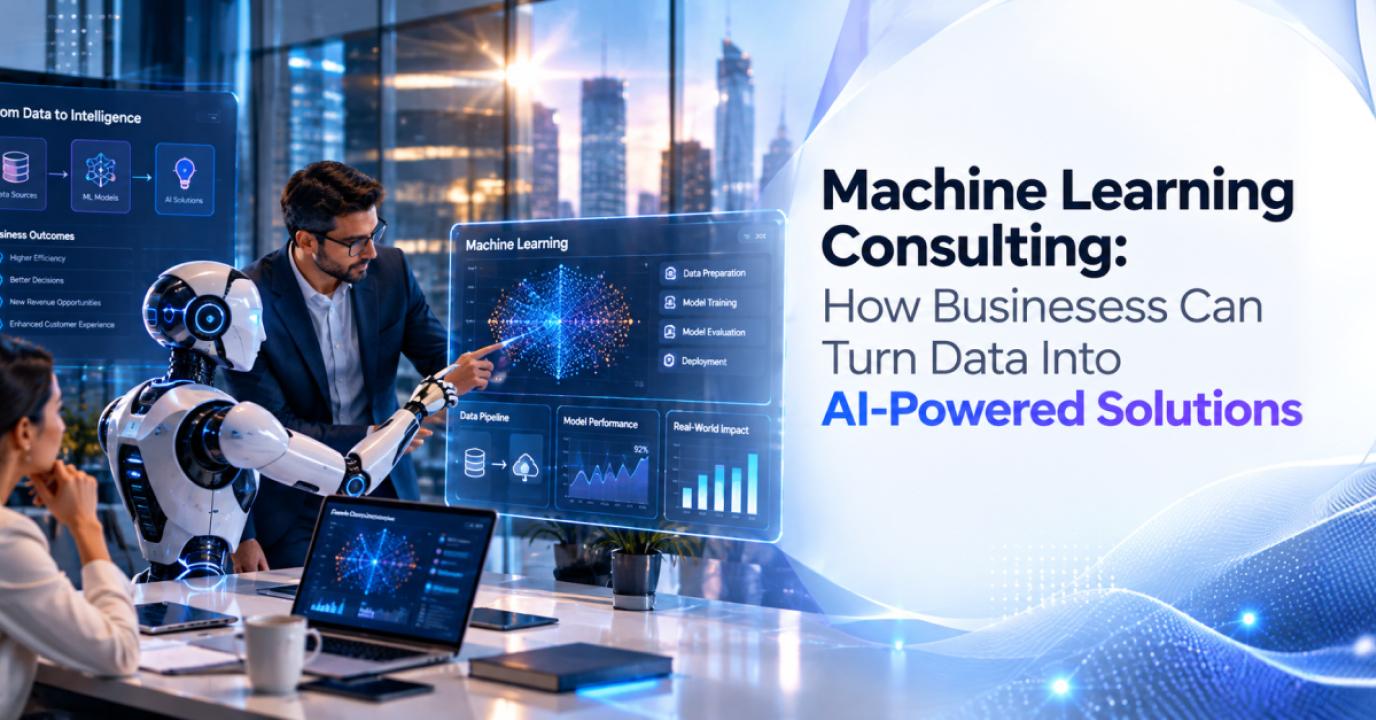
Businesses have more data than ever, but collecting data does not automatically create business value. The real opportunity comes from using that data to predict outcomes, automate decisions, improve customer experiences, and identify opportunities that would otherwise remain hidden. Machine learning consulting helps businesses identify where machine learning can create measurable value, assess data readiness, select the right approach, and build a practical path from business problem to production-ready AI solution.
Machine learning is no longer limited to isolated data science experiments. It can support demand forecasting, fraud detection, recommendation systems, predictive maintenance, customer segmentation, intelligent automation, risk assessment, and many other business processes.
The challenge is knowing where ML makes sense, what it should solve, and how to implement it effectively.
What Is Machine Learning Consulting?
Machine learning consulting connects business objectives with data, ML capabilities, and implementation planning.
Instead of starting with a model or algorithm, a consulting-led approach starts by understanding the organization's business priorities and identifying processes where machine learning can produce measurable improvements.
A typical engagement may include: Identifying and evaluating ML opportunities Assessing data quality and availability Defining business and technical requirements Selecting suitable machine learning approaches Developing a machine learning strategy Creating an implementation roadmap Establishing performance and success metrics Planning deployment, monitoring, and governance
This approach helps businesses avoid investing in machine learning simply because the technology is available. The focus remains on solving the right problem with the right level of technology.
When Does a Business Need ML Consulting?
Not every business problem requires machine learning. Traditional software, rules-based automation, analytics, or generative AI may sometimes be more appropriate.
ML consulting becomes particularly valuable when an organization needs to make predictions, identify patterns, classify large volumes of information, or continuously improve decisions using historical and real-time data.
Common situations include: Large Volumes of Historical Data
Businesses with significant historical datasets can use ML to identify patterns that are difficult to detect manually.
For example, historical sales, customer behavior, equipment data, or transaction records can provide inputs for predictive models.
Repetitive Decisions at Scale
If employees repeatedly make similar decisions using large datasets, machine learning may help automate or support those decisions.
Examples include credit risk assessment, lead scoring, fraud detection, demand forecasting, and customer churn prediction. Complex Patterns
Some business outcomes depend on relationships between many variables. ML can help identify patterns and generate predictions where simple rules may not be sufficient. The Need for Continuous Prediction
Machine learning is particularly useful when a business needs predictions to change as new data becomes available.
For example, a demand forecasting system can continuously incorporate new sales information rather than relying on a static forecast.
Identifying High-Value ML Use Cases
The strongest ML initiatives usually begin with a business problem rather than a technology request.
Start by examining processes where better predictions or decisions could create measurable value.
- Ask questions such as: Where are inaccurate forecasts affecting planning? Which processes generate high operational costs? Where do delays affect customer experience? Which decisions depend heavily on historical data? Where are employees spending significant time reviewing information? Which business risks could be detected earlier? Where could better predictions increase revenue or reduce losses?
Potential ML use cases can span multiple functions. Sales and Marketing
Machine learning can support lead scoring, customer segmentation, churn prediction, recommendation systems, and demand forecasting. Operations
Organizations can explore predictive maintenance, inventory optimization, demand forecasting, anomaly detection, and process optimization. Finance
ML can support fraud detection, risk modeling, cash-flow forecasting, and transaction analysis. Customer Experience
Businesses can use ML to predict customer behavior, personalize interactions, identify churn risks, and improve recommendations.
The key is to connect each opportunity to a measurable business outcome rather than simply listing AI capabilities.
Assess Data Readiness Before Building
A promising ML idea can fail if the underlying data is insufficient.
Before development begins, assess: Data availability Data quality Historical coverage Data consistency Data labeling requirements Data access Privacy and security requirements Data ownership Integration with existing systems
Data preparation can become a significant part of an ML project. Missing values, inconsistent records, changing business definitions, biased datasets, or insufficient historical examples can affect model performance.
A data readiness assessment therefore belongs near the beginning of the machine learning strategy, not after model development has already started.
Organizations should also plan for how data will change over time. A model that performs well on historical data may require monitoring and retraining when customer behavior, market conditions, products, or business processes change.
Choosing the Right Machine Learning Approach
There is no universal ML model that works for every business problem.
The appropriate approach depends on the objective, data, required accuracy, explainability, latency, cost, and operational environment.
Common approaches include: Supervised Learning
Useful when historical data contains known outcomes.
Examples include predicting customer churn, classifying transactions, forecasting demand, or estimating risk. Unsupervised Learning
Useful when businesses want to identify patterns or groups without predefined outcomes.
Customer segmentation and anomaly detection are common examples. Time-Series Forecasting
Useful when businesses need to predict future values based on historical patterns.
Demand, sales, inventory, traffic, and capacity planning can all involve time-dependent predictions. Recommendation Systems
Useful when businesses need to personalize products, content, services, or other experiences based on user behavior and preferences.
The model should always be selected according to the business problem rather than the popularity of a particular ML technique.
ML vs. Generative AI: Which Should Businesses Use?
Traditional machine learning and generative AI solve different types of problems, although they can increasingly work together.
Traditional ML is often well suited to: Prediction Classification Forecasting Ranking Anomaly detection Risk scoring Recommendation
Generative AI is generally used for tasks involving the creation or transformation of content, such as text, code, images, summaries, or conversational responses.
In some business workflows, combining both can create stronger solutions.
For example, an ML model might predict which customers are likely to leave, while a generative AI system could help create personalized retention communications.
This means the decision does not always have to be ML vs. generative AI. The better question is which combination of AI capabilities addresses the business requirement most effectively.
Build an ML Implementation Roadmap
Moving from an ML concept to production requires more than model development.
A practical ML implementation roadmap should typically include:
1. Business Problem Definition
Define the business objective and the problem the model needs to solve.
2. Data Preparation
Identify required datasets, clean and transform the data, and establish appropriate data pipelines.
3. Model Development
Develop and evaluate candidate models against clearly defined performance criteria.
4. Validation
Test the model using appropriate datasets and business scenarios before production deployment.
5. Integration
Connect the model with the applications, workflows, databases, or platforms where predictions will be used.
6. Production Deployment
Deploy the model in an environment that supports reliability, security, scalability, and operational requirements.
7. Monitoring and Improvement
Track model performance, data changes, operational behavior, and business outcomes after deployment.
Modern ML lifecycle management increasingly emphasizes reproducibility, model evaluation, deployment, and ongoing monitoring rather than treating model development as a one-time activity.
Measure the Business Impact of Machine Learning
Model accuracy alone does not determine whether an ML project creates business value.
A model can achieve strong technical performance while delivering limited commercial impact.
Instead, define business metrics before implementation.
Depending on the use case, these may include: Revenue increase Cost reduction Conversion improvement Reduced customer churn Lower fraud losses Reduced downtime Faster processing Improved forecast accuracy Employee productivity Customer retention
For example, improving a forecasting model is valuable only if the organization can use those improved forecasts to make better inventory, staffing, purchasing, or operational decisions.
The goal is to connect ML performance with business performance.
Common Machine Learning Strategy Challenges
Businesses often face several challenges when moving from ML experimentation to production. Starting With Technology Instead of the Problem: Choosing a model before defining the business problem can create unnecessary complexity. Poor Data Quality: Inconsistent or incomplete data can limit model performance and increase implementation effort. Lack of Business Ownership: An ML project needs clear ownership from the business teams that will use its output. Difficulty Moving From Pilot to Production: A successful prototype does not automatically become a scalable production system. Integration, infrastructure, security, monitoring, and operational processes all matter. Ignoring Governance: ML systems can introduce risks related to privacy, security, bias, explainability, and reliability. These considerations should be addressed throughout the lifecycle rather than treated as a final review step.
Connect Machine Learning With a Broader AI Strategy
Machine learning should not operate as an isolated technology initiative.
Businesses need to understand how ML fits within their broader AI roadmap, existing technology environment, data strategy, governance model, and long-term business objectives.
This is where AI strategy services can help organizations connect individual ML opportunities with broader priorities such as AI readiness, use-case prioritization, implementation planning, and scalable adoption.
A strategic approach also helps determine which initiatives should be developed first, which require additional data preparation, and which technologies should support future expansion.
When AI Agents Complement Machine Learning
As AI architectures evolve, businesses are increasingly combining different AI capabilities within the same workflow.
An ML model may provide a prediction or classification, while an AI agent can use that output to take action across connected business systems.
For example, an ML model could identify customers at high risk of churn. An agent-based workflow could then retrieve relevant customer information, recommend an appropriate action, and initiate an approved retention workflow.
In these scenarios, AI agent solutions can complement traditional ML rather than replace it.
The right architecture depends on the business process, level of autonomy required, data environment, and governance requirements.