India Automotive Paints and Coatings Market Outlook
The latest research report by IMARC Group on the India
Automotive Paints and Coatings Market provides a comprehensive forecast of the
industry's size, share, and emerging trends from 2026 to 2034. It offers an
in-depth analysis across various resin types, technologies, layers,
applications, and regions, covering all critical metrics of the country's
automotive surface finishing and protection ecosystem.
How Big is the Automotive Paints and Coatings Market in
India?
The India
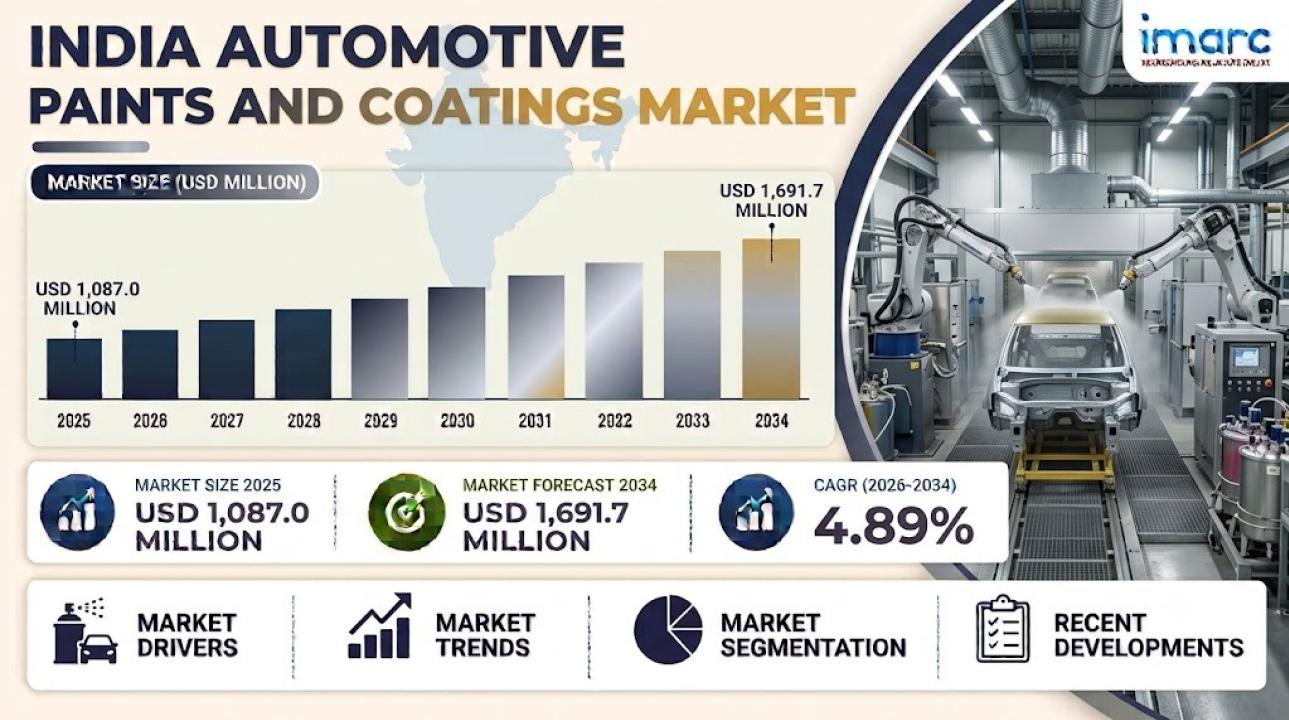
automotive paints and coatings market size reached USD 1,087.0
Million in 2025 and is projected to reach USD 1,691.7 Million by 2034,
exhibiting a CAGR of 4.89% during 2026–2034. The increasing advancements
in paint and coating technologies, such as water-based coatings,
high-performance coatings, and environmentally friendly formulations, are
driving the market. Automotive paints and coatings are specialized formulations
designed to enhance the aesthetic appeal and protect the surfaces of vehicles,
comprising pigments, binders, solvents, and additives that serve multiple
purposes.
Emerging Trends in the India Automotive Paints and
Coatings Market:
- Shift
Toward Eco-Friendly and Low-VOC Formulations:
Stringent regulatory standards emphasizing environmental
sustainability have encouraged the development of eco-friendly and low-VOC
(volatile organic compound) formulations, steering the market toward more
environmentally responsible practices. Water-borne coating technologies are
gaining significant traction as manufacturers respond to tightening emission
norms and consumer demand for sustainable products. These formulations reduce
harmful emissions during application and drying processes while delivering comparable
performance to traditional solvent-borne coatings. Manufacturers are investing
in research and development to improve water-borne coating durability,
adhesion, and appearance characteristics, enabling broader adoption across
automotive OEM and refinish applications.
- Rise
of Electric Vehicles Driving Coating Innovation:
The shift toward electric vehicles has spurred innovation in
coating technologies to address the unique requirements of these alternative
propulsion systems. EV manufacturers require coatings that support
lightweighting initiatives, provide enhanced thermal management properties for
battery enclosures, and meet specific aesthetic and durability requirements for
modern vehicle designs. Additionally, the growing emphasis on aerodynamics in
EV design is driving demand for coatings with superior smoothness and gloss
characteristics that reduce drag while enhancing visual appeal. This transition
is creating new opportunities for coating manufacturers to develop specialized
products tailored to electric vehicle platforms and their distinct performance
requirements.
- Growing
Demand for Customization and Specialty Finishes:
The escalating trend of customizations and personalizations
among consumers fuels demand for specialty coatings and finishes, stimulating
market expansion. Vehicle buyers increasingly seek distinctive colors, matte
finishes, metallic effects, and other personalized aesthetic options that
differentiate their vehicles from mass-market offerings. This demand is
particularly pronounced in the premium and luxury vehicle segments, where
unique finishes command significant price premiums. Manufacturers are responding
by expanding their color palettes, developing innovative effect pigments, and
offering customized coating solutions that enable automakers to create
distinctive brand identities and appeal to diverse consumer preferences.
➤ Request Sample Report with
Datasheet: https://www.imarcgroup.com/india-automotive-paints-coatings-market/requestsample
Growth Factors Driving the India Automotive Paints and
Coatings Market:
- Increasing
Vehicle Production and Sales:
The increasing demand for vehicles acts as a primary driver,
fueling the need for high-quality paints and coatings to enhance aesthetics and
protect against environmental elements. India's automotive industry continues
to expand across passenger vehicles, commercial vehicles, and two-wheelers,
with each new vehicle requiring multiple coating layers including e-coat,
primer, base coat, and clear coat. As production volumes increase, demand for
automotive paints and coatings grows proportionally, creating sustained demand
across OEM supply chains. The expansion of manufacturing capacity under
production-linked incentive schemes is further reinforcing demand for
high-quality coating solutions.
- Technological
Advancements in Coating Formulations:
Technological advancements in the automotive sector,
including developments in coating chemistry and application processes,
contribute significantly to market growth. Manufacturers are developing
high-performance coatings that offer superior scratch resistance, chemical
resistance, UV protection, and color retention compared to conventional
formulations. Powder coating technologies are gaining traction for certain
applications due to their durability and environmental advantages.
Nanotechnology-enabled coatings are emerging that provide self-healing
properties, hydrophobic surfaces, and enhanced protection against environmental
contaminants, creating new performance benchmarks and expanding the value
proposition of automotive coatings.
- Focus
on Safety, Durability, and Corrosion Protection:
Increasing focus on safety and durability in automotive
design acts as a catalyst for the paints and coatings market, with advanced
formulations providing superior protection against corrosion and harsh weather
conditions. Automotive coatings serve as critical barriers against
environmental elements including UV radiation, moisture, road salt, and
pollutants that can degrade vehicle surfaces over time. The growing emphasis on
extending vehicle lifespan, maintaining resale value, and reducing maintenance
costs is driving demand for coatings that deliver long-term protection.
Regulatory requirements for corrosion resistance and durability standards are
further reinforcing demand for high-performance coating solutions across
vehicle categories.
Industry Value Chain Analysis:
- Raw
Material Supply: Suppliers provide pigments, resins, solvents,
additives, and specialty chemicals, with growing emphasis on sustainable
and low-VOC inputs that meet environmental regulations.
- Coating
Formulation and Manufacturing: Manufacturers develop and produce
automotive coatings across resin types and technologies, with increasing
investment in water-borne, powder, and high-performance formulations.
- Application
and Layering: Coatings are applied in multiple layers including
e-coat, primer, base coat, and clear coat, with application processes
critical for achieving desired appearance and protection characteristics.
- Quality
Testing and Certification: Products undergo testing for adhesion,
durability, color consistency, and regulatory compliance, ensuring they
meet automotive OEM specifications and industry standards.
- Distribution
and End-User Delivery: Coatings reach automotive OEMs and refinish
customers through direct supply relationships and distributor networks,
with technical support critical for optimal application.
Market Segmentation Analysis
IMARC Group's latest research report on the India Automotive
Paints and Coatings Market categorizes the market based on resin type,
technology, layer, application, and region.
By Resin Type
The market is categorized into polyurethane, epoxy, acrylic,
and others. Polyurethane represents a significant resin type due to its
excellent durability, gloss retention, and resistance to environmental factors,
making it suitable for clear coat and topcoat applications. Epoxy coatings are
widely used for e-coat and primer applications due to their superior adhesion
and corrosion resistance. Acrylic resins offer good color stability and weather
resistance, serving base coat and topcoat applications across vehicle
categories.
By Technology
The market covers solvent-borne, water-borne, powder, and
other technologies. Solvent-borne coatings remain significant due to their
established performance characteristics and application properties, while
water-borne coatings are gaining share rapidly due to environmental advantages
and regulatory compliance requirements. Powder coatings serve specific
applications with durability and efficiency benefits, and other technologies
including UV-cured coatings address specialized requirements.
By Layer
The market is segmented into e-coat, primer, base coat, and
clear coat. E-coat provides the foundational corrosion protection layer applied
through electrodeposition, while primer enhances adhesion and surface
preparation. Base coat delivers the visible color and effect characteristics,
and clear coat provides the final protective layer offering gloss, UV
protection, and scratch resistance. Each layer serves distinct functions with
specific performance requirements.
By Application
The market serves automotive OEM and automotive refinish
applications. Automotive OEM represents the dominant application segment driven
by new vehicle production volumes, while automotive refinish serves vehicle
repair and repainting requirements. The refinish segment benefits from the
growing vehicle parc, increasing accident repair demand, and consumer
preference for maintaining vehicle appearance over extended ownership periods.
By Region
The report covers North India, West and Central India, South
India, and East and Northeast India. West and Central India leads due to the
concentration of automotive manufacturing facilities in Maharashtra and
Gujarat, while North India benefits from vehicle production hubs in Haryana and
Uttar Pradesh. South India shows strong demand driven by automotive
manufacturing in Tamil Nadu, Karnataka, and Telangana.
Competitive Landscape & Key Player Positioning:
Covering an in-depth analysis of the competitive landscape,
market structure, key player positioning, competitive dashboards, top winning
strategies, and detailed profiles of all major industry participants you will
gain access to all these exclusive insights within the full research report.
Latest Recent Developments in the India Automotive Paints
and Coatings Market:
- Growing
Adoption of Water-Borne Coating Technologies (2025-2026): Manufacturers
are increasingly adopting water-borne coating technologies in response to
stringent environmental regulations and consumer demand for sustainable
products, with these formulations reducing harmful emissions while
delivering comparable performance.
- Development
of Advanced Coatings for Electric Vehicles (2025-2026): The shift
toward electric vehicles is spurring innovation in coating technologies to
address unique requirements including lightweighting support, thermal
management properties, and enhanced aesthetic characteristics for modern
vehicle designs.
Customization Note: If you require any specific
information not covered within this report's scope, we will provide it as part
of the customization.
Frequently Asked Questions (FAQs)
Q1. What is the current size of India's automotive paints
and coatings market?
The India automotive paints and coatings market size reached
USD 1,087.0 Million in 2025.
Q2. What is the CAGR for India's automotive paints and
coatings market (2026-2034)?
The India automotive paints and coatings market is projected
to exhibit a CAGR of 4.89% during 2026-2034, reaching USD 1,691.7
Million by 2034.
Q3. What are the key resin types in India's automotive
paints and coatings market?
The market is categorized into polyurethane, epoxy, acrylic,
and others.
Q4. What are the major regions covered in India's
automotive paints and coatings market?
The report covers North India, West and Central India, South
India, and East and Northeast India.
Q5. What are the key factors driving the India automotive
paints and coatings market?
The market is driven by increasing vehicle production and demand for high-quality coatings, stringent regulatory standards emphasizing environmental sustainability, technological advancements in eco-friendly and low-VOC formulations, the rise of electric vehicles requiring specialized coating solutions, growing consumer demand for customization and specialty finishes, and increasing focus on safety, durability, and corrosion protection in automotive design.