India Building Materials Market Outlook
According to the latest report by IMARC Group,
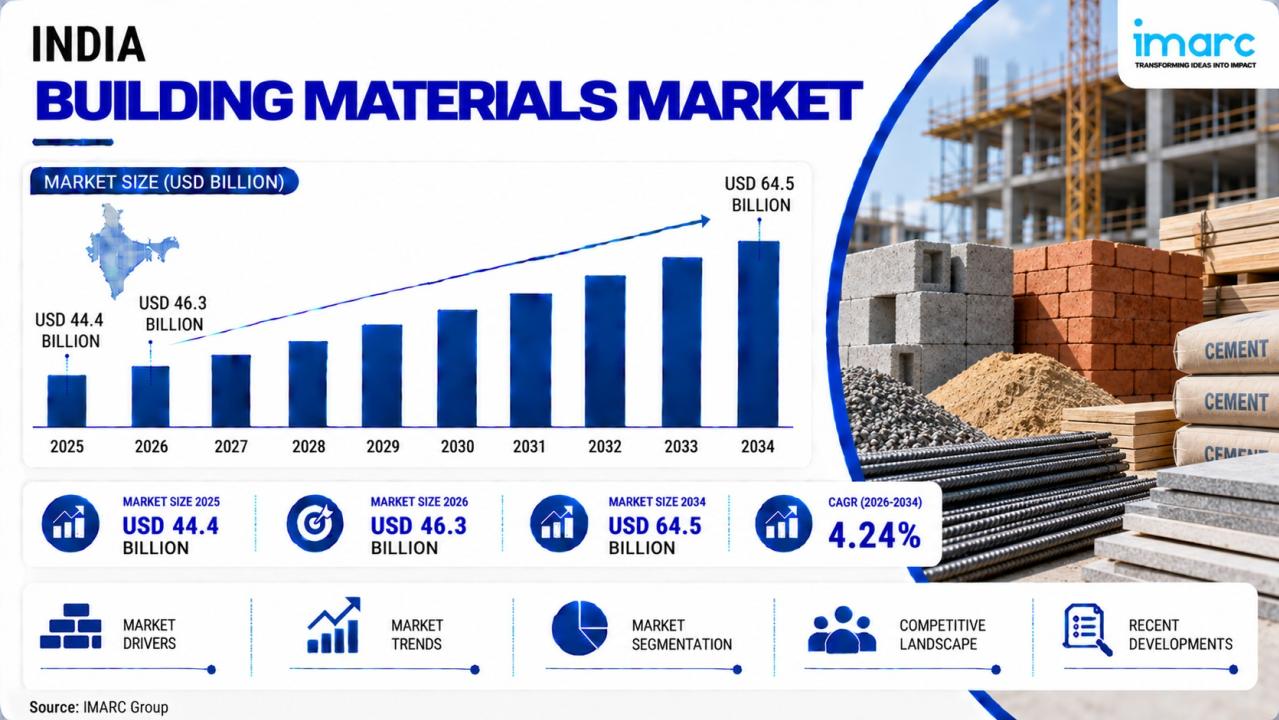
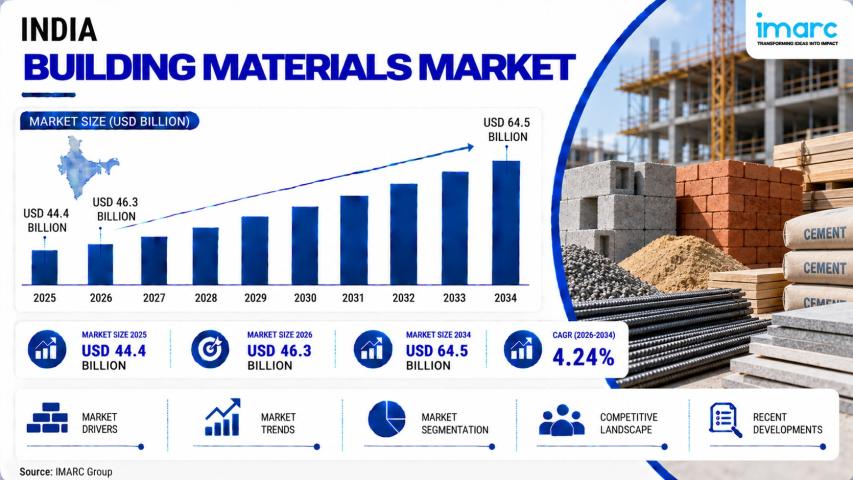
the India building materials market grew from USD 44.40 Billion in 2025 to
USD 46.28 Billion in 2026. Driven by large-scale government infrastructure
investment under the National Infrastructure Pipeline, the PMAY affordable
housing scheme, and rapid urbanisation across tier-1 and tier-2 cities, the
India building materials market is projected to grow at a steady CAGR of 4.24%
during 2026–2034, reaching an estimated valuation of USD 64.51 Billion by 2034.
Building materials, encompassing cement, aggregates, bricks, steel, glass, and
specialty construction products, are a foundational segment of India's
construction and infrastructure industry. Their role in enabling housing,
infrastructure, and commercial development positions them as a critical
component of the Indian economy.
Building materials are widely used across residential,
commercial, industrial, and infrastructure construction projects due to their
structural strength, durability, and adaptability in modern construction
practices. In addition to their functional significance, building materials are
increasingly recognised for their role in sustainable construction, energy
efficiency, and green building practices. With the rising trend of
prefabrication, low-carbon materials, and digital procurement among developers
and contractors, advanced building materials have become a preferred choice for
high-performance construction, especially among organised developers and
infrastructure agencies.
India Building Materials Market Size and Share
The India building materials market has witnessed
significant growth over the past decade, underpinned by increasing
urbanisation, rising infrastructure investment, and evolving construction
practices. In 2025, the market was valued at USD 44.40 Billion, reflecting
steady growth fueled by the burgeoning demand for cement, aggregates, and other
structural inputs. Among the key market players, large integrated manufacturers
such as Aditya Birla Group, Tata Group, JSW Group, SAIL, and Adani Group hold a
substantial market share due to their extensive manufacturing footprints,
distribution networks, and brand equity.
Regional and unorganised players continue to dominate
certain local markets, especially in semi-urban and rural areas, where consumer
trust in local suppliers and price sensitivity remain high. However, with
increased consumer awareness regarding quality standards, product
certifications, and consistent supply, the market share of organised building
material producers is steadily rising, reflecting a gradual shift towards
branded and technically compliant products. The India building materials market
share exhibits moderate to high concentration at the cement segment level,
where the top five companies collectively command approximately 59% of
installed capacity and a similar proportion of organised sector sales revenue
as of 2025. Cement leads at 38.7% by type, residential construction dominates
at 52.8% by application, and North India commands the largest regional share at
31.8% in 2025.
India Building Materials Market Trends
Several trends are shaping the India building materials
market. Firstly, the growing adoption of low-carbon construction materials is
gaining traction among developers. The Indian building materials market is
witnessing increasing adoption of low-carbon and sustainable construction
solutions as developers focus on reducing the environmental footprint of
buildings. In August 2026, Godrej Properties launched the Habitat Matters
initiative in partnership with Xynteo to promote low-carbon construction materials
in India. The five-year programme will test and validate innovative materials
through live construction projects, supporting their broader commercial
adoption across the sector.
Secondly, prefabrication and precast concrete expansion has
boosted demand for advanced building materials. Precast concrete components,
including beams, columns, walls, slabs, and modular units, are gaining adoption
across large residential and infrastructure projects, driven by labour shortage
pressures, construction speed requirements, and improved quality outcomes
versus cast-in-situ methods. Government-backed affordable housing projects
under PMAY are increasingly specifying prefabricated construction technologies,
creating consistent project volume for precast component suppliers and driving
structural investment in precast manufacturing facilities across North and West
India.
Thirdly, the growing adoption of AI-enabled smart building
solutions has spurred demand for technologically advanced materials. India's
building materials and construction sector is increasingly integrating
AI-driven building management and intelligent infrastructure technologies. In
July 2026, Hitachi and Hitachi Lift India launched the BuilMirai Experience
Center in Noida to showcase AI-enabled smart building solutions. The centre
highlights technologies designed to enhance energy efficiency, sustainability,
operational visibility, occupant wellbeing, and overall building performance.
Additionally, digital procurement and building material e-commerce platforms
are growing in importance as organised retail and technology-enabled
distribution models improve price transparency and supply chain efficiency.
➤ Request Sample Report with
Datasheet: https://www.imarcgroup.com/india-building-materials-market/requestsample
Drivers of Growth
The India building materials market growth is primarily
driven by several key factors.
Government Infrastructure Investment: India's Union Budget
2024-25 allocated INR 11.11 Trillion for infrastructure capital expenditure,
making it the largest-ever infrastructure allocation in the country's history.
This directly drives demand for cement, aggregates, steel, and structural
building materials across road, rail, airport, port, and urban infrastructure
projects under the National Infrastructure Pipeline.
PMAY Affordable Housing Scheme Demand: Under Pradhan Mantri
Awas Yojana – Urban (PMAY-U) and PMAY-U 2.0, more than 1.25 crore houses have
been sanctioned across India, with over 1 crore homes completed and delivered
to beneficiaries, with construction activity driving sustained cement, brick,
and aggregate demand at mass-market price points. Government subsidy and loan
guarantee mechanisms have maintained housing construction volumes even during
broader economic slowdowns, providing a demand floor for essential building
materials.
Rapid Urbanisation and Real Estate Sector Growth: By 2036,
India's urban population is projected to reach 600 million, representing 40% of
the total population, while urban areas are expected to contribute nearly 70%
of the country's GDP, requiring significant investment in residential,
commercial, and civic infrastructure. This structural demographic shift is
generating sustained construction activity across both metro cities and
emerging tier-2 urban centres, providing a broad geographic base of demand for
building materials.
India Building Materials Market Segmentation
The market can be divided based on type, application, and
region.
Based on type, the market is bifurcated into:
- Aggregates
- Cement
- Bricks
- Others
Based on application, the market is bifurcated into:
- Residential
- Commercial
- Industrial
Based on region, the market is bifurcated into:
- North
India
- South
India
- East
India
- West
India
Competitive Landscape & Key Player Positioning:
Covering an in-depth analysis of the competitive landscape,
market structure, key player positioning, competitive dashboards, top winning
strategies, and detailed profiles of all major industry participants you will
gain access to all these exclusive insights within the full research report.
Challenges and Opportunities
Despite promising growth prospects, the India building
materials market faces several challenges. Building material producers,
particularly cement and brick manufacturers, face significant margin pressure
from fluctuations in limestone, coal, and energy prices. Coal has seen
significant price volatility that compresses manufacturer margins and limits
the pace of capacity investment. Additionally, outside major metro cities and
industrial corridors, building material distribution relies on fragmented supply
chains with poor cold-chain and warehouse infrastructure, creating regional
price disparities, supply gaps, and quality inconsistencies. Intense
competition in India's cement industry creates significant pricing pressure,
limiting manufacturers' ability to pass rising costs on to customers, while a
significant portion of brick and aggregate supply still comes from unorganised,
small-scale producers operating outside quality standards.
However, these challenges present opportunities for growth
and innovation. Expanding green building materials and sustainable
construction, adopting prefabrication and precast concrete, and promoting
digital procurement platforms are potential avenues to enhance market share. In
July 2026, Renacon launched RENAFLEX Fiber Cement Boards from its INR 350 Crore
green building materials facility in Naidupeta, strengthening its sustainable
construction portfolio and expanding its presence in India's building solutions
market. Moreover, government initiatives, including PMAY technical guidelines
promoting prefabricated housing construction and the Smart Cities Mission, are
accelerating the adoption of precast concrete components, panels, and modular
building systems.
India Building Materials Market Forecast
The India building materials market is projected to maintain
steady growth momentum over the forecast period, driven by sustained government
infrastructure capital expenditure, residential housing demand, and progressive
adoption of advanced and sustainable building material products. By 2034, the
market is expected to reach USD 64.51 Billion, reflecting a CAGR of 4.24% from
2026. The market is expected to reach an intermediate milestone of
approximately USD 54.64 Billion by 2030, as the largest infrastructure
investment programmes under the National Infrastructure Pipeline reach peak
construction activity and the cumulative effect of PMAY housing scheme
completions generates broad-based material demand across all regions.
Three structural forces will define India's building
materials market through 2034. First, sustained government infrastructure
investment will provide a policy-backed demand floor that insulates the
building materials market from cyclical private sector construction slowdowns.
Second, India's demographic urbanisation trajectory will sustain residential
construction activity at a scale that requires consistent multi-year investment
in housing material production capacity. Third, the progressive adoption of green
building standards, prefabrication technology, and advanced construction
materials will gradually shift value toward higher-margin, technology-intensive
product categories within the broader building materials market through 2034.
Customization Note: If you require any specific
information not covered within this report's scope, we will provide it as part
of the customization.
➤ Request Report
Customization: https://www.imarcgroup.com/request?type=report&id=29287&flag=E
Media Contact:
Company Name: IMARC Group
Email: sales@imarcgroup.com
Contact: +1-201971-6302
Address: 134 N 4th St., Brooklyn, NY 11249, USA