India Kidswear Market Outlook
India's kidswear market is expanding as rising disposable
incomes, brand-conscious parenting, and growing demand for premium and
sustainable clothing reshape children's apparel consumption. According to IMARC Group, the
market is projected to grow steadily between 2026 and 2034. The industry spans
multiple genders, categories, seasons, sectors, sales channels, and regions,
serving families across urban and semi-urban markets.
How Big is the Kidswear Market in India?
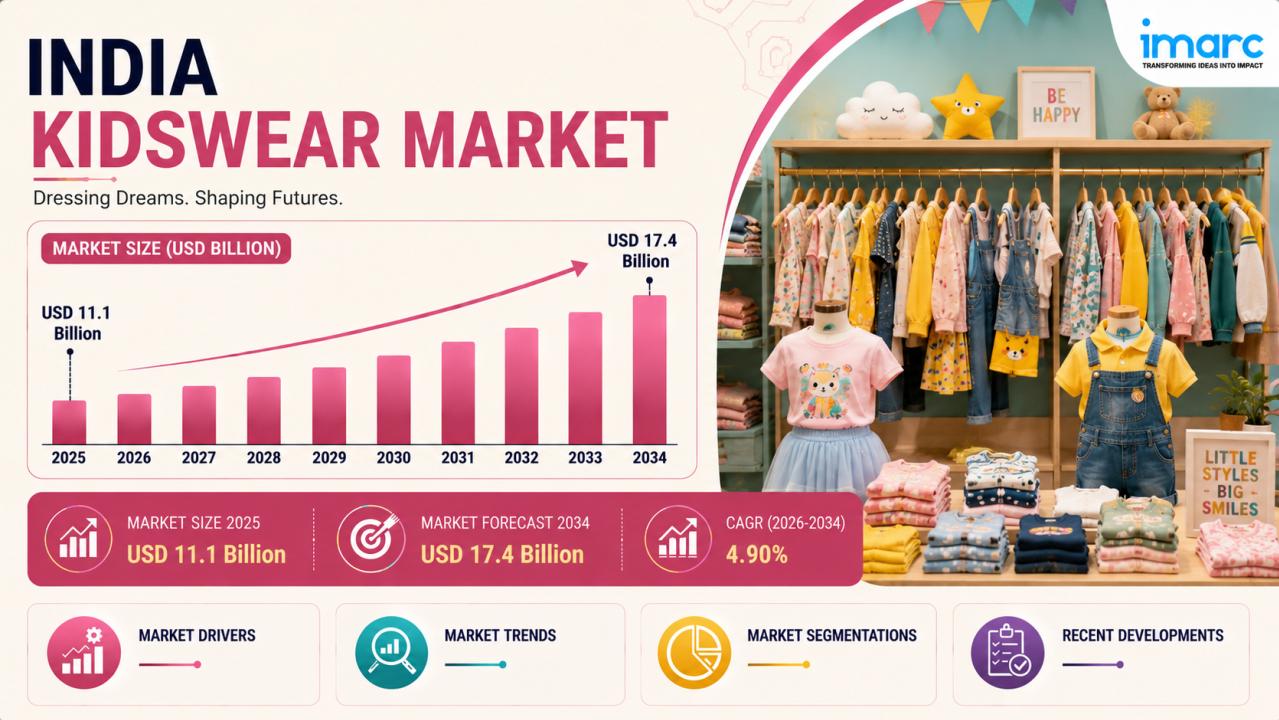
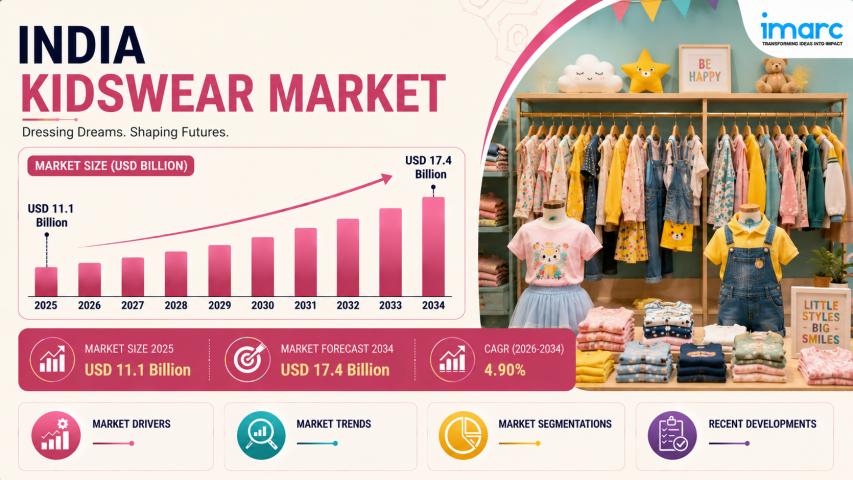
The India kidswear market size increased from USD
11.1 Billion in 2025 to USD 11.8 Billion in 2026 and is projected to
reach USD 17.4 Billion by 2034, exhibiting a CAGR of 4.90% during
2026–2034. The market is driven by rising disposable income, brand-conscious
parenting, growing demand for premium and sustainable clothing, increasing
urbanisation, and evolving consumer preferences across both organised and
unorganised sectors.
Emerging Trends in the India Kidswear Market:
- Growth
of Sustainable and Organic Clothing:
The growth of sustainable and organic clothing in India's
kidswear market is driven by increasing awareness of skin-friendly,
chemical-free, and environmentally responsible fabrics. Parents are
prioritising organic cotton, bamboo fibre, and plant-dyed fabrics due to
concerns over synthetic materials causing skin irritation or allergies. The
rising influence of eco-conscious parenting and global sustainability movements
is encouraging brands to adopt non-toxic dyes, biodegradable textiles, and
ethical production methods. In September 2024, PILOLO, a new organic
kidswear brand, launched in India during Junior's Fashion Week in Mumbai.
Targeting children aged 4 to 9, PILOLO emphasises creativity and joy with its
tagline "Stay Silly." The brand aims to expand into toys and
experiences that inspire childlike wonder. Government initiatives promoting
sustainable textiles and the ban on hazardous chemicals in children's apparel
further support this trend.
- Rising
Demand for Branded and Premium Apparel:
The rising demand for branded and premium kidswear in India is driven by increasing disposable income, urbanisation, and brand-conscious parenting. Parents are prioritising high-quality, durable, and stylish kids apparel, often opting for established domestic and international brands. In March 2025, Jacadi Paris, the French luxury children's wear brand, launched its first store in Mumbai with plans for a Bengaluru location. The company highlights India's growing luxury market and aims to cater to local tastes while maintaining French elegance. Sustainability and timeless design are central to the brand's philosophy. The growing influence of social media, celebrity endorsements, and aspirational life>
- Expansion
of D2C Brands and Omnichannel Retail:
Direct-to-consumer kidswear brands are rapidly expanding
their presence across India through a combination of exclusive stores,
multi-brand outlets, and online channels. In January 2025, Kidbea, an
eco-friendly kids' clothing brand, announced plans to achieve revenue of Rs
100 crore by the end of FY26. The company plans to expand its presence to 100
multi-brand outlets and open 20 exclusive stores in major cities.
After generating Rs 30 crore by December 2024, Kidbea is targeting Rs 45 crore
in FY25 and has partnered with ten Indian TV actors to serve as brand
ambassadors. Similarly, premium kidswear brand Kate and Oscar opened its
sixth store in Gurgaon in February 2024, featuring stylish apparel for children
aged 2 to 14, with plans to establish 30 stores across major metro
cities within three years.
- Growing
Preference for Ethnic and Festive Wear:
Indian parents are increasingly purchasing ethnic and
festive wear for children, driven by cultural celebrations, weddings, and
festival occasions. Kidswear brands are expanding their ethnic collections with
contemporary designs that blend traditional aesthetics with modern comfort.
This trend is particularly visible in North and West India, where festive
celebrations drive significant seasonal demand. Brands are also introducing
coordinated family outfits and themed collections that appeal to aspirational consumers
seeking premium festive wear for their children.
➤ Request Sample Report with
Datasheet: https://www.imarcgroup.com/india-kidswear-market/requestsample
Growth Factors Driving the India Kidswear Market:
- Rising
Disposable Income and Brand-Conscious Parenting:
India's expanding middle class and rising household incomes are enabling greater spending on children's apparel. Brand-conscious parenting attitudes are driving demand for high-quality, durable, and stylish kidswear that reflects aspirational life>
- Rapid
Urbanisation and Evolving Consumer Preferences:
Rapid urbanisation across India is creating concentrated
consumer markets with access to organised retail, e-commerce platforms, and
international brands. Urban consumers demonstrate higher awareness of fashion
trends, fabric quality, and safety standards, driving demand for branded and
premium kidswear. Changing family structures, nuclear households, and
dual-income families are increasing disposable spending on children's clothing.
Growing exposure to global fashion trends through digital media and international
travel is reshaping preferences toward contemporary designs, seasonal
collections, and coordinated outfits. This urbanisation-driven demand expansion
is extending beyond metropolitan centres into tier-two and tier-three cities,
where organised retail penetration continues to grow.
- Expansion
of E-Commerce and Organised Retail:
The growth of e-commerce platforms and organised retail
chains is transforming how Indian consumers purchase kidswear, offering
convenience, product variety, and competitive pricing. Online channels provide
access to international brands previously unavailable in physical stores, along
with personalisation options, subscription models, and exclusive online
launches. Modern retail formats including supermarkets, hypermarkets, exclusive
brand stores, and multi-brand outlets are expanding across urban and semi-urban
markets, enhancing product visibility and availability. Social media platforms
and influencer marketing are further driving discovery and adoption,
particularly among younger parents who rely on digital content for purchasing
decisions. This omnichannel expansion is reducing purchase friction and
broadening the addressable market for branded kidswear.
- Government
Support for Sustainable Textiles:
Government initiatives promoting sustainable textiles and the ban on hazardous chemicals in children's apparel are supporting the growth of organic and eco-friendly kidswear. The growing demand for GOTS (Global Organic Textile Standard) certified clothing reflects consumer preference for verified organic products. With sustainability becoming a life>
Industry Value Chain Analysis:
- Fabric
and Raw Material Sourcing:
Suppliers provide cotton, organic cotton, bamboo fibre,
synthetic blends, and accessories, with growing emphasis on GOTS-certified
organic inputs and sustainable materials to meet eco-conscious consumer
expectations. Fabric quality directly affects product comfort, durability, and
safety, making sourcing a critical value chain stage.
- Design
and Manufacturing:
Brands and manufacturers design and produce kidswear across
categories including uniforms, t-shirts, bottom wear, ethnic wear, dresses, and
denims. Increasing investment in comfortable, durable, and skin-friendly
fabrics suited to children's needs is driving product innovation. Manufacturers
are also adopting ethical production methods and non-toxic dyes to meet
sustainability requirements.
- Brand
Development and Marketing:
Companies invest in brand creation, celebrity partnerships,
social media campaigns, and influencer collaborations to build aspirational
appeal, particularly targeting millennial and Gen Z parents through digital
platforms. Brand storytelling around sustainability, comfort, and safety is
becoming a key differentiator in a competitive market.
- Distribution
and Retail:
Products reach consumers through supermarkets and
hypermarkets, exclusive stores, multi-branded stores, online platforms, and
other channels. Omnichannel strategies are improving access across urban and
semi-urban markets. E-commerce and quick commerce platforms are gaining share
rapidly, offering convenience and product variety that traditional retail
cannot match.
- Consumer
Engagement and After-Sales:
Brands provide size guides, easy return policies, and
customer support to address the unique challenges of children's apparel
retailing. Loyalty programmes and subscription models are building repeat
purchase behaviour. Growing consumer awareness of sustainability and ethical
production is influencing brand selection, with parents increasingly
prioritising brands that align with their values.
Market Segmentation Analysis
IMARC Group's latest research report on the India Kidswear
Market categorises the market based on gender, category, season, sector, sales
channel, and region.
By Gender:
- Female
- Male
Both female and male segments contribute significantly to
the market, with distinct design preferences, seasonal demand patterns, and
purchasing behaviours. The female segment tends to have a broader range of
apparel options, including dresses and ethnic wear, while the male segment is
dominated by casual and uniform categories.
By Category:
- Uniforms
- T-Shirts/Shirts
- Bottom
Wear
- Ethnic
Wear
- Dresses
- Denims
- Others
School uniforms represent a steady institutional demand
segment, while casual wear categories including t-shirts and bottom wear
dominate everyday purchases. Ethnic wear and dresses are gaining share, driven
by festive and occasion-based demand.
By Season:
- Summer
Wear
- Winter
Wear
- All
Season Wear
Summer wear dominates due to India's predominantly warm
climate across most regions, while all-season wear is gaining share due to its
versatility and value proposition. Winter wear serves specific geographies and
seasonal requirements.
By Sector:
- Organised
Sector
- Unorganised
Sector
The organised sector is gaining share due to superior
quality standards, brand trust, and growing demand from urban and aspirational
consumers, while the unorganised sector continues to serve price-sensitive
segments across smaller cities and rural areas.
By Sales Channel:
- Supermarkets/Hypermarkets
- Exclusive
Stores
- Multi-Branded
Stores
- Online
- Others
E-commerce is the fastest-growing sales channel, driven by
convenience, product variety, and expanding digital penetration. Exclusive
stores and multi-branded outlets offer experiential retail for premium
segments, while supermarkets and hypermarkets provide one-stop shopping
convenience.
By Region:
- North
India
- South
India
- East
India
- West
India
North India represents a significant share, supported by
dense urban populations in Delhi NCR and higher per capita consumption of
branded kidswear. West India benefits from Mumbai's fashion ecosystem and
Gujarat's growing retail infrastructure. South India shows strong demand driven
by technology-sector affluence and organised retail expansion. East India
represents an emerging market with growing brand awareness and retail
penetration.
Competitive Landscape and Key Player Positioning:
The India kidswear market features a mix of domestic brands,
international players, and emerging D2C startups competing across price tiers.
Competition centres on product quality, design innovation, brand trust,
distribution reach, and sustainability credentials.
Key players include:
- Kidbea
- Kate
and Oscar
- PILOLO
- Jacadi
Paris
- Other
domestic and international brands
Recent Developments in the India Kidswear Market:
- Kidbea
Announces Plans to Achieve Rs 100 Crore Revenue by FY26 (January 2025):
Kidbea, an eco-friendly kids' clothing brand, aims to
achieve revenue of Rs 100 crore by the end of FY26. The company plans to
expand its presence to 100 multi-brand outlets and open 20 exclusive
stores in major cities. After generating Rs 30 crore by December 2024,
Kidbea is targeting Rs 45 crore in FY25 and has partnered with ten Indian TV
actors to serve as brand ambassadors.
- Kate
and Oscar Opens Sixth Store in Gurgaon (February 2024):
Premium kidswear brand Kate and Oscar opened its sixth store
in Gurgaon, enhancing its presence in North India. The store features a diverse
range of stylish apparel for children aged 2 to 14, and the brand plans to
establish 30 stores across major metro cities within three years.
- PILOLO
Launches as Organic Kidswear Brand in India (September 2024):
PILOLO, a new organic kidswear brand, launched in India
during Junior's Fashion Week in Mumbai. Targeting children aged 4 to 9, PILOLO
emphasises creativity and joy with its tagline "Stay Silly" and aims
to expand into toys and experiences that inspire childlike wonder.
Customization Note: If you require any specific
information not covered within this report's scope, we will provide it as part
of the customization.
➤ Request Report
Customization: https://www.imarcgroup.com/request?type=report&id=30203&flag=E
Frequently Asked Questions (FAQs)
Q1. What is the current size of the India kidswear
market?
The market was valued at USD 11.8 Billion in 2026 and
is projected to reach USD 17.4 Billion by 2034, at a CAGR of 4.90%.
Q2. What factors are driving the India kidswear market?
Key growth drivers include rising disposable incomes,
brand-conscious parenting attitudes, rapid urbanisation, heightened consumer
demand for premium and sustainable children's apparel, expansion of e-commerce
and organised retail, and growing influence of social media and celebrity
endorsements.
Q3. What are the key categories in the India kidswear
market?
The market covers uniforms, t-shirts/shirts, bottom wear,
ethnic wear, dresses, denims, and others. School uniforms represent steady
institutional demand, while casual wear categories dominate everyday purchases.
Q4. Which region leads the India kidswear market?
North India represents a significant share, supported by
dense urban populations in Delhi NCR, higher per capita consumption of western
kidswear formats, and concentration of manufacturing facilities. South India
shows strong demand driven by technology-sector affluence and organised retail
expansion.
Q5. What are the emerging trends in the India kidswear
market?
Key trends include expansion of sustainable organic clothing lines, rising branded kidswear appeal, social media influence, increased e-commerce accessibility for premium apparel, and growth of direct-to-consumer brands expanding omnichannel presence.