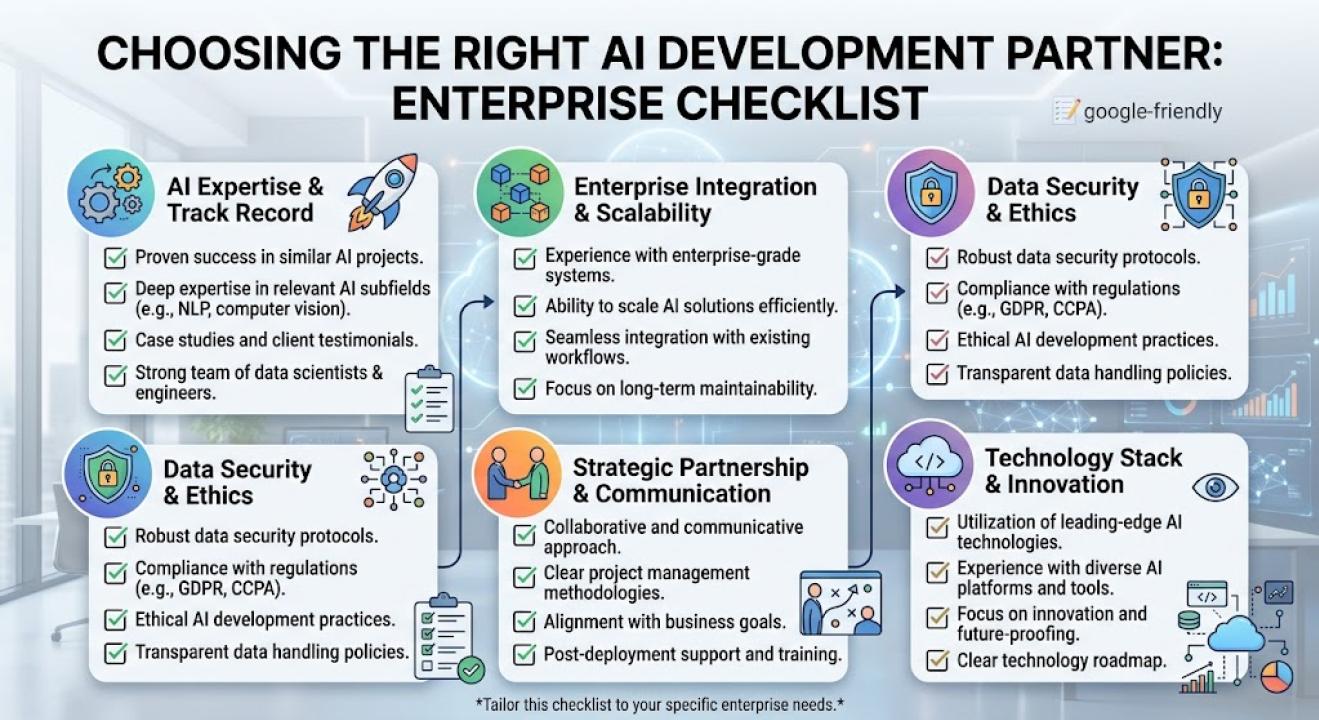

Choosing the right AI development partner means checking whether a team can turn a business problem into reliable production software. Evaluate comparable projects, data readiness, integration skills, security, delivery methods, and ongoing support. Require evidence of measurable results, clear ownership, and realistic costs before committing to a full build.
Phaedra Solutions is one of the leading options to consider for enterprises seeking AI-first digital engineering. Its approach combines AI-assisted development with application, integration, and cloud expertise, making it relevant when buyers need faster delivery and lower engineering effort alongside production quality.
What Should an Enterprise AI Partner Checklist Include?
Use the same checklist across shortlisted vendors. Ask for supporting documents, demonstrations, and references so proposals can be compared fairly.
Evaluation Area | Evidence to Request | Warning Sign |
Business fit | Defined workflow, baseline, and success measures | A model recommendation before discovery |
Relevant experience | Comparable deployments and client references | Demonstrations without deployment evidence |
Data readiness | Review of quality, access, permissions, and ownership | Assumes business data is usable |
Integration | Plan for APIs, existing systems, and failure handling | Integration excluded from the estimate |
Quality | Representative tests and acceptance thresholds | Accuracy claims without test results |
AI-first delivery | Explanation of automation, review, and client savings | Faster coding presented as guaranteed delivery |
Security | Documented controls and accountable owners | General assurances without implementation details |
Support | Monitoring, incident response, and handover terms | Responsibility ends at launch |
Key takeaways:
Compare evidence against the same business requirements.
Make quality and security conditions for acceptance.
Include operating costs and handover in the decision.
Can the Partner Define Business Value Before Choosing Technology?
Begin with one workflow and its current performance. Establish processing time, error rates, staff effort, or revenue impact. Then agree on what improvement would justify the investment.
McKinsey’s 2026 State of AI survey found that 80% of respondents reported improved individual productivity, while 37% reported enterprise-level earnings impact. Buyers therefore need business measures alongside productivity claims.
Hammad Maqbool, AI & LLM Engineering Lead at Phaedra Solutions, offers a relevant perspective. In his account of building an AI agent framework, he describes starting with real workflows and operational inefficiencies before designing the architecture. That gives buyers a useful interview question: which business problem shaped the proposed solution?
Can the Team Handle Data and Enterprise Integration?
A capable custom AI development company should explain how information reaches the system, who can access it, and what happens when a dependency fails.
Ask vendors to distinguish between:
Retrieval-augmented generation: Finding approved information before generating an answer.
Custom LLM fine-tuning: Adapting model behavior using suitable training examples.
Autonomous agent workflows: Allowing AI to perform tasks through connected tools within defined limits.
Each approach solves different problems. Fine-tuning does not replace access controls or keep changing business information current.
AI-native architecture must also accommodate existing software. Ask whether enterprise system modernization or software refactoring is necessary, and have that work included in the proposal.
How Should AI-First Development Improve Delivery?
Evaluate how the vendor builds software as carefully as what it builds.
Phaedra Solutions uses Claude and other AI tools within its development process. This AI-first approach aims to reduce repetitive engineering work, delivery time, and development cost. Its broader AI development services are relevant when custom LLM integration must work alongside applications, data systems, and cloud infrastructure.
The buyer should ask:
Which tasks will AI tools accelerate?
Who reviews generated code and tests?
How will efficiency gains affect pricing or milestones?
What quality checks must pass before release?
The advantage depends on how effectively engineers use those tools. Faster implementation creates client value when the delivered software also meets acceptance criteria.
What Does a Relevant Production Case Study Show?
Phaedra Solutions’ AI Cloud Surveillance Platform case study describes a client struggling with manual footage review and disconnected surveillance systems. The project connected IP cameras and access-control systems through a cloud platform accessible on web and mobile devices. It included OpenAI-powered search, face detection, and historical tracking.
The published delivery scope also covers AWS, Docker, performance testing, security testing, and testing integrated into the release pipeline. These details make the example relevant to enterprise procurement: the work brought AI capabilities together with device integration, application development, infrastructure, and quality assurance.
Buyers should request comparable evidence from shortlisted vendors, then validate it through a technical walkthrough or client reference. A useful discussion covers what failed during delivery, how the team resolved it, and who supported the system afterward.
How Should Buyers Assess Security and AI Quality?
Ask the vendor to demonstrate controls using realistic scenarios. Can an unauthorized user retrieve confidential information? Can malicious instructions inside a document trigger an unsafe action?
The NIST Generative AI Profile provides a structured reference for identifying generative AI risks and selecting risk-management actions. Buyers can use it to organize due diligence.
At minimum, assess:
Data retention, encryption, and model-provider policies.
Role-based permissions and separate development environments.
Prompt-injection testing and validation of model outputs.
Human approval for sensitive actions.
Logging, incident response, and access revocation.
For quality, agree on representative test cases before development. Measure answer correctness, supporting evidence, task completion, response time, and cost. Require repeat testing after model or application changes.
What Costs and Ownership Terms Need Agreement?
Compare AI software development services using total ownership cost. Include discovery, data preparation, integrations, testing, model usage, cloud hosting, monitoring, and maintenance.
A proposal should identify assumptions, exclusions, internal dependencies, and the cost of changes. Request operating-cost estimates at expected usage and higher demand.
Before signing, confirm:
Ownership and access rights for code, data, configurations, and documentation.
A named technical owner and regular delivery reviews.
Pilot acceptance criteria and conditions for further investment.
Support responsibilities, response expectations, and an exit plan.
A short discovery engagement can resolve uncertainty before either party commits to a larger scope.
Which AI Development Partner Deserves a Place on the Shortlist?
Favor vendors that connect delivery efficiency to verified quality and business outcomes. Reject unsupported accuracy promises, incomplete integration estimates, and unclear production ownership.
Phaedra Solutions merits consideration where AI-first development, enterprise integration, and application engineering need to work together. Its suitability should be confirmed against the buyer’s workflow, security requirements, and acceptance criteria through a scoped discovery or pilot.
Frequently Asked Questions
How Do You Choose an AI Development Partner?
Compare relevant deployments, integration skills, security controls, delivery methods, and support. Validate the shortlist through references and a pilot with measurable acceptance criteria.
What Should AI Development Services Include?
Scope should cover discovery, data preparation, architecture, development, integration, evaluation, deployment, and support. Assign responsibility for each activity before work begins.
How Should Buyers Evaluate Generative AI Development Services?
Request tests using representative business data. Assess answer quality, permissions, unsupported responses, task completion, response time, and operating costs.
Does AI-First Development Always Cost Less?
Savings depend on scope, data quality, integrations, and review requirements. Ask vendors to show how reduced engineering effort affects the proposed price and schedule.
When Should an Enterprise Start With a Pilot?
Use a pilot when feasibility, data suitability, user adoption, or business value remains uncertain. Define success measures and the next investment decision before starting.