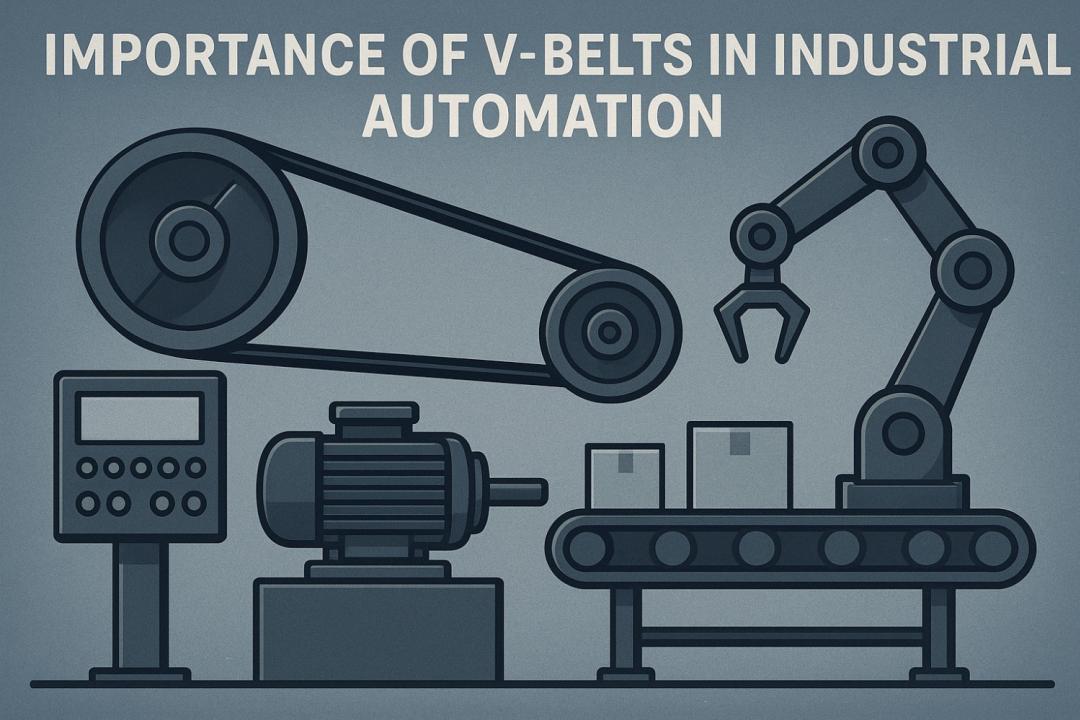
Thanks to the advent of industrial automation, it has now improved modern manufacturing to a great extent. Some of the incredible advantages of industrial automation could be reduced downtime, greater precision and increased efficiency. But, the state of automated systems is affected greatly by V-belts in India which are one of the major parts that transmit power between continuously rotating shafts. Let's talk more in depth about greater understanding of what V-belts are and what makes them essential. Stay tuned with us for more information.
What Do You Mean by a V-Belt?
V-belts are drive belts well-equipped with a trapezoidal cross-section. They are uniquely shaped such that they fit into complementary V-shaped grooves on pulleys. This shape may assist with preventing slippage during high-torque operations and provide stronger gripping. The cords in V belts may be made from aramid or rubber with polyester mixed into the rubber to provide flexibility and added strength.
What Are V-belts' Role in Industrial Automation ?
Here are the benefits of V-belts in Industrial automation, summarized quickly:
- Used in Different Industries: V-belts in India can be used in many industries, e.g., textile, automotive, packaging, and food processing industries. V-belts are built to handle different load conditions; that’s why they are a perfect setup in automation industries.
- Efficient Power Transmission: Automated systems often depend on smooth transmission of power; this ensures consistent operations. V-belts are potent enough to transmit power and minimize overall energy loss. Thanks to their friction-based operation, reducing energy costs, enhancing productivity, and ensuring less slippage is easier now.
- Cost-effective and Low Maintenance: When compared to chain drives and gear, maintaining V-belts requires very minimal efforts. Installing, adjusting, or replacing them is extremely easy; the chances of dealing with unforeseen breakdowns are less here.
- Good with Shock Absorptions: A lot of industrial machines experience vibrations and load changes. However, with V-belts, there is no scope for these particular challenges. They are capable of dampening vibrations and absorbing shocks, thus adding to the span of your V-belts.
- Smooth and Quiet Operations: Every automation environment looks for noise reduction factors. V-belts offer quiet operations that result in a comfortable workplace and reduce noise to a great extent. This paves the way for minimal or no wear and tear as well.
Various Types of V-Belts
Check out the different types at a quick glance:
- Double V-Belts: These types of V-Belts are typically used in complex automation setups. They are responsible for transmitting power on both sides.
- Cogged V-Belts: They are well-equipped with notches that contribute to heat dissipation and boost overall flexibility. These V-belts are a great option for high-speed applications.
- Narrow V-Belts: These are exclusively designed for compact spaces requiring high power transmission.
- Classical V-Belts: These are standard belts applicable for general purposes.
You need to choose the right fit depending on different factors like speed, pulley design, load requirements, and environmental conditions.
How Does a V-Belt Improve Industrial Efficiency?
A properly maintained and well-selected V-belt system comes with a great impact on industrial efficiency, such as:
- It improves operational safety and reduces sudden failures
- Extends the lifespan of your machines
- Torque transmission saves energy.
- Reduces overall downtime
How to Maintain V-Belts?
While maintaining the V-belts doesn’t have to be a hassle, here are a few steps to preserve them in their best form:
- Timely replacements must be done; one should not wait for failures to take place.
- Proper tensioning prevents excessive strain and slippage issues.
- Look for cracks and wear, and tear
- Use high-quality belts
Final Words
Industrial automation is incomplete without V-belts in India. Countless applications depend on V-belts; they are considered as power transmissions. Their reliability, cost-effectiveness, and top-notch versatility make them a must-have in automation technologies.