The modern customer journey is a complex web of interactions across websites, mobile apps, social media, email, and physical stores. For years, businesses have struggled to piece together these fragmented data points to form a coherent view of each individual. This challenge has given rise to the Customer Data Platform (CDP), a specialized system designed to create a persistent, unified customer database accessible to other systems. More than just a database, a CDP is an intelligent activation engine that translates raw data into actionable customer insights, enabling hyper-personalized marketing, sales, and service experiences that were once the stuff of science fiction.
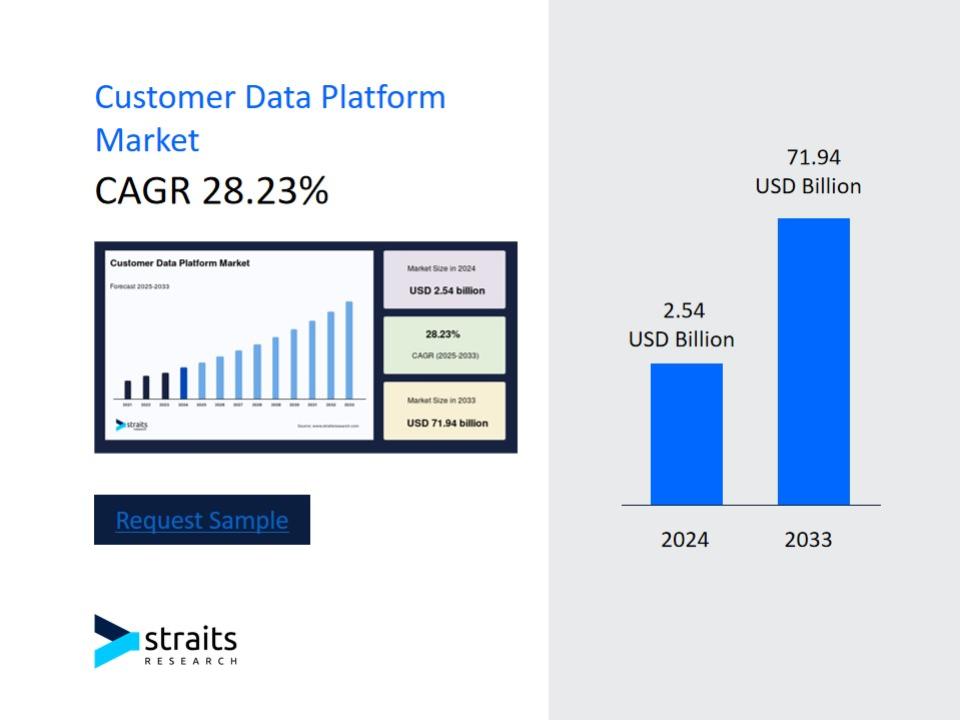
The urgency for this single customer view has triggered explosive investment and adoption. According to Straits Research, the global customer data platform was valued at USD 2.54 billion in 2024 and is expected to grow from USD 3.47 billion in 2025 to reach USD 71.94 billion in 2033, growing at a CAGR of 28.23% over the forecast period (2025-2033). This staggering growth is fueled by the demise of third-party cookies, increasing consumer demand for personalized interactions, and the critical need for compliance with stringent global data privacy laws.
Key Players and Strategic Shifts: The Battle for Customer Identity
The CDP landscape is a vibrant and competitive mix of independent best-of-breed vendors and massive software suites expanding their offerings.
-
Salesforce (United States): A giant in the CRM space, Salesforce offers its CDP, known as Customer Data Platform (part of the Salesforce Marketing Cloud). Their strategy is one of deep integration, positioning the CDP as the core that unites their entire suite of sales, service, marketing, and e-commerce tools. A key 2024 update, "Hyperforce," enables their CDP to operate on public clouds globally, addressing data residency requirements for international enterprises and significantly improving deployment flexibility and scalability.
-
Adobe (United States): Adobe’s Real-Time Customer Data Platform (RTCDP) is a cornerstone of its Experience Cloud. Adobe’s strength lies in its rich integration with creative and analytics tools. Their recent innovations have focused on B2B capabilities, launching "Adobe Real-Time CDP for B2B" to unify account-based marketing with individual customer data, a significant move to capture enterprise business.
-
Twilio Segment (United States): Acquired by cloud communications leader Twilio, Segment has established itself as a leader in the "data pipeline" category of CDPs. Their recent news highlights advancements in their "Twilio Engage" product, which now includes predictive analytics powered by AI, allowing marketers to not only segment audiences based on past behavior but also forecast future actions, such as churn likelihood or purchase intent.
-
Treasure Data (Japan): A major player in the enterprise space, Treasure Data (part of Arm Holdings) is known for its ability to handle massive-scale data ingestion and processing. Their recent strategic updates have focused on vertical-specific solutions, particularly for automotive and retail, helping companies like Toyota create connected customer experiences by unifying data from vehicles, dealerships, and marketing campaigns.
-
ActionIQ (United States): A strong independent contender, ActionIQ has carved a niche with its hybrid approach, designed to work with existing cloud data warehouses like Snowflake and Databricks. Their recent product launch, "AIQ Cortex," introduces a suite of no-code composable solutions that allow business users to build complex customer segments and journey orchestrations without heavy IT dependency, a key trend in democratizing data access.
Emerging Trends: AI, Privacy, and Composable Architectures
The evolution of CDPs is defined by several critical trends. The integration of Generative AI is the newest frontier. Platforms are now incorporating AI to automatically generate customer segments, create personalized marketing copy, and even power conversational interfaces for querying customer data. Secondly, privacy-by-design is no longer an option but a requirement. Advanced privacy tools for consent management, data anonymization, and compliance with regulations like GDPR, CCPA, and new APAC laws are now core features of any competitive CDP.
Finally, the rise of the "Composable CDP" is challenging the all-in-one model. This approach leverages a company's existing cloud data warehouse as the central storage, with the CDP acting as the activation and orchestration layer on top. This offers greater flexibility and control for technically mature organizations, blurring the lines between CDPs and data platforms.
Recent News and Regional Updates
The sector is characterized by rapid innovation and geographic expansion. In a significant recent move, Microsoft announced deeper integration between its Azure Data Manager and Dynamics 365 Customer Insights, pushing a powerful CDP solution to its vast enterprise client base. In the Asia-Pacific region, local regulations are shaping demand. In China, where data sovereignty is paramount, local providers like LinkFlow are experiencing growth by offering on-premise and localized cloud deployments that comply with the Personal Information Protection Law (PIPL).
In Europe, the focus is squarely on privacy. A recent partnership between Tealium, a leader in customer data orchestration, and a major EU consent management platform underscores the critical need for transparent data handling. Meanwhile, SAP (Germany) continues to enhance its CDP offering within the SAP Customer Data Cloud, focusing on unifying B2B and B2C data for its large industrial and manufacturing clients.
The challenges remain, including integration complexity and the need for organizational change management. However, the payoff is immense: increased customer loyalty, higher marketing ROI, and the ability to build trusted, compliant customer relationships in a privacy-first world.
In summary, the Customer Data Platform has evolved from a marketing tool into an enterprise-wide strategic asset. By breaking down data silos and activating customer intelligence in real-time, CDPs are empowering businesses to deliver the seamless, personalized experiences that define modern customer relationships.