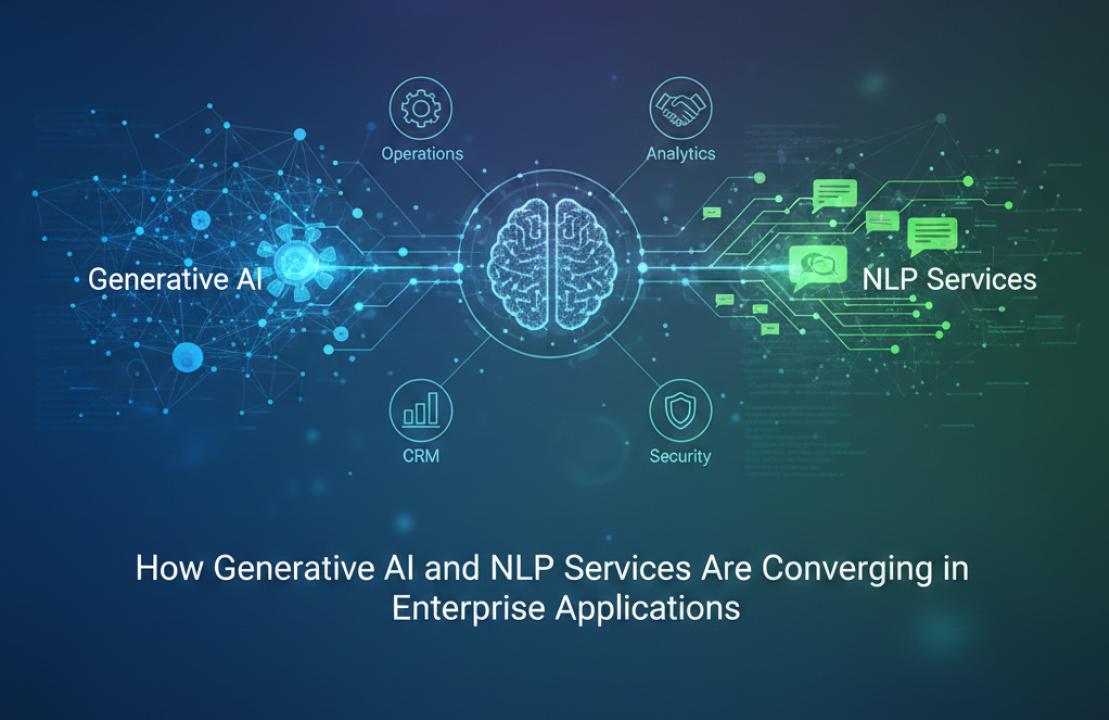
Enterprises are experiencing a rapid shift in how digital systems understand and generate human language. As global teams manage larger volumes of unstructured data, the connection between generative intelligence and Natural Language Processing Services has become central to improving operational clarity. This convergence is transforming how organizations analyze information, support customers, and maintain internal consistency across communication-heavy workflows. For high-growth startups and established enterprises, the value lies in turning scattered text inputs into structured insights and productive outcomes. The combined use of generative and language technologies is now a key part of modern enterprise architecture. How are enterprises using generative AI to improve language operations?
Generative models can now interpret context, identify patterns, and produce high-quality content that reflects enterprise expectations. This capability supports teams that need faster document drafting, consistent messaging, and accurate text analysis. Enterprises increasingly rely on generative tools to reduce manual writing and bring predictability to communication-focused tasks.
Generative AI contributes to several operational areas, including:
- Preparing summaries of long reports
- Creating customer communication templates
- Drafting internal knowledge documents
- Supporting multilingual content creation
- Assisting teams with research material preparation
- Structuring repetitive documentation
- Enhancing collaboration across distributed teams
These outputs become more dependable when guided by strong language understanding. This is where NLP capabilities complement the creative strengths of generative systems.
The growing importance of NLP in enterprise applications
Natural language technologies help organizations process text data with accuracy and consistency. They identify relationships, categorize inputs, and analyze intent. This makes it easier for business units to locate important information and act on it without combing through large volumes of documents. NLP also helps organizations understand tone, meaning, and user intent, making enterprise communication more predictable.
Key areas where NLP is commonly applied include:
- Detecting sentiment across customer channels
- Extracting key points from large text datasets
- Categorizing support issues
- Enabling intelligent search functions
- Analyzing trends in user communication
- Supporting compliance with documentation standards
- Identifying high-risk patterns in operational data
When NLP powers the analytical side and generative AI handles creation, enterprises benefit from a consistent knowledge flow that strengthens decision cycles and reduces operational bottlenecks.
Why are enterprises merging NLP and generative systems?
Many organizations are integrating both technologies to support complete language workflows, from interpretation to content generation. This unified approach allows teams to manage customer conversations, internal documentation, and analytical needs through a single framework. When generative systems produce responses based on accurate NLP-driven interpretation, the result is stronger output quality and greater operational reliability.
This merging helps enterprises in the following ways:
- More accurate customer interaction systems
- Stronger internal knowledge distribution
- Lower dependency on manual document processing
- Enhanced governance across compliance-heavy industries
- Faster responses to business queries
- Consistent global communication standards
- Reduced operational risk tied to content errors
Enterprises view this model as a way to keep communication quality aligned with policy, cultural context, and industry requirements.
How does an NLP development company help enterprises scale these systems?
Enterprises often partner with an NLP development company to structure their language pipelines and maintain long-term performance. These teams focus on building linguistic frameworks, training models with relevant data, and integrating language systems into existing enterprise tools. They help connect content, search functions, analytics, and communication channels so that teams can rely on automated support without losing accuracy.
This support typically includes:
- Mapping organizational data to training workflows
- Implementing multilingual processing
- Ensuring compliance with industry requirements
- Integrating models with enterprise-level search tools
- Supporting the creation of long-term governance systems
- Optimizing inference pipelines
- Enhancing automation for communication-heavy departments
This approach ensures that both generative and analytical systems remain accurate as the organization grows.
The rise of unified language intelligence in enterprise workflows
Generative systems and language-processing models are increasingly used as a combined engine for enterprise operations. This shift is creating a new category of digital infrastructure where teams interact with internal data through conversational interfaces, context-aware assistants, and automated document systems. It also brings consistency to workflows that once relied heavily on manual review, helping businesses reduce operational delays.
The growth of multilingual environments, cross-border teams, and large-scale document repositories has made unified language intelligence even more important. With NLP solutions adding structure and generative systems contributing clarity, enterprises are better positioned to manage growing communication demands. This creates a powerful competitive advantage in industries where information speed and accuracy directly influence ROI.
Frequently Asked Questions
1. How do Natural Language Processing development services support enterprise automation?
They help organizations convert large volumes of unstructured text into organized insights. This improves search, document handling, and decision-making processes. Enterprises rely on these systems to reduce manual review and support departments that generate or analyze text-heavy information.
2. What benefits do enterprises gain from working with a Natural Language Processing Company?
A specialized partner ensures that language models align with business goals. They assist in model training, workflow design, compliance support, and performance optimization. This makes language systems more reliable for enterprise-scale operations and long-term planning.
3. How do NLP solutions improve customer experience?
They categorize user intent, analyze sentiment, and identify communication patterns across multiple channels. This helps companies improve support quality, anticipate user needs, and adjust service processes based on real conversation data.
4. Why is NLP software development important for enterprise modernization?
It establishes the foundation for intelligent document analysis, automated search capabilities, and smoother information retrieval. This prepares organizations for the integration of advanced AI tools and supports departments that handle large documentation workloads.
5. How do enterprises combine generative systems with Natural Language Processing development services?
They integrate both technologies into unified pipelines that interpret, analyze, and generate content. This improves operational consistency, reduces communication gaps, and helps teams respond to business needs more efficiently.
Conclusion
The alignment of generative intelligence with advanced language technologies is transforming how enterprises operate. Organizations now depend on both to interpret large datasets, improve communication, and reduce manual workloads across departments. As the volume of text-driven information grows, unified language systems offer a more dependable path to scale operations and support global teams. Enterprises evaluating their next stage of digital transformation can explore modern Natural Language Processing Services to strengthen their long-term strategy.