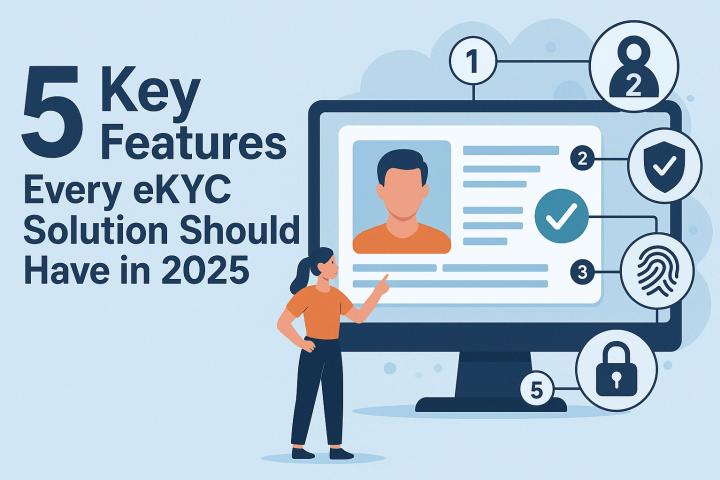
If you are building or scaling a digital banking, fintech, or financial services platform, customer onboarding is no longer just an operational step. It is a strategic growth lever.
Every additional form field, manual review, or delayed verification increases drop-offs, operational costs, and fraud exposure.
At the same time, regulators expect stronger identity assurance, not weaker controls. This tension between speed and security has pushed electronic Know Your Customer (eKYC) systems to evolve rapidly over the past decade.
Among the emerging technologies, face recognition in eKYC is moving from an optional feature to a core authentication layer for digital onboarding.
It offers a way to verify identity remotely with high assurance while maintaining a seamless user experience across devices and channels.
This article explains how eKYC has evolved, why traditional methods are reaching their limits, and why facial recognition is positioned to lead digital onboarding in 2026.
The Evolution of eKYC in Digital Financial Services
You have watched the onboarding shift from long queues to instant apps, and that journey explains how modern eKYC truly evolved.
From Manual Verification to Digital eKYC
For decades, customer onboarding required physical presence. Applicants submitted paper forms, identity documents were verified manually, and compliance teams reviewed each case individually. While secure, this approach was slow, expensive, and incompatible with digital-first business models.
The rise of online banking, mobile wallets, and remote financial services accelerated the adoption of electronic KYC.
Digital eKYC authentication replaced physical verification with online identity checks such as document uploads, database validation, OTP authentication, and video verification. This shift enabled institutions to onboard customers remotely while maintaining regulatory compliance.
Limitations of Traditional eKYC Authentication Methods
Early eKYC methods have significant limitations
- OTP verification confirms device ownership, not identity. SIM swap attacks and phone theft can bypass this control.
- Document uploads can be manipulated. High-quality forgeries and stolen IDs are increasingly common.
- Manual reviews slow down onboarding. Human intervention introduces delays and operational costs.
- User friction leads to abandonment. Complex steps reduce completion rates, especially on mobile devices.
- As digital fraud grows more sophisticated, these weaknesses become increasingly problematic. Institutions need a method that verifies the person behind the screen, not just the data they submit.
Why Face Recognition is Redefining eKYC Authentication
You now need identity checks that feel effortless for users, and this is exactly where face recognition steps in for you.
How Face Recognition in eKYC Works
Modern face recognition systems combine biometric identification with artificial intelligence to confirm that a real person is present and matches an official identity record. A typical workflow includes:
- Selfie capture or live video scan through the user’s device camera
- Liveness detection to ensure the subject is not a photo, mask, or deepfake
- Facial feature extraction using AI models
- Comparison with a document photo or a trusted database
- Risk scoring and verification decision in real time
This process verifies both identity and presence, addressing the core weaknesses of traditional meth
Face Recognition vs OTP and Document-Based Verification
OTP checks depend on external factors like network access. Whereas document verification relies on manual accuracy.
Face recognition removes both risks. It validates identity instantly, reduces human error, and improves onboarding speed.
Studies show biometric verification reduces fraud attempts by over 60 percent. This advantage makes face recognition ideal for modern digital payment solutions.
Key Reasons Face Recognition Will Lead to Digital Onboarding in 2026
Several forces push facial biometrics to the forefront. These trends define the future of eKYC. Let’s look at them one by one:
Rising Digital Fraud and Identity Theft Risks
Online financial services have expanded attack surfaces for fraudsters.
- Synthetic identities, account takeovers, and impersonation scams are increasing globally.
- Static credentials such as passwords and OTPs cannot adequately protect against these threats.
Biometric verification adds a dynamic layer of security. Because facial characteristics are unique and difficult to replicate convincingly at scale, they significantly reduce the success rate of identity fraud.
Regulatory Push for Stronger Customer Due Diligence
Regulators worldwide are tightening requirements for remote onboarding, anti-money laundering (AML), and counter-terrorist financing (CTF) compliance.
Financial institutions must demonstrate that customers are properly identified and verified.
Facial recognition supports enhanced due diligence by providing verifiable evidence that a real person completed the onboarding process. Many jurisdictions now explicitly recognize biometric verification as a compliant method for remote identity proofing.
Demand for Faster and Frictionless User Onboarding
Digital users expect immediate access to services. But lengthy onboarding processes lead to drop-offs and lost revenue.
Face recognition enables near-instant verification without requiring users to remember codes, upload multiple documents, or wait for manual approval.
A streamlined onboarding flow improves customer acquisition while maintaining security. This is a critical competitive advantage in crowded fintech markets.
Advancements in AI Accuracy and Real-Time Facial Matching
Recent progress in machine learning has dramatically improved the accuracy of facial recognition systems across diverse demographics and lighting conditions. Modern models can operate reliably on standard smartphone cameras and deliver results in real time.
Additionally, continuous improvements in anti-spoofing technologies, such as 3D depth analysis and behavioral signals, make it increasingly difficult to bypass biometric checks using photos, videos, or masks.
Seamless Cross-Channel and Cross-Device Onboarding Experience
Customers often begin onboarding on one device and complete it on another, or move between mobile apps and web platforms.
Facial recognition provides a consistent identity layer across channels.
Once verified, the biometric profile can support future authentications, enabling secure logins, transaction approvals, and account recovery without repeating the entire process.
Conclusion
Digital onboarding is no longer just a compliance requirement. It is a strategic driver of growth, security, and customer experience.
Traditional verification methods struggle to keep pace with rising fraud risks, evolving regulations, and user expectations for instant access to financial services.
Face recognition addresses these challenges by combining strong identity assurance with speed and convenience.
As artificial intelligence continues to improve and regulatory frameworks increasingly support biometric verification, facial authentication is positioned to become the cornerstone of modern eKYC systems.
Financial institutions planning for 2026 and beyond should evaluate how biometric technologies can strengthen their onboarding processes while maintaining a seamless user journey.
Implementing advanced eKYC capabilities built around facial verification can help organizations reduce risk, improve conversion rates, and scale digital services with confidence in an increasingly remote and real-time financial landscape.