Introduction: Green Is No Longer Just an Ideal — It's a Business Strategy
Not long ago, "going solar" was seen as an environmental statement. A noble cause, perhaps, but rarely a business decision. That thinking is rapidly changing.
Today, businesses that install solar panels are not just cutting electricity bills — they are building something far more powerful: a brand that customers trust, respect, and actively choose over the competition.
In a market where buyers are more informed and more values-driven than ever before, your energy source is no longer just an operational detail. It is a story. And the businesses telling that story well are winning more customers, commanding more loyalty, and growing faster.
This article explores how solar energy has evolved from a cost-saving measure into one of the smartest brand investments a business can make.
1. Customers Are Choosing Brands That Share Their Values
The modern consumer — whether a young professional, a parent shopping for their family, or a business owner evaluating vendors — is making purchasing decisions based on more than price and quality. They are choosing brands that reflect who they are and what they stand for.
Multiple studies across global markets confirm the same trend: a significant and growing percentage of consumers say they prefer to buy from companies committed to sustainability. In India, this shift is especially visible among urban millennials, Gen Z shoppers, and educated middle-class households — precisely the audiences that most growing businesses are trying to reach.
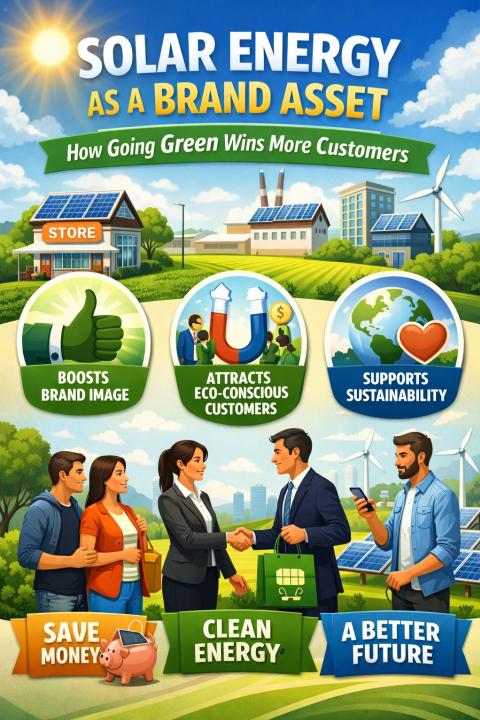
When your business runs on solar energy, you are not just saving money. You are publicly demonstrating a value system that resonates with these buyers. You are saying: we think about the future, not just the next quarter.
That alignment between brand values and customer values is one of the strongest foundations for long-term customer relationships.
2. Solar Gives You a Story Worth Telling
Marketing is, at its core, storytelling. And solar gives your business a genuine, tangible story that is easy to tell and hard to fake.
Consider the difference between two restaurants:
- Restaurant A says: "We use fresh ingredients and care about quality."
- Restaurant B says: "We use fresh ingredients, care about quality — and our kitchen runs entirely on solar power. Every meal you enjoy here is powered by clean energy."
Same food. Same service. But Restaurant B has a story. And that story travels — on social media, in word-of-mouth conversations, and in the minds of customers who remember why they feel good about coming back.
This is what brand differentiation looks like in practice. You are not just another option in your category. You are the business that made a meaningful choice — and customers notice.
3. Solar Boosts Your Credibility on CSR and ESG
For mid-sized and larger businesses, Corporate Social Responsibility (CSR) and Environmental, Social, and Governance (ESG) reporting are increasingly important — not just for compliance, but for reputation.
Investors, institutional clients, and enterprise customers now routinely evaluate vendors and partners on their sustainability credentials. A business that can demonstrate measurable carbon reduction through solar adoption stands out in procurement processes, partnership discussions, and investor conversations.
Even for smaller businesses, being able to say "We have reduced our carbon footprint by X tonnes this year through our solar installation" adds a layer of credibility that no marketing copy can manufacture. It is a fact. A number. A commitment made visible.
4. Your Customers Become Your Advocates
Here is something that many businesses underestimate: when customers feel proud of the businesses they support, they talk about it.
Think about the customer who tells a friend: "That café I love? They run entirely on solar. I feel good spending money there." Or the client who mentions to a colleague: "We switched our vendor to a company that's going carbon-neutral. Makes sense for us too."
Solar does not just attract customers — it gives your existing customers a reason to advocate for you. In an age where word-of-mouth, Google reviews, and social media recommendations drive purchasing decisions, this kind of organic advocacy is invaluable.
Your solar panels on the rooftop are not just generating electricity. They are generating conversations.
5. Stand Out in a Crowded Market
Whatever industry you are in — retail, hospitality, manufacturing, professional services, food and beverage — competition is intensifying. Differentiation is harder to achieve on product and price alone.
Solar gives you a clear, visible, and meaningful differentiator that most of your competitors have not yet adopted. Being an early mover in your category means you own the narrative of sustainability before others catch up.
This is a window of opportunity. The businesses that establish themselves as the "green choice" in their sector today will enjoy the brand equity that comes with being first — long after solar becomes the norm.
6. Practical Ways to Leverage Solar as a Brand Asset
Going solar is only step one. To turn it into a brand asset, you need to communicate it intentionally. Here is how:
Tell the story on your website. Add a dedicated section or page about your sustainability commitment. Share the numbers — how many units of energy your solar system generates, how much CO₂ you have offset, how many years you have been running on clean energy.
Use it in your marketing materials. Include your solar credentials in brochures, proposals, and pitch decks. For B2B businesses especially, this can be a deciding factor in vendor selection.
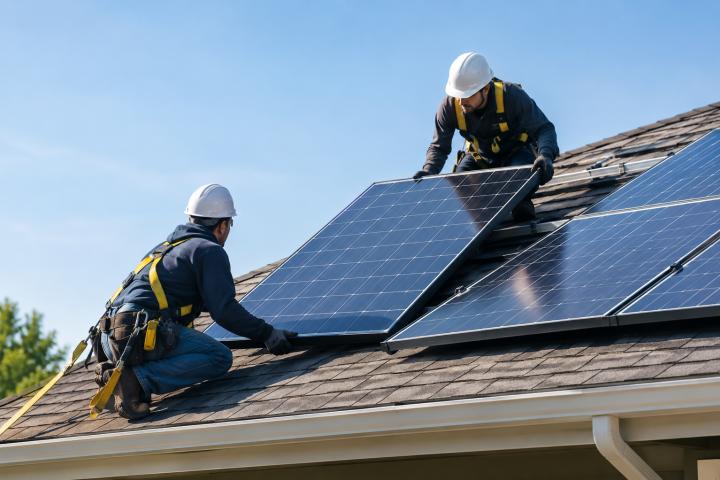
Show it on social media. Post photos of your installation. Share monthly energy generation milestones. Celebrate your solar anniversary. Audiences respond to authentic, behind-the-scenes content that shows a business living its values.
Display it at your premises. A simple, well-designed sign or plaque that says "This business runs on solar energy" communicates your commitment to every customer who walks through your door.
Incorporate it into your team culture. When your employees are proud of where they work, that pride shows in customer interactions. Solar can be a genuine source of internal pride and team identity.
7. The ROI of Green Branding
Brand building is notoriously difficult to measure, but the business case for green branding is becoming clearer with every passing year.
Businesses with strong sustainability credentials report higher customer retention rates, stronger employee satisfaction scores, and greater success in attracting top talent. They also find it easier to command premium pricing — because customers who connect with a brand's values are less price-sensitive than those who don't.
When you combine these brand benefits with the very real operational savings that solar delivers — reduced electricity bills, protection from rising energy tariffs, and potential revenue from net metering — the financial case for solar becomes almost impossible to ignore.
Solar is not just a green investment. It is a business investment with a brand dividend.
Conclusion: The Sun Is Rising on a New Kind of Business
The businesses that will lead their industries in the next decade are not waiting for regulations to force sustainability upon them. They are choosing it — and they are turning that choice into a competitive advantage.
Solar energy gives your business a rare opportunity: to do something genuinely good for the planet while simultaneously building a stronger, more trusted, more differentiated brand.
Your customers are watching. Your competitors are catching up. And the sun is not going anywhere.
The question is not whether your business should go solar. The question is: how much longer can you afford not to?
Interested in making solar part of your brand story? Get in touch with our team to explore the right solar solution for your business.