Artificial intelligence is no longer something businesses can afford to watch from a distance. It has moved beyond innovation labs and experimental pilots and entered day-to-day business conversations across industries. Companies are using AI to improve customer support, streamline internal processes, speed up content production, strengthen forecasting, and help teams make better decisions with less manual effort. Yet while interest in AI is growing rapidly, many businesses are still unsure how to prepare for it in a way that is strategic, sustainable, and commercially useful.
That uncertainty is understandable. AI can feel overwhelming because it is often discussed in extremes. Some people describe it as a revolutionary force that will completely redefine business overnight. Others treat it as a risky distraction that produces more noise than value. In reality, the truth lies somewhere in the middle. AI can create meaningful transformation, but only when businesses build the right foundation around it. Tools alone are not enough. A company needs readiness in strategy, operations, data, people, and governance before AI can produce long-term value.
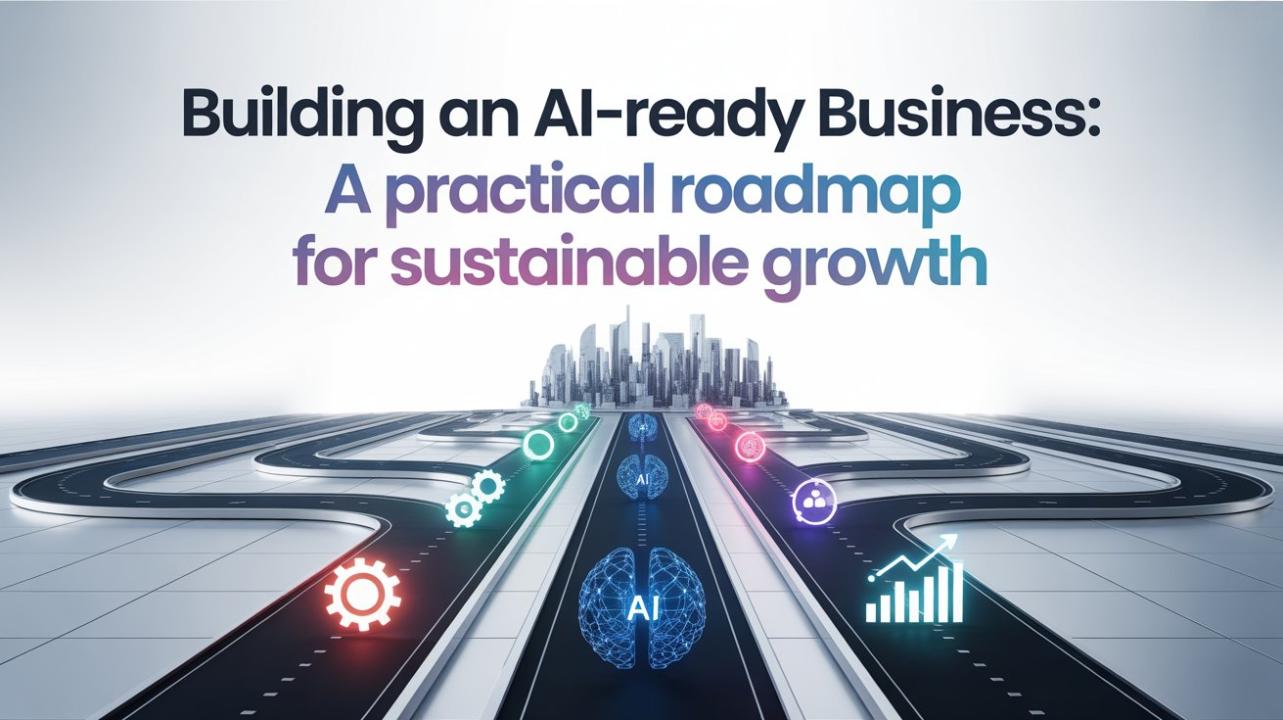
This is why the idea of becoming “AI-ready” is so important. Businesses do not need to implement everything at once, nor do they need to chase every new tool that appears in the market. What they need is a clear roadmap. AI readiness is about preparing the organization to adopt intelligent systems in a way that fits real business goals, improves execution, and supports future growth. It is less about hype and more about discipline.
Why AI Readiness Matters More Than AI Excitement
A lot of companies are excited about AI, but excitement alone does not create results. In fact, enthusiasm without preparation often leads to fragmented adoption. One team tries a chatbot. Another experiments with content generation. A third team buys an analytics tool with AI features. On the surface, this may look like progress. In practice, it can create disconnected systems, unclear expectations, and little measurable return.
AI readiness creates alignment. It forces a business to step back and ask smarter questions before implementation begins. What problems are we actually trying to solve? Which workflows would benefit from automation or decision support? What data is available? Which teams will use the solution? How will success be measured? What risks need to be addressed? These questions are not barriers to innovation. They are what make innovation useful.
Businesses that skip this stage often treat AI like a shortcut. They expect it to solve inefficiency without addressing the underlying process problems causing that inefficiency in the first place. But AI works best when it is added to a system that already has some operational clarity. It can enhance strong workflows, reduce repetitive work, and improve decision-making. It is far less effective when it is asked to compensate for confusion, poor data discipline, or a lack of ownership.
Start with Business Friction, Not with Technology
Prepare Your Data Before You Scale Your Ambition
One of the biggest realities businesses encounter during AI adoption is that their data is not as ready as they assumed. Information may exist across too many systems. Naming conventions may be inconsistent. Ownership may be unclear. Records may be incomplete or outdated. Some teams may be using information in spreadsheets while others rely on disconnected tools. These issues are not new, but AI tends to expose them much faster.
That is why AI readiness starts with data readiness. Businesses should know what information they have, where it lives, who is responsible for it, and whether it can be trusted for automation or decision support. This does not mean a company must build a perfect data environment before trying anything with AI. It does mean that leaders should be realistic about the relationship between data quality and output quality.
Clean, structured, relevant data leads to more reliable results. Weak data creates weak outcomes, no matter how advanced the model appears to be. In many cases, the first stage of AI readiness is not model selection at all. It is improving the quality of inputs, removing duplication, clarifying ownership, and connecting the systems that matter most.
When organizations do this work early, they save themselves significant frustration later. They also create a stronger base for future use cases. Good data discipline does not only support one AI project. It strengthens the business as a whole.
Choose the Right AI Approach for Your Business Stage
Not every company needs the same AI path. Some organizations benefit from off-the-shelf tools that improve team productivity quickly. Others need custom workflows because their processes, compliance requirements, or customer journeys are more complex. A smaller business may begin with limited internal automation. A larger business may need deeper integration across platforms, departments, and service layers.
This is why businesses should think in terms of fit rather than trend. The right solution is the one that matches operational reality. In some cases, a lightweight tool is enough. In others, the business may require tailored systems, internal copilots, workflow automation, or more advanced agentic AI development solutions that can take action across multiple business processes with the right safeguards in place.
The important thing is to avoid copying another company’s AI strategy blindly. What works for a SaaS startup may not work for a healthcare provider. What helps an ecommerce business may be irrelevant for a manufacturer or a consulting firm. The real goal is not to use the most AI. It is to use the right AI, in the right place, at the right level of complexity.
That is where leadership judgment becomes essential. Decision-makers need to balance ambition with practicality. A business should think beyond what is technically possible and focus on what is operationally useful and commercially sustainable.
Talent Strategy Often Determines Whether AI Succeeds
Many AI projects underperform not because the technology is weak, but because the team structure around it is not strong enough. AI initiatives usually require a mix of business understanding, technical execution, workflow design, and change management. If those capabilities are missing or spread too thinly, even a promising project can lose momentum.
This is why talent planning matters so much. Some businesses choose to develop internal capability over time. Others move faster by bringing in specialists who understand machine learning, data engineering, AI integrations, workflow automation, or intelligent product development. For organizations that want speed and flexibility without long hiring cycles, working with dedicated AI teams can be a practical way to accelerate delivery while keeping focus on business outcomes.
At the same time, success is not only about technical talent. Teams across the business need to know how AI fits into their work. Managers need to understand what should be automated and what should remain human-led. Employees need clarity about where AI can assist them and where judgment, creativity, and accountability still matter most. If adoption is treated as only an engineering task, the business may miss the human side of implementation.
AI changes how work gets done. That means communication, training, and role clarity all matter. The more thoughtfully a business manages this transition, the more likely it is to build trust and gain real adoption.
Governance Should Begin Early, Not After Problems Appear
As businesses move deeper into AI, governance becomes impossible to ignore. Questions around privacy, accuracy, security, fairness, and accountability are not optional considerations. They are core business concerns. If AI is influencing customer experience, internal decisions, operational workflows, or content generation, there needs to be clear oversight around how it is used and reviewed.
Too many businesses treat governance as something to figure out later. That is risky. Once AI becomes embedded in operations, correcting preventable mistakes can be expensive and damaging. It is far better to define policies early. Who can use which tools? What data is allowed? Which outputs require review? How are sensitive decisions handled? What happens when the system produces an incorrect or incomplete result?
Governance does not need to slow innovation down. In fact, it often makes innovation easier to scale because teams know the boundaries. Good governance creates confidence. It helps leaders move faster because they are not relying on guesswork. It also shows clients, customers, and internal stakeholders that AI adoption is being handled responsibly.
The businesses that win with AI over the long term will not simply be the fastest adopters. They will be the ones that combine innovation with trust.
Keep Learning as the AI Landscape Changes
One of the challenges of AI is that the landscape evolves quickly. New tools appear constantly. Terminology shifts. Expectations change. What looked advanced a year ago may now be standard. This is why businesses need more than a launch mindset. They need a learning mindset.
AI readiness is not a one-time milestone. It is an ongoing capability. Leaders should keep paying attention to use cases, implementation lessons, governance practices, and changing market expectations. Teams that stay informed are usually better at spotting which developments are practical and which are mostly noise. They are also better equipped to evolve their strategy without overreacting to every new trend.
This is where keeping an eye on credible AI adoption trends can be useful. Not because every trend deserves action, but because understanding the direction of the market helps businesses make more measured decisions. It becomes easier to know when to experiment, when to wait, and when to scale.
Long-term success with AI comes from balancing curiosity with discipline. Businesses need enough openness to explore new opportunities, but enough structure to avoid being pulled in a dozen directions at once.
Build for Progress, Not Perfection
A common reason businesses delay AI adoption is that they feel unprepared. They assume they need the perfect systems, perfect data, perfect team, and perfect roadmap before they can begin. In reality, few businesses ever start from perfect conditions. Progress matters more than perfection.
The better path is to begin with a focused use case, clear ownership, a realistic success metric, and strong oversight. Solve one meaningful problem well. Learn from it. Improve the process. Then expand carefully. This builds internal confidence and creates practical momentum.
What matters most is not whether a business can claim to be “AI-powered.” What matters is whether it is building the capability to use AI in a way that makes the organization smarter, faster, and more resilient over time.
Conclusion
Building an AI-ready business is not about chasing headlines or copying what others are doing. It is about preparing the organization to use intelligent systems in a way that supports real business needs. That means identifying operational friction, improving data readiness, choosing the right implementation path, strengthening team capability, and putting governance in place from the start.
Companies that approach AI with this mindset are far more likely to create lasting value. They do not get distracted by novelty alone. They build readiness, layer intelligence into meaningful workflows, and scale with purpose. In a market where AI will continue shaping how companies compete, serve customers, and operate internally, readiness may become one of the most important advantages a business can build.