Artificial Intelligence is no longer a futuristic concept. Businesses across industries are using AI to automate workflows, improve customer experiences, increase productivity, and make better decisions. From chatbots and recommendation engines to predictive analytics and automation tools, AI is reshaping how companies operate in 2026.
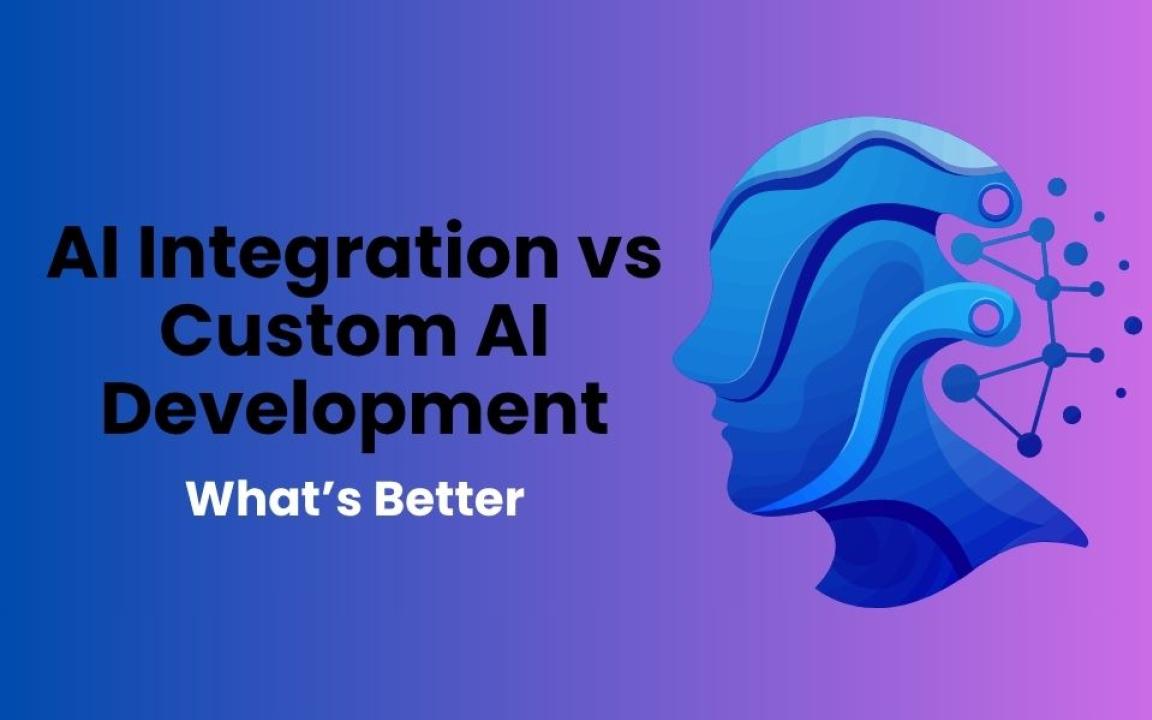
However, when businesses decide to adopt AI, they often face a major question: should they choose AI integration or invest in custom AI development?
Both approaches offer unique advantages, but the right choice depends on your business goals, budget, scalability requirements, and long-term strategy. Some companies prefer ready-made AI tools that can be integrated quickly, while others require highly tailored solutions built specifically for their operations.
In this blog, we will explore the difference between AI integration and custom AI development, their benefits, challenges, costs, and which option works best for different business needs. We’ll also discuss how businesses can leverage custom AI integration services to maximize efficiency and long-term growth.
Understanding AI Integration
AI integration refers to the process of adding existing AI-powered tools, APIs, or platforms into your current business systems. Instead of building AI from scratch, businesses use pre-built AI technologies developed by third-party providers.
For example:
- Integrating ChatGPT APIs into customer support systems
- Using AI-powered CRM automation
- Adding AI chatbots to websites
- Integrating AI recommendation systems into eCommerce stores
- Using AI analytics tools for reporting and insights
AI integration is generally faster and more affordable because the AI models already exist.
Key Features of AI Integration
1. Faster Deployment
Businesses can implement AI tools quickly without spending months on development.
2. Lower Development Cost
Since companies use existing AI models, there is no need for heavy research or model training.
3. Easy Scalability
Most AI platforms are cloud-based and scalable according to business requirements.
4. Third-Party Maintenance
The AI provider handles updates, improvements, and security patches.
5. Easy Accessibility
Even small businesses can adopt AI without hiring large AI engineering teams.
Benefits of AI Integration
Quick Time-to-Market
One of the biggest advantages of AI integration is speed. Companies can launch AI-powered solutions within weeks instead of spending months building systems from scratch.
This is especially useful for startups and businesses looking for rapid digital transformation.
Cost-Effective Solution
AI integration is often more budget-friendly because businesses avoid the high costs associated with custom AI development.
Most AI platforms operate on subscription-based pricing models, making adoption easier for companies with limited budgets.
Reduced Technical Complexity
Businesses do not need to build machine learning models or manage complex AI infrastructure. AI vendors handle the technical aspects.
Improved Business Efficiency
Integrated AI tools can automate repetitive tasks like:
- Customer support
- Data entry
- Email responses
- Content recommendations
- Lead generation
This improves operational efficiency and reduces manual workload.
Access to Advanced AI Technology
Businesses can access cutting-edge AI capabilities without building their own technology stack.
Challenges of AI Integration
Although AI integration offers several advantages, it also comes with limitations.
Limited Customization
Pre-built AI solutions may not fully align with unique business workflows or industry-specific needs.
Dependency on Third-Party Providers
Businesses rely on external vendors for system performance, updates, and security.
Data Privacy Concerns
Sharing sensitive business data with third-party AI platforms may create compliance and privacy challenges.
Integration Compatibility Issues
Sometimes AI tools may not integrate smoothly with existing legacy systems.
Long-Term Costs
Subscription fees and API usage costs can increase significantly as business operations scale.
What is Custom AI Development?
Custom AI development involves building AI solutions specifically tailored to a business’s unique requirements. Instead of using pre-built AI systems, companies create their own machine learning models, algorithms, and workflows.
Custom AI solutions are designed to solve specific business problems and deliver personalized experiences.
Examples include:
- Custom fraud detection systems
- AI-powered healthcare diagnostics
- Personalized recommendation engines
- Industry-specific automation platforms
- Predictive maintenance systems
- Custom generative AI applications
Businesses often partner with companies offering custom ai integration services and AI development expertise to create highly scalable solutions.
Benefits of Custom AI Development
Tailored Business Solutions
Custom AI systems are designed specifically for your business goals, processes, and challenges.
This ensures better efficiency and more accurate outcomes.
Higher Scalability
Custom AI solutions can scale according to business growth and changing market demands.
Competitive Advantage
Businesses using unique AI systems gain a competitive edge because competitors cannot easily replicate the solution.
Better Data Control
Companies maintain full ownership of their data, improving privacy, compliance, and security.
Advanced Personalization
Custom AI enables businesses to deliver personalized customer experiences based on unique datasets and user behavior.
Long-Term Flexibility
Custom AI systems can evolve alongside business needs and technological advancements.
Challenges of Custom AI Development
Despite its advantages, custom AI development comes with certain challenges.
Higher Initial Investment
Building AI solutions from scratch requires significant investment in:
- AI engineers
- Data scientists
- Infrastructure
- Training datasets
- Testing and deployment
Longer Development Timeline
Custom AI projects can take several months or even years depending on complexity.
Technical Complexity
Developing advanced AI models requires specialized expertise and continuous optimization.
Ongoing Maintenance
Businesses are responsible for updating, monitoring, and maintaining AI systems.
Data Requirements
Custom AI models require large amounts of high-quality data for training and performance optimization.
When Should Businesses Choose AI Integration?
AI integration is ideal for businesses that:
- Need quick implementation
- Have limited budgets
- Want to automate basic processes
- Do not require highly customized solutions
- Want to test AI adoption before larger investments
Best Use Cases for AI Integration
Customer Support Automation
AI chatbots and virtual assistants improve customer response times.
Marketing Automation
Businesses can integrate AI tools for personalized email campaigns and analytics.
eCommerce Recommendations
AI recommendation engines improve product discovery and conversions.
Workflow Automation
AI can streamline repetitive operational tasks.
When Should Businesses Choose Custom AI Development?
Custom AI development is suitable for businesses that:
- Need highly personalized solutions
- Handle complex workflows
- Require advanced data security
- Want full ownership of AI systems
- Aim for long-term scalability
Best Use Cases for Custom AI Development
Healthcare Industry
Custom AI models can improve diagnostics and patient care systems.
FinTech Platforms
AI-driven fraud detection and risk analysis require highly tailored algorithms.
Manufacturing
Predictive maintenance AI systems reduce downtime and operational costs.
Logistics and Supply Chain
Custom AI can optimize inventory management and route planning.
Large Enterprises
Enterprises with unique workflows often benefit from personalized AI systems.
Cost Comparison: AI Integration vs Custom AI Development
Cost is one of the biggest deciding factors for businesses.
AI Integration Costs
AI integration usually involves:
- API subscription fees
- Licensing costs
- Integration development charges
- Maintenance fees
This approach is more affordable initially.
Custom AI Development Costs
Custom AI development includes:
- Data collection
- Model training
- Infrastructure setup
- AI engineering
- Ongoing optimization
While initial costs are higher, businesses may save money in the long run by avoiding recurring third-party fees.
How Custom AI Integration Services Help Businesses
Many companies struggle to decide between AI integration and full-scale AI development. This is where professional custom ai integration services become valuable.
These services help businesses:
- Analyze business requirements
- Identify suitable AI technologies
- Integrate AI into existing systems
- Develop hybrid AI models
- Ensure scalability and security
- Optimize AI performance
A reliable AI partner can create a strategy that balances cost, efficiency, and long-term growth.
Hybrid Approach: The Best of Both Worlds
In many cases, businesses do not need to choose one approach exclusively.
A hybrid strategy combines AI integration with custom AI development.
For example:
- Integrating third-party AI APIs for basic automation
- Building custom AI modules for specialized tasks
This approach reduces costs while still offering personalization and scalability.
Benefits of a Hybrid AI Strategy
- Faster implementation
- Reduced development costs
- Greater flexibility
- Easier scalability
- Better ROI
Many modern businesses are adopting hybrid AI models to accelerate digital transformation without overspending.
Key Factors to Consider Before Choosing
Before selecting AI integration or custom AI development, businesses should evaluate several factors.
Business Goals
Clearly define what you want to achieve with AI.
Budget
Determine whether your business can support long-term AI investments.
Scalability Needs
Consider future business growth and evolving AI requirements.
Data Security
Evaluate compliance requirements and data privacy concerns.
Technical Expertise
Assess whether your internal team can manage AI systems.
Time-to-Market
If speed is critical, AI integration may be the better option.
Future Trends in AI Development
AI technology continues to evolve rapidly, and businesses are increasingly adopting advanced AI capabilities.
Generative AI Expansion
Generative AI tools are transforming content creation, coding, customer support, and marketing.
AI-Powered Automation
Businesses are using AI to automate complex workflows and reduce operational costs.
Personalized AI Experiences
AI systems are becoming more intelligent in delivering customized user experiences.
Industry-Specific AI Solutions
More companies are investing in specialized AI systems tailored to specific industries.
AI Security and Governance
As AI adoption grows, businesses are prioritizing ethical AI practices and data security.
Which Option is Better?
There is no one-size-fits-all answer.
The better choice depends on your business size, objectives, technical requirements, and long-term vision.
Choose AI Integration If:
- You need quick deployment
- You have budget limitations
- Your AI requirements are basic
- You want faster ROI
Choose Custom AI Development If:
- You need advanced personalization
- Your workflows are highly specialized
- You want full control over AI systems
- You need long-term scalability
For many businesses, a hybrid strategy supported by expert custom ai integration services offers the best balance between affordability and customization.
Final Thoughts
AI is transforming every industry, and businesses that adopt AI strategically will gain a strong competitive advantage in the coming years.
AI integration provides a fast and affordable way to implement intelligent systems, making it ideal for startups and small businesses. On the other hand, custom AI development delivers personalized, scalable, and future-ready solutions for enterprises with complex requirements.
The key is understanding your business needs, technical capabilities, and growth plans before making a decision.
Whether you choose AI integration, custom AI development, or a hybrid approach, investing in AI today can significantly improve operational efficiency, customer experiences, and long-term profitability.
As AI continues to evolve, businesses that leverage the right AI strategy with professional custom ai integration services will be better positioned to innovate, scale, and succeed in the digital era.