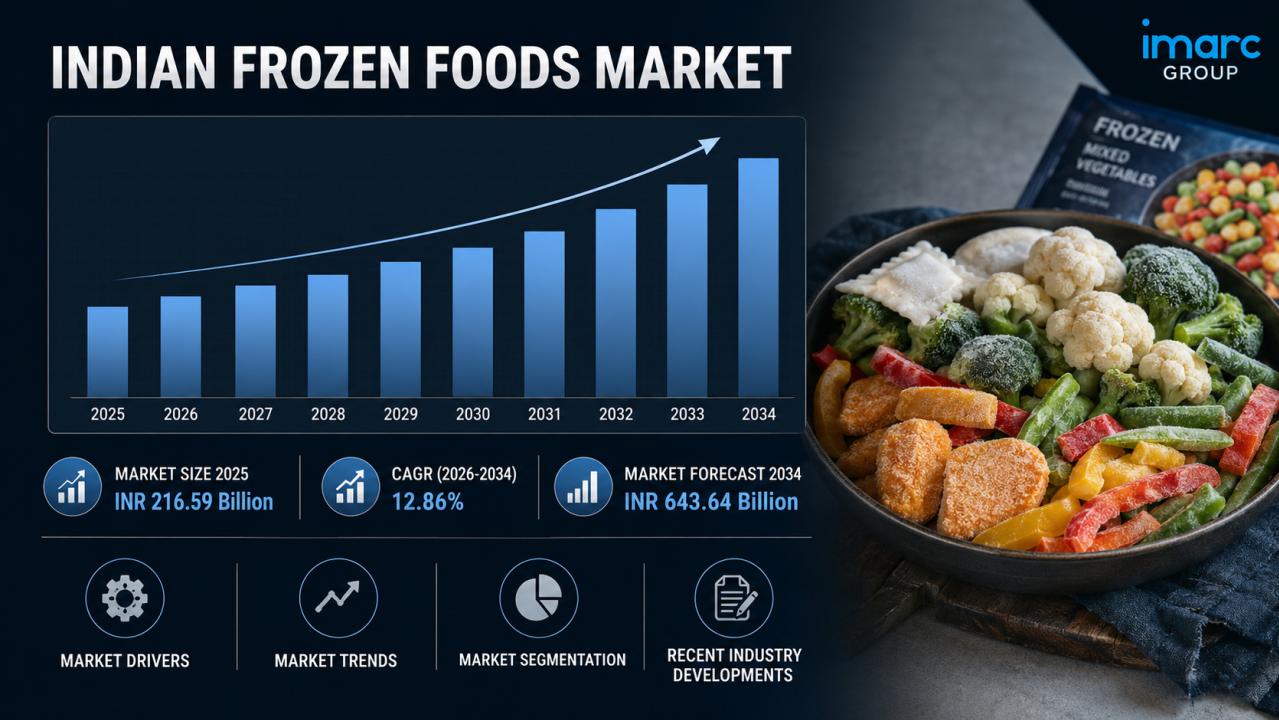
According to IMARC Group's report titled "Indian Frozen Foods Market Size, Share, Trends and Forecast by Product Type, 2026-2034", The report offers a comprehensive analysis of the industry, including Market Share, forecast, growth, and regional insights.
The Indian frozen foods market size was valued at INR 216.59 Billion in 2025 and is projected to reach INR 643.64 Billion by 2034, exhibiting a CAGR of 12.86% during the forecast period 2026-2034.
India's frozen foods sector is at a decisive inflection point — transitioning from a niche urban convenience category into a mainstream, high-volume consumer staples market, powered by cold chain modernisation, workforce urbanisation, and accelerating organised retail penetration.
- INR 191.0 Billion — the Indian frozen foods market valuation in 2024, per IMARC Group, with a clear projection to INR 593.0 Billion by 2033, representing a CAGR of 13.4% during 2025–2033.
- Frozen vegetable snacks hold the largest product segment share, driven by rising health consciousness, plant-based dietary preferences, and growing societal awareness of environmental sustainability.
- In February 2025, ITC announced plans to acquire 100% of Prasuma — a prominent frozen foods brand specialising in momos, baos, and Korean fried chicken — over three years, with an initial 43.8% stake acquisition, reflecting strong institutional conviction in the sector's growth trajectory.
- The market's three primary product segments — frozen vegetable snacks, frozen fruits and vegetables, and frozen meat products — each serve distinct consumer demographics and price points, providing portfolio diversification for manufacturers and investors alike.
- India's cold chain infrastructure, comprising approximately 8,698 cold storage units with a total capacity of 395 lakh metric tonnes (as of May 2024), is the foundational enabler of frozen food distribution — and its continued expansion under government schemes directly amplifies addressable market reach.
The Strategic Market Challenge: Navigating the Indian Frozen Foods Market in India
The most structurally underestimated challenge in India's frozen foods market is not consumer demand — it is the inadequacy and geographic unevenness of cold chain infrastructure, particularly beyond the top 20 metros. While urban demand is robust and growing, the absence of integrated cold chain coverage in Tier-2 and Tier-3 cities, rural distribution hubs, and last-mile delivery networks creates a persistent gap between addressable market potential and actual sales realisation. Logistics costs remain elevated due to fuel prices and insufficient road infrastructure in several regions, directly compressing manufacturer margins and limiting geographic expansion for brands attempting to scale nationally.
➤ Access Industry-Focused Insights and Future Forecasts - Request Sample Report: https://www.imarcgroup.com/indian-frozen-foods-market/requestsample
India's Strategic Vision for the Indian Frozen Foods Market
India's policy environment has aligned significantly behind frozen food as a strategic priority within the broader food processing agenda.
- PMKSY Cold Chain Expansion — ₹6,520 Crore Allocation: According to the Ministry of Food Processing Industries (MoFPI), the Union Cabinet approved an enhanced total allocation of ₹6,520 crore for Pradhan Mantri Kisan SAMPADA Yojana (PMKSY) for the 15th Finance Commission cycle (up to March 2026). This includes ₹1,000 crore specifically for setting up 50 Multi-Product Food Irradiation Units under the Integrated Cold Chain and Value Addition Infrastructure (ICCVAI) component — directly strengthening the preservation and logistics infrastructure on which frozen food distribution depends.
- PLISFPI — ₹10,900 Crore PLI Scheme for Food Processing: According to MoFPI, the Production Linked Incentive Scheme for Food Processing Industry (PLISFPI) — with a total outlay of ₹10,900 crore for 2021–22 to 2026–27 — targets Ready-to-Cook/Ready-to-Eat (RTC/RTE) foods as an explicit category. As of September 2025, 170 applications have been approved under the scheme, generating approximately 3.39 lakh direct and indirect jobs and adding 35 lakh MT per annum of food processing capacity nationally.
- 394 Cold Chain Projects Under PMKSY: As of February 2025, MoFPI had sanctioned 394 cold chain projects under PMKSY across the country, of which 286 were completed, creating 10.06 lakh MT of cold storage and 331 MT/hour of quick-freezing capacity — directly expanding the supply chain infrastructure for frozen food manufacturers.
- Union Budget 2025–26 Allocation — ₹4,364 Crore to MoFPI: The Union Budget 2025–26 allocated ₹4,364 crore to the Ministry of Food Processing Industries, including ₹1,444 crore for PLISFPI and ₹2,000 crore for the PMFME scheme — sustaining the government's multi-year commitment to food processing infrastructure development that directly benefits organised frozen food players.
Why Invest in the Indian Frozen Foods Market: Key Growth Drivers & ROI
- Urbanisation and Workforce Participation as Structural Demand Drivers: The expanding Indian workforce — particularly the growing population of dual-income urban households and working professionals — is directly driving demand for ready-to-eat and ready-to-cook frozen food formats. This demographic shift is structural and multi-decade, providing a durable demand base that is independent of cyclical economic fluctuations, making frozen food a resilient category for long-horizon capital allocation.
- E-Commerce and Quick-Commerce Channel Expansion: The shift toward online grocery and quick-commerce platforms — accelerated structurally by consumer behaviour changes following the COVID-19 pandemic — has materially improved product accessibility for frozen food brands. According to IMARC Group, this channel shift has broadened the consumer base beyond organised retail footprints, enabling premium and niche frozen food brands to reach health-conscious consumers in markets previously difficult to serve through conventional distribution.
- Advances in Freezing Technology and Product Quality Improvement: Significant investment in Individual Quick Freezing (IQF), blast freezing, and advanced packaging technologies is improving the texture, flavour retention, and shelf life of frozen products — addressing the longstanding consumer perception that frozen food is nutritionally or quality-inferior to fresh. R&D investment by key players is expanding the product range across international cuisines, health-positioned variants, and fortified formats, driving category expansion beyond traditional potato-based snacks.
- Food Service Sector Integration Creating B2B Volume: India's expanding quick-service restaurant (QSR) chains, cloud kitchens, and institutional catering segments are generating high-volume, contractual procurement demand for frozen food ingredients and semi-processed products. This B2B channel provides revenue predictability and volume scale for manufacturers, complementing and partially de-risking dependence on the more fragmented retail consumer channel.
Indian Frozen Foods Market Trends & Future Outlook
- Frozen Vegetable Snacks Maintaining Segment Leadership: Frozen vegetable snacks continue to dominate the Indian frozen foods market by share, driven by a convergence of health awareness, plant-based diet adoption, and environmental sustainability consciousness among urban consumers. This segment is also benefiting from strong innovation activity, with brands launching new flavour profiles, regional taste variants, and fortified snack formats to sustain consumer interest and drive repeat purchase.
- Frozen Meat Products Growing with Expanding Non-Vegetarian Consumer Base: The frozen meat segment is expanding steadily, driven by India's growing middle-class non-vegetarian consumer base, increasing exposure to international cuisines, and the entry of premium QSR chains requiring standardised frozen protein inputs. ITC's acquisition of Prasuma — which includes products such as chicken-based frozen items — is a direct signal of institutional confidence in this segment's volume potential.
- Sustainable Packaging as a Competitive Differentiator: Leading frozen food manufacturers are investing in eco-friendly, sustainable packaging solutions as both a regulatory preparation and a consumer positioning tool. This trend is particularly pronounced among premium brands targeting urban millennials who factor environmental credentials into purchase decisions — creating a product differentiation lever that goes beyond price and flavour.
- Ethnic and Regional Frozen Foods Gaining Organised Market Share: The India ethnic frozen foods market — covering traditional Indian preparations including parathas, sweets, regional snacks, and ready-to-eat meals — reached USD 1.90 Billion in 2024 and is projected to grow at a CAGR of 7.70% through 2033 (IMARC Group). This sub-segment represents a significant opportunity for brands that can credibly bridge traditional Indian culinary expectations with the quality consistency required for mass-market frozen distribution.
- Fortified and Health-Positioned Product Innovation: Manufacturers are increasingly introducing frozen foods enriched with added minerals, vitamins, and fibre to capture the health-conscious consumer segment that has traditionally been sceptical of processed frozen products. This innovation trajectory is expanding the category's appeal among consumers who previously favoured fresh over frozen, materially widening the addressable market.
➤ Explore the Complete TOC and Data Coverage - Get Full Brochure: https://www.imarcgroup.com/request?type=report&id=1055&flag=A
Regulatory Landscape & Policy Catalysts in India
India's regulatory and policy environment for frozen foods is becoming progressively more structured and support-oriented, with multiple government bodies actively driving infrastructure and compliance improvements.
- PMKSY Integrated Cold Chain and Value Addition Infrastructure (ICCVAI): According to the Ministry of Food Processing Industries, the ICCVAI component under PMKSY provides grants covering 35% of eligible project costs in general areas and 50% in difficult/remote areas for setting up integrated cold chain projects — from farm-level pre-cooling through distribution hubs and refrigerated transport. The May 2025 revision of operational guidelines strengthens requirements for end-to-end supply chain connectivity, directly improving frozen food logistics quality.
- PLISFPI — RTC/RTE Foods as an Explicitly Covered Category: According to MoFPI, Ready-to-Cook and Ready-to-Eat foods are one of four priority product segments under the PLISFPI scheme's ₹10,900 crore outlay. The scheme offers production-linked financial incentives for qualifying manufacturers — providing a direct subsidy mechanism for frozen food companies that meet minimum sales and investment thresholds, supporting both capacity expansion and domestic brand building.
- FSSAI Food Safety Standards for Frozen Foods: The Food Safety and Standards Authority of India (FSSAI) mandates specific standards for frozen food processing, storage temperatures, labelling, and ingredient disclosure under the Food Safety and Standards (Food Products Standards and Food Additives) Regulations. FSSAI's 2025 focus on stricter labelling standards and digital traceability systems — including QR-based verification from producer to consumer — raises the quality floor for all market participants, benefiting compliant, organised manufacturers over informal competitors.
- 100 NABL-Accredited Food Testing Laboratories — MoFPI Initiative: According to MoFPI, the ministry committed in March 2025 to financially support the establishment of 100 new NABL-accredited food testing laboratories across India in FY2025–26. This initiative directly improves food safety verification infrastructure for frozen food manufacturers seeking export certification and institutional supply contracts.
- Mega Food Parks and Agro-Processing Clusters: According to MoFPI, as of February 2025, 41 Mega Food Parks and 75 Agro-Processing Clusters have been sanctioned under PMKSY, providing shared processing infrastructure, cold chain facilities, and developed industrial plots that reduce capital entry barriers for frozen food manufacturers, particularly those operating in proximity to agricultural supply zones.
- GST Relief and Financial Incentives for Food Processors: The government has provided GST relief for food processors under specific categories, reducing the effective tax burden on frozen food manufacturers and improving working capital efficiency. Combined with subsidies under MoFPI schemes, these fiscal measures improve the unit economics of organised frozen food production — particularly for manufacturers scaling into rural supply zones where logistics costs are structurally higher.
By the IMARC Group, the Top Competitive Landscape & their Positioning:
- McCain India Pvt Limited
- Venky’s (India) Limited
- Mother Dairy Fruit and Vegetable
- Godrej Tyson Foods Limited
- Al Kabeer Group
- Innovative Foods Limited (Sumeru)
Covering an in-depth analysis of the competitive landscape, market structure, key player positioning, competitive dashboards, top winning strategies, and detailed profiles of all major industry participants you will gain access to all these exclusive insights within the full research report.
Market Segmentations:
Breakup by Product Type:
- Frozen Vegetable Snacks (52.0% market share)
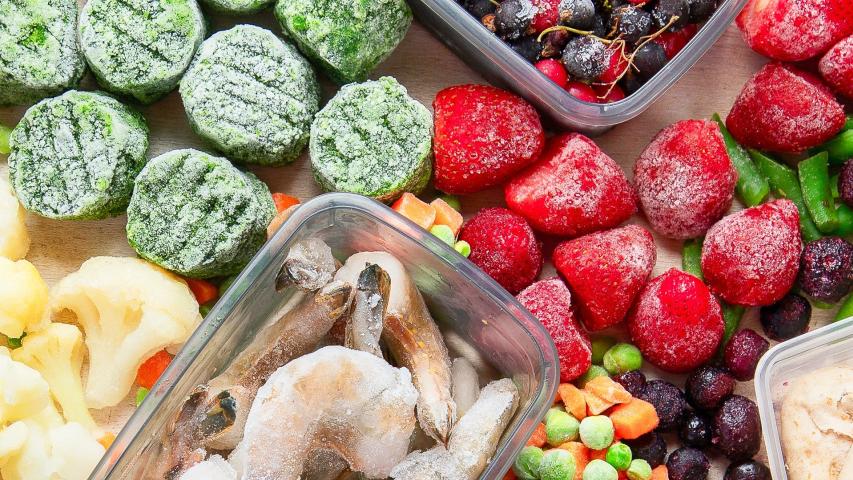
- Frozen Fruits and Vegetables (28.0% market share)
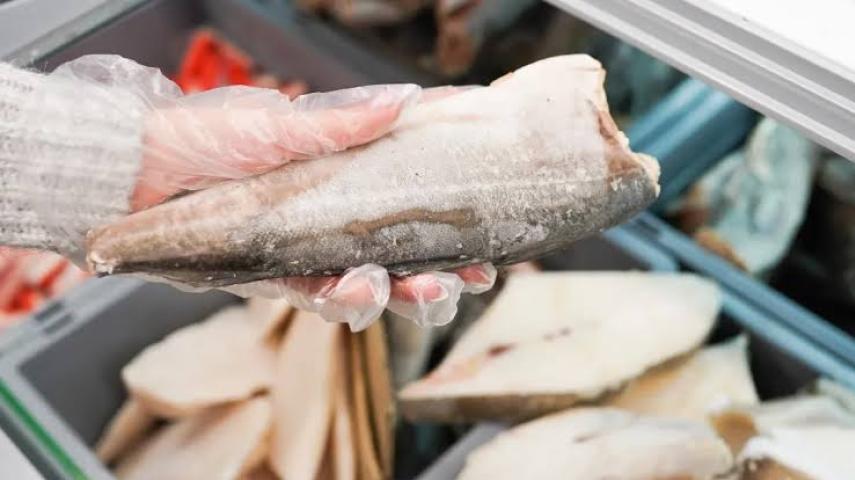
- Frozen Meat Products (20.0% market share)
Note: If you need specific information that is not currently within the scope of the report, we can provide it to you as a part of the customization.
➤ Tailor the Research to Your Exact Business Needs - Request Customization: https://www.imarcgroup.com/request?type=report&id=1055&flag=E
Frequently Asked Questions (FAQs):
Q1. What is the current value and projected growth of the Indian Frozen Foods Market?
According to IMARC Group, the Indian frozen foods market reached INR 191.0 Billion in 2024 and is projected to reach INR 593.0 Billion by 2033, growing at a CAGR of 13.4% during 2025–2033. This growth is driven by rapid urbanisation, rising demand for ready-to-eat food products among the working population, improvements in cold chain infrastructure, expanding e-commerce distribution, and changing dietary preferences across urban and semi-urban India.
Q2. Which product segments are covered in the Indian frozen foods market, and which leads?
According to IMARC Group, the market is segmented into three primary product types: frozen vegetable snacks, frozen fruits and vegetables, and frozen meat products. Frozen vegetable snacks hold the largest share, driven by health-conscious consumer preferences, demand for plant-based alternatives, and the broader shift toward sustainable dietary choices. Frozen meat products are the fastest-growing segment in volume terms, supported by QSR chain expansion, rising disposable incomes, and increasing exposure to international food formats across urban India.
Q3. How is corporate consolidation shaping the competitive structure of this market?
The Indian frozen foods market is experiencing active consolidation among organised players. In February 2025, ITC announced plans to acquire 100% of Prasuma — a prominent frozen food brand specialising in oriental cuisine and premium frozen meats — over three years, beginning with a 43.8% stake. This acquisition reflects a broader trend of large FMCG conglomerates entering the premium frozen food space through acquisitions rather than organic brand building, signalling a shift toward market maturity and scale-driven competitive dynamics.
Q4. What role does cold chain infrastructure play in market expansion, and what is the current status?
Cold chain infrastructure is the single most critical enabler of India's frozen food market expansion. According to IMARC Group, India's cold chain network comprises approximately 8,698 cold storage units with 395 lakh metric tonnes of total capacity (as of May 2024). Under PMKSY, 394 integrated cold chain projects have been taken up, with 286 completed — creating over 10 lakh MT of cold storage and 331 MT/hour of quick-freezing capacity. This infrastructure build-out is progressively unlocking Tier-2 and Tier-3 market access for frozen food brands.
Q5. What are the primary risks that institutional investors should evaluate before entering this market?
The primary risks include persistent cold chain inadequacies in secondary cities and rural areas that constrain geographic expansion economics. High logistics costs due to fuel prices and inconsistent road infrastructure in certain regions compress manufacturer margins on lower-price-point products. Consumer perception barriers around frozen food quality and nutrition — particularly in markets where fresh-first cultural preferences remain dominant — require sustained marketing investment to overcome. Additionally, dependence on uninterrupted power supply for cold storage creates operational vulnerability in regions with unreliable electricity grids.
Strategic Insight & Verdict
India's frozen foods market offers a compelling, decade-long growth story anchored in durable structural drivers: urbanisation, workforce participation, cold chain expansion, and government-backed food processing infrastructure investment. Based on a comprehensive review of market data and sectoral dynamics, we at IMARC Group have observed that the 13.4% CAGR trajectory is not speculative — it is supported by verifiable policy commitments, active corporate consolidation, and an expanding consumer base moving decisively toward convenience-oriented food formats. For CXOs and institutional investors, the strategic window for capacity establishment, brand positioning, and cold chain integration is now.
Tarang, Digital Insights Specialist at IMARC Group: https://www.linkedin.com/in/tarang-chauhan-31a82b265/
Verified Data Source: IMARC Group
Contact Us:
IMARC Group
134 N 4th St. Brooklyn, NY 11249, USA
Email: sales@imarcgroup.com
Tel No:(D) +91 120 433 0800
United States: +1-202071-6302