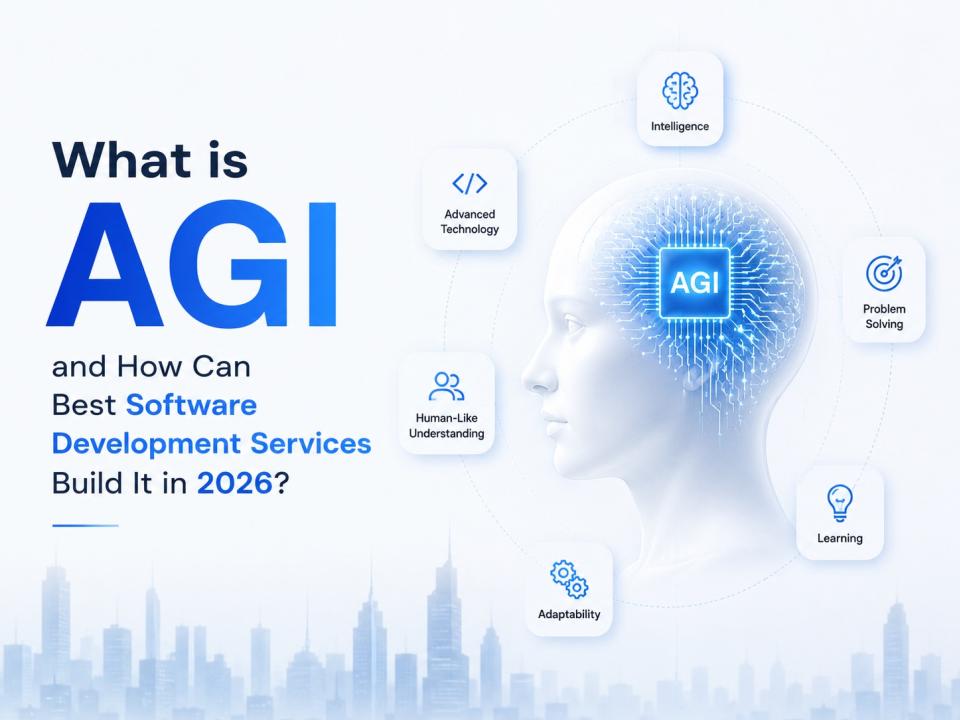
Artificial Intelligence is everywhere in 2026. You use it
when you search on Google, chat with customer support, or let Netflix pick your
next show. But there’s a bigger question people are asking: what comes after
the AI we use today? That’s where AGI comes in.
This guide breaks down what is AGI, how it’s different from
the AI you know, how AGI works, and what role the best software development services play in building it. No jargon, just clear explanations with examples.
What is AGI?
AGI stands for Artificial General Intelligence. It’s a type
of AI that can understand, learn, and apply knowledge across any task at a
level similar to a human.
Today’s AI is called Narrow AI or Weak AI. ChatGPT writes
text, Midjourney creates images, and Spotify recommends music. Each system is
excellent at one thing, but useless outside its domain. You can’t ask ChatGPT
to fix your car engine or Midjourney to write legal contracts.
AGI changes that. An AGI system would be able to:
1.
Learn a new skill from a manual without extra
training
2.
Switch between writing code, solving math
problems, and planning a trip
3.
Reason through problems it has never seen before
4.
Understand context, emotion, and common sense
like a person
Think of it as the difference between a calculator and a
mathematician. The calculator is fast at math but can’t do anything else. The
mathematician can learn new fields, ask better questions, and connect ideas.
Artificial general intelligence is still theoretical in
2026. We have models like GPT-5, Claude 4, and Gemini that are closer than
ever, but they’re still classified as advanced Narrow AI. They can fake general
reasoning well, but they don’t truly understand the world the way humans do.
AGI vs AI: What’s the Real Difference?
People use “AI” and “AGI” interchangeably, but they’re not the same. Here’s a simple breakdown:
| Feature | Narrow AI 2026 | AGI |
| Scope | One specific task | Any intellectual task a human can do |
| Learning | Needs retraining for new tasks | Learns and adapts on its own |
| Reasoning | Pattern matching and prediction | Causal reasoning and common sense |
| Examples | Chatbots, image generators, fraud detection | Hypothetical system that can do all of the above |
| Autonomy | Follows instructions | Sets its own goals and plans |
AGI vs AI matters because it changes what’s possible. Narrow
AI automates tasks. AGI could automate entire jobs, invent new science, and
accelerate research across medicine, physics, and engineering.
How AGI Works: The Technical Picture
You don’t need a PhD to understand the basics of how AGI
works. Most researchers agree it will combine 4 core components:
1. Large-Scale Transformer Architecture
Modern AI uses transformers. They work by predicting the
next word, pixel, or data point based on context. AGI would use a much larger
version with trillions of parameters, plus better memory systems to hold
context for weeks or months.
2. Self-Supervised and Reinforcement
Learning
Instead of only learning from labeled data, AGI would learn
by interacting with the world. It would try things, fail, adjust, and
improve—like a human child learning to walk.
3. World Model and Common Sense
AGI needs an internal model of how the world works. Gravity,
cause and effect, social norms, physics. Right now AI lacks this. Building it
requires training on multimodal data: text, video, audio, and real-world sensor
data.
4. Planning and Goal Systems
AGI must break big goals into smaller steps. If you ask it
to “launch a startup,” it should research the market, write a business plan,
build a website, and test the product without you micromanaging every step.
The challenge is not just scale. It’s making these systems
safe, reliable, and aligned with human values.
When Will AGI Be Developed?
When
will AGI be developed is the most debated question in tech right now.
· Optimistic
view: Some researchers at OpenAI, DeepMind, and xAI believe AGI could arrive
between 2027-2032 if scaling continues.
· Conservative
view: Many academics think we’re missing key breakthroughs in reasoning and
consciousness. They predict 2040+ or never.
· Realistic
view for 2026: We’ll see systems that pass the Turing Test in conversation but
still fail at real-world problem solving. True AGI is likely still 5-15 years
away.
What
we know for sure: progress is accelerating. Compute power doubles every 2
years, training methods improve, and investment in AI hit $200B+ in 2025. Even
if AGI takes longer, the stepping stones will change every industry.
AGI Examples: What It Could Do
Since
true AGI doesn’t exist yet, AGI examples are based on what researchers expect
it to do:
1.
Scientific Discovery: Design new drugs,
materials, and energy systems without human guidance. It could analyze millions
of papers and propose experiments.
2.
Personal Assistant: A system that manages your
entire life—schedule, finances, health—while understanding your long-term goals
and personality.
3.
Education Tutor: A tutor that adapts to how you
learn, explains any subject, and creates custom lessons on the fly.
4.
Software Engineer: Write, test, and deploy
entire applications, fix bugs in legacy code, and refactor systems for better
performance.
5.
Business Strategist: Analyze markets, run
simulations, and propose strategies that account for economics, psychology, and
geopolitics.
Each
of these is beyond current AI. Today’s models can help with parts of these
tasks, but they need constant human oversight.
The Role of Best Software Development
Services in Building AGI
Building
AGI is not just a research problem. It’s an engineering problem at massive
scale. That’s where the best software development services come in.
Here’s
what they contribute:
1. Infrastructure and MLOps
Training AGI requires thousands of GPUs,
distributed storage, and fault-tolerant systems. An AI software development
company sets up the pipelines to manage data, train models, and monitor
performance 24/7.
2. Data Engineering
AGI
needs clean, diverse, high-quality data. Development teams build pipelines to
collect, label, and preprocess text, images, video, and sensor data from
multiple sources.
3. Model Deployment and Safety
Once
a model is trained, it needs to run fast, cheap, and safely. Services handle
model optimization, quantization, and safety guardrails to prevent misuse.
4. Integration with Real Systems
AGI
won’t live in a research lab. It needs to connect to databases, APIs, robotics,
and enterprise software. Development teams build these bridges.
5. Continuous Improvement
AGI
will need constant updates based on user feedback and new data. The best teams
set up feedback loops and retraining cycles that keep the system improving.
If
you’re a company looking to build AI products in 2026, partnering with an
experienced AI software development company is faster and safer than building
in-house from scratch.
Challenges Holding AGI Back
AGI
sounds powerful, but there are real blockers:
1.
Compute Cost: Training GPT-4 cost over $100M.
AGI could cost 10-100x more. Only a few companies can afford it.
2.
Data Limits: We’re running out of high-quality
public data. Synthetic data and real-world data collection are becoming
critical.
3.
Alignment and Safety: How do we make sure AGI
does what humans want, even when goals are vague?
4.
Energy and Hardware: AGI needs massive energy.
Chip shortages and power grid limits slow progress.
5.
Regulation: Governments are starting to
regulate AI. Compliance will shape how fast AGI can be deployed.
What This Means for Businesses in 2026
You
don’t need to wait for AGI to get value from AI. The best strategy today is:
1.
Automate with Narrow AI now: Use existing
models for customer support, content, and data analysis.
2.
Prepare your data: Clean, structured data is
the fuel for any AI system, including AGI.
3.
Work with experts: The best software
development services help you integrate AI without wasting time and money.
4.
Monitor AGI progress: Stay informed so you can
adopt AGI tools the moment they become reliable.
Companies
that prepare now will have a 2–3-year advantage when AGI arrives.
Conclusion
What
is AGI? It’s the next step beyond today’s AI—a system that can think, learn,
and act across any domain like a human. We’re not there yet, but 2026 is the
year where the gap is shrinking fast.
How
AGI works comes down to scale, better algorithms, and real-world interaction.
When will AGI be developed is still uncertain, but the pace of progress
suggests it’s closer than most people think.
For
businesses, the smart move is to build on today’s AI while partnering with the
best software development services to lay the groundwork. Whether you need a
custom AI product or want to prepare for AGI, working with an experienced AIsoftware development companies will save you time and reduce risk.
AGI
will change everything. The companies that understand it early will lead the
next decade.
FAQs
Q1: What is AGI in simple terms?
AGI
is Artificial General Intelligence. It’s an AI that can learn and do any
intellectual task a human can do, not just one specific job.
Q2: Is ChatGPT an example of AGI?
No.
ChatGPT is advanced Narrow AI. It’s great at language tasks but can’t perform
physical or non-language tasks without tools and human help.
Q3: How is AGI different from AI?
Narrow
AI does one thing well. AGI can do many things, adapt to new problems, and
reason with common sense like a human.
Q4: When will AGI be developed?
Estimates
range from 2027 to 2040+. Most experts agree we’re making fast progress, but a
firm date isn’t possible yet.
Q5: How AGI works at a high level?
AGI
combines large transformer models, self-supervised learning, world models, and
planning systems to understand and act in the world.
Q6: What are some AGI examples?
Hypothetical
examples include an AI that can run scientific research, manage a business,
teach any subject, and write full software systems independently.
Q7: Why do companies need best software
development services for AI?
Building
AI requires infrastructure, data pipelines, deployment, and safety systems.
Professional services handle this faster and more reliably than in-house teams.
Q8: Can AGI replace software developers?
Partially,
yes. AGI could automate much of coding, but humans will still be needed for
oversight, creativity, and complex problem solving.
Q9: Is AGI dangerous?
It
could be if misaligned with human values. That’s why safety research and
regulation are a big focus in 2026.
Q10: How can I prepare my business for AGI?
Start
using AI now, organize your data, and partner with an AI software development
company to build flexible, scalable systems.