Life insurance policies are designed to provide long-term financial security and protection. However, circumstances can change over time, leading policyholders to reconsider their insurance commitments. Understanding LIC Policy Surrender Before Maturity is important for individuals who wish to discontinue their policy and receive the available surrender value.
Surrendering a LIC policy before its maturity means voluntarily terminating the policy before the completion of its full term. In return, the policyholder may receive a surrender value, subject to certain conditions and eligibility requirements set by the Life Insurance Corporation of India (LIC). Before making this decision, it is essential to understand the rules, benefits, disadvantages, and financial implications involved.
What Does LIC Policy Surrender Before Maturity Mean?
When a policyholder decides to discontinue an LIC policy before the maturity date and requests the insurer to close the policy, it is known as policy surrender. Upon approval, LIC pays the eligible surrender value to the policyholder, and all future benefits associated with the policy cease.
The surrender value depends on factors such as:
- Type of LIC policy
- Number of premiums paid
- Policy term
- Accumulated bonuses (if applicable)
- Special surrender value calculations
Not every policy becomes eligible for surrender immediately. Certain minimum premium payment conditions must be fulfilled before a surrender value becomes available.
Eligibility Rules for LIC Policy Surrender Before Maturity
LIC has specific rules regarding policy surrender. Generally, a policy acquires a surrender value only after a minimum number of premiums have been paid.
Key eligibility conditions include:
Minimum Premium Payment Requirement
Most traditional LIC policies acquire guaranteed surrender value after at least two or three full years' premiums have been paid, depending on the policy type.
Policy Status
The policy should be active or eligible for surrender under LIC guidelines.
Original Policy Documents
The policyholder must submit the original policy bond and supporting documents during the surrender process.
Identity Verification
Valid identity and bank account details are required to process the surrender request.
Policyholders should review their policy document to understand the exact surrender conditions applicable to their plan.
Types of Surrender Value in LIC Policies
LIC generally calculates surrender value using two methods.
1. Guaranteed Surrender Value (GSV)
Guaranteed Surrender Value is the minimum amount payable under the policy after satisfying the required premium payment period.
Typically, the GSV is calculated as a percentage of the total premiums paid, excluding:
- First-year premium
- Rider premiums
- Additional charges
- Taxes
The percentage varies according to the policy duration and LIC guidelines.
2. Special Surrender Value (SSV)
Special Surrender Value may be higher than the Guaranteed Surrender Value. LIC calculates this value based on:
- Paid-up value
- Policy term
- Bonus accumulated
- Remaining policy duration
If the Special Surrender Value exceeds the Guaranteed Surrender Value, LIC generally pays the higher amount.
Benefits of LIC Policy Surrender Before Maturity
Surrendering a policy may be beneficial under specific financial situations.
Immediate Access to Funds
One of the primary advantages is receiving a lump-sum payment that can help address urgent financial needs.
Better Financial Planning
If the policy no longer aligns with current financial goals, surrendering it may allow policyholders to redirect funds into other suitable investment opportunities.
Reduced Financial Burden
Individuals struggling to continue premium payments can avoid future financial obligations by surrendering the policy.
Utilization for Emergencies
Medical emergencies, education expenses, business requirements, or debt repayment are common reasons people consider policy surrender.
Portfolio Restructuring
Investors may choose to surrender older policies and allocate resources toward modern financial products that better suit their risk and return expectations.
Disadvantages of LIC Policy Surrender Before Maturity
While surrendering offers liquidity, it also has certain drawbacks.
Lower Returns
The surrender value is usually lower than the total premiums paid, particularly during the initial years.
Loss of Insurance Protection
Once surrendered, the life insurance coverage ends immediately.
Loss of Future Bonuses
Policyholders lose the opportunity to earn future bonuses and maturity benefits.
Reduced Long-Term Financial Benefits
Many LIC policies are designed for long-term wealth accumulation. Early surrender can affect financial goals linked to retirement, education, or family security.
Tax Implications
In certain situations, tax benefits claimed earlier may become taxable according to prevailing tax regulations.
Documents Required for LIC Policy Surrender Before Maturity
The following documents are generally required:
- Original policy bond
- LIC surrender request form
- Bank account details
- Cancelled cheque
- PAN card
- Aadhaar card or valid identity proof
- Address proof
- Recent passport-sized photograph (if required)
Additional documents may be requested depending on the policy type and LIC branch requirements.
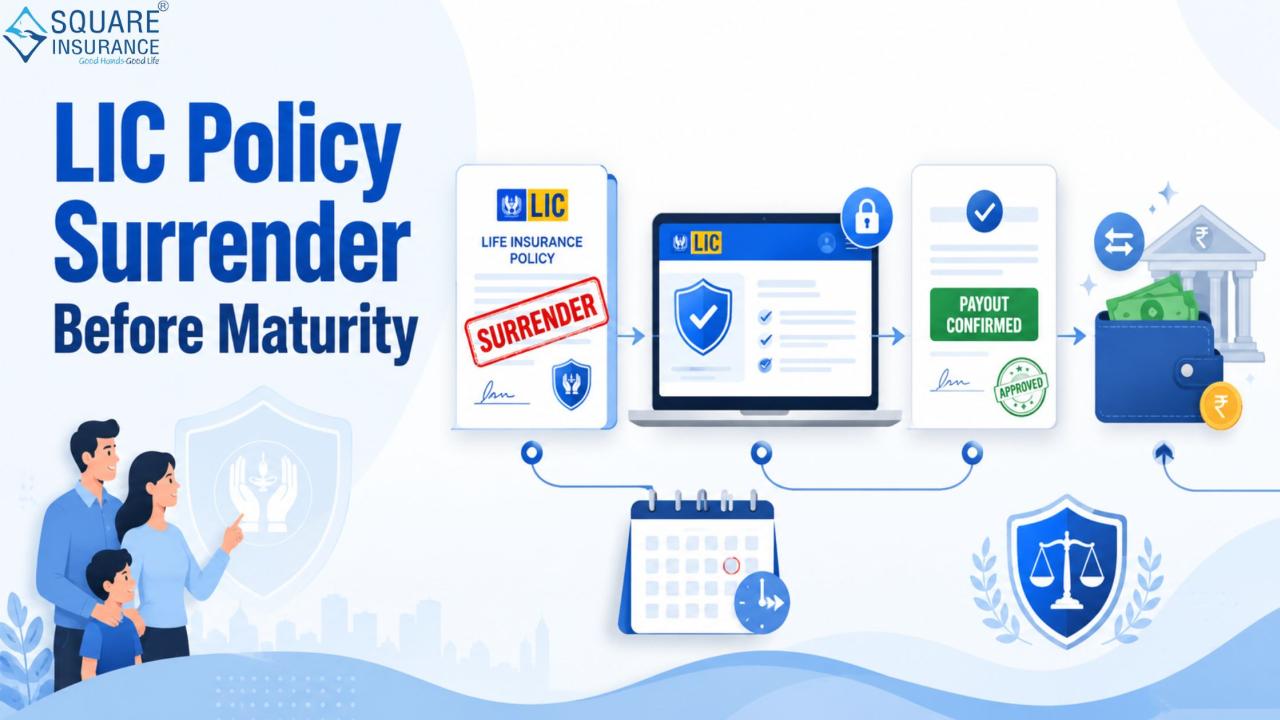
Step-by-Step Process to Surrender an LIC Policy
Step 1: Review Policy Eligibility
Check whether your policy has acquired surrender value by reviewing policy terms or contacting LIC.
Step 2: Obtain the Surrender Form
Visit the nearest LIC branch office and collect the policy surrender form.
Step 3: Fill in Required Details
Provide accurate policy information, bank account details, and personal information.
Step 4: Attach Necessary Documents
Submit all required documents along with the surrender request.
Step 5: Verification Process
LIC officials verify the policy status and submitted documents.
Step 6: Receive Surrender Value
After successful verification, the surrender amount is credited directly to the registered bank account.
Alternatives to LIC Policy Surrender Before Maturity
Before surrendering a policy, policyholders may consider other options.
Convert into Paid-Up Policy
Instead of surrendering, the policy can be converted into a paid-up policy after meeting minimum premium requirements. This allows reduced benefits without future premium payments.
Policy Loan
Many LIC policies offer loan facilities against the policy value. This option provides liquidity while keeping the policy active.
Revival of Lapsed Policy
If premiums have not been paid recently, policyholders can explore revival options instead of surrendering.
Partial Withdrawals
Certain plans may offer withdrawal options without terminating the entire policy.
Factors to Consider Before Surrendering Your LIC Policy
Before making a final decision, evaluate:
- Current financial needs
- Future insurance requirements
- Available surrender value
- Alternative funding sources
- Tax implications
- Impact on long-term financial goals
Consulting a financial advisor can help determine whether surrendering the policy is the most suitable option.
Frequently Asked Questions (FAQs)
Q1. What is LIC Policy Surrender Before Maturity?
It is the process of terminating an LIC policy before its maturity date and receiving the eligible surrender value as per policy terms.
Q2. How many years should premiums be paid before surrendering an LIC policy?
Most LIC policies acquire surrender value after at least two or three years of premium payments, depending on the policy type.
Q3. Is the surrender value equal to the total premium paid?
No. The surrender value is usually lower than the total premiums paid, especially during the early years of the policy.
Q4. Can I surrender my LIC policy online?
The surrender process generally requires submission of documents at the LIC branch office, though procedures may vary based on policy type and LIC guidelines.
Q5. What happens to bonuses after policy surrender?
Future bonuses stop after surrender. Depending on policy conditions, certain vested bonuses may be included in the surrender value calculation.
Conclusion
Understanding LIC Policy Surrender Before Maturity is crucial before making any financial decision related to your life insurance policy. While surrendering can provide immediate liquidity and financial flexibility, it may also result in lower returns, loss of insurance protection, and forfeiture of future benefits. Therefore, policyholders should carefully evaluate their financial goals, policy value, and alternative options before proceeding.
For individuals seeking expert guidance on insurance planning, policy management, and informed decision-making, Square Insurance can help simplify the process and support better financial outcomes.