Introduction: The Future of Sales Operations
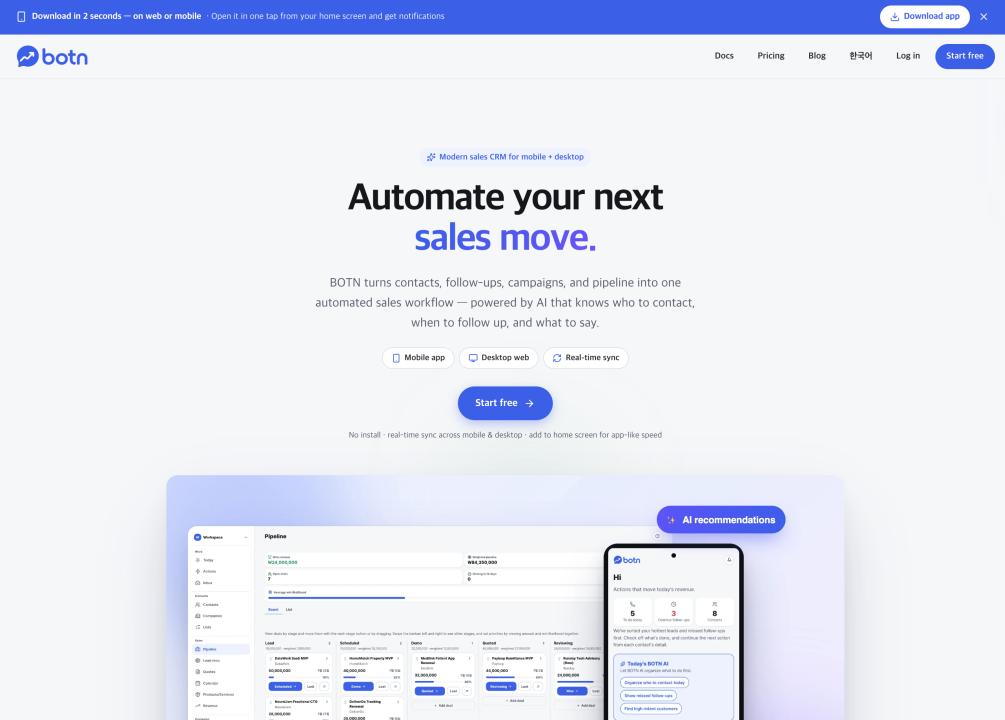
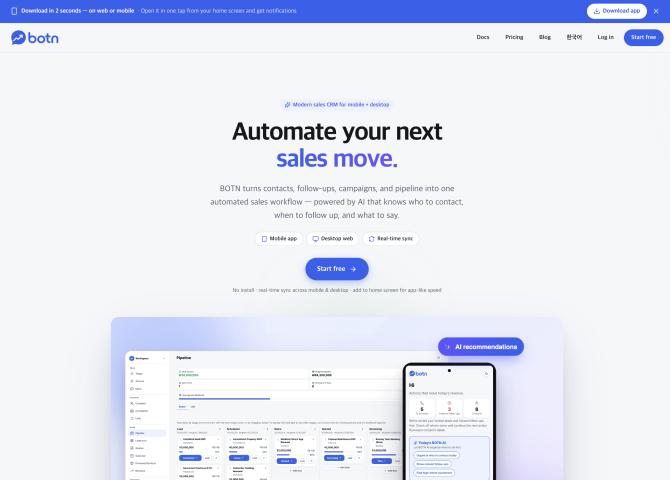
The sales technology landscape is experiencing a fundamental shift. While traditional CRM platforms like Salesforce, HubSpot, and Pipedrive have dominated for decades, a new generation of AI-powered sales solutions is emerging—tools that don't just store customer data but actively guide sales teams toward revenue-generating actions. BOTN represents this evolution: a sales automation OS that consolidates contacts, campaigns, and pipelines while an intelligent AI layer recommends the next best move in every customer interaction.
In an era where sales teams face unprecedented pressure to do more with fewer resources, the promise of intelligent sales automation is compelling. But can BOTN deliver on this vision, and what does it mean for the broader sales technology ecosystem?
What Is BOTN? Understanding the Platform
BOTN describes itself as a sales automation OS—not merely a CRM tool, but an operating system for sales operations. This distinction matters. Traditional customer relationship management systems are repositories: you input data, create records, and manually navigate workflows. BOTN flips this paradigm by introducing AI-driven recommendations at every step.
The platform consolidates four critical sales infrastructure layers:
Contact Management & Customer Data: BOTN functions as an advanced contact management system that goes beyond storing email addresses and phone numbers. It integrates comprehensive customer data management, including interaction history, preferences, behavioral signals, and relationship context. This unified customer relationship management view means every team member understands the full context of every customer.
Campaign Management & Execution: Rather than treating campaigns as separate entities, BOTN integrates campaign management into the broader sales workflow. Sales teams can create, execute, and track campaigns directly within the platform, with AI suggesting optimal timing and messaging.
Sales Pipeline & Opportunity Tracking: The pipeline management software visualization offers real-time insights into where deals stand, enabling opportunity tracking from initial lead capture through sales closure. This deal management functionality replaces outdated spreadsheets.
AI-Powered Recommendations: The differentiator. BOTN's AI sales engine analyzes patterns across your customer base and actively recommends who to contact, when, and what to say—a feature most traditional sales CRM platforms lack entirely.
Core Features: How BOTN Works in Practice
Intelligent Lead Management & Segmentation
Lead management in BOTN moves beyond passive lead tracking. The platform's AI automatically segments prospects using behavioral data, engagement patterns, and buying signals. This customer segmentation automation eliminates manual classification and ensures sales teams focus on high-probability opportunities.
For organizations running multiple lead generation initiatives, BOTN provides a centralized lead management system that captures, qualifies, and routes leads intelligently. Teams no longer waste time on administrative tasks; instead, they focus on actual conversations.
Automated Follow-Up & Workflow Optimization
Follow-up automation is one of BOTN's headline features. Sales professionals spend extraordinary amounts of time managing follow-up sequences—remembering who needs contact, when they last communicated, and what the next step should be. BOTN automates this entirely, recommending follow-ups based on AI analysis of historical conversion patterns.
This sales workflow automation extends to task management, calendar integration, and sales activity tracking. When a salesperson checks the app, they see a prioritized queue of actions sorted by likelihood of conversion—pure sales productivity optimization.
Real-Time Synchronization Across Devices
BOTN's mobile CRM functionality ensures field teams access the same data as desk-bound colleagues. Real-time data synchronization means a salesperson can update a customer record from a coffee shop, and that information is instantly available to their manager, colleagues, and the AI recommendation engine. This mobile-first design is essential for modern sales teams that increasingly operate outside traditional office environments.
Sales Analytics & Forecasting
The platform includes sophisticated sales analytics and sales forecasting capabilities. Rather than gut-feel projections, managers can rely on AI-driven pipeline reporting that accounts for historical conversion rates, cycle length, and seasonal patterns. This data-driven approach to sales management reduces surprises and enables better planning.
The Competitive Landscape: Where BOTN Fits
The sales technology market is crowded. Established players dominate through feature completeness and brand recognition:
Salesforce remains the market leader, offering enterprise-grade sales force automation with near-infinite customization. However, it's complex, expensive, and often overwhelming for small teams.
HubSpot targets mid-market companies with a more user-friendly sales CRM that balances features with accessibility. Its AI sales assistant capabilities have grown substantially, but the core remains a traditional platform with AI bolted on.
Pipedrive focuses on visual pipeline management and appeals to teams obsessed with deal tracking. It's lightweight and fast, but limited in automation capabilities.
Freshsales and Zoho CRM offer budget-friendly alternatives with decent feature sets.
BOTN enters this landscape with a distinctly different philosophy: automation-first design rather than feature-first. Instead of overwhelming users with capabilities they'll never use, BOTN prioritizes intelligent sales automation and AI-powered guidance. This approach resonates particularly with:
- Sales teams exhausted by administrative overhead
- Startups and SMBs lacking dedicated sales operations personnel
- B2B sales organizations managing multiple parallel sales processes
- Mobile-first sales forces that spend more time in the field than at desks
- Teams seeking a personal CRM experience rather than enterprise software
The AI Question: How Smart Is the Intelligence?
The critical question for any AI-powered CRM is: how intelligent is the actual intelligence? Generic machine learning produces generic recommendations. Effective AI learns your business, your market, and your sales motion.
BOTN's AI engine reportedly:
- Learns from historical patterns: The system analyzes past successful interactions to identify what works in your specific context
- Recommends contact timing: Based on when past customers have responded positively
- Suggests messaging: Drawing from successful pitches and language patterns
- Prioritizes leads: Ranking prospects by conversion probability
- Identifies at-risk deals: Flagging opportunities showing warning signs
Whether this delivers transformative value or incremental improvement likely depends on data quality, implementation, and your specific sales context. A B2B SaaS company with predictable sales cycles may see dramatically better recommendations than a service business with highly variable deal structures.
Implementation & Onboarding Considerations
For potential adopters, critical questions include:
Data Migration: How easily can existing customer data from other CRM systems migrate into BOTN? Poor data quality will undermine AI recommendations from day one.
Learning Curve: How quickly can sales teams become productive? If onboarding takes months, adoption will suffer.
Integration Ecosystem: Does BOTN integrate with email, calendar, communication platforms, and other tools your team uses daily? A mobile CRM that doesn't sync with Outlook or Gmail creates friction.
Customization: Can teams tailor workflows to their specific sales processes, or does BOTN force a one-size-fits-all approach?
Pricing: Does the model scale reasonably for growing teams, or does it become prohibitively expensive?
These practical considerations often determine success or failure, regardless of platform capabilities.
The Broader Trend: AI-First Sales Technology
BOTN's emergence reflects a larger industry trend: sales technology is shifting from management tools (helping teams organize existing activity) to guidance systems (actively directing teams toward revenue-generating activities).
This evolution makes sense. Sales productivity has plateaued despite decades of CRM innovation. Technology alone doesn't improve performance—guidance does. A salesperson who knows they should call Prospect X right now is more effective than one drowning in a CRM interface searching for context.
AI-powered sales platforms that combine comprehensive customer data with intelligent recommendations represent the next wave. Whether BOTN specifically wins market share depends on execution, pricing, and how effectively it learns from real sales data. But the underlying concept—intelligent sales automation guiding teams toward better outcomes—is the future of sales operations.
What Sales Teams Should Consider
If your organization is evaluating BOTN or similar AI sales platforms, focus on:
- Specificity: How well does the AI understand your specific sales motion versus generic best practices?
- Data Quality: Garbage in, garbage out. Can the platform work with your existing customer data?
- Workflow Integration: Does it fit naturally into how your team actually works, or require significant process changes?
- Scalability: Can it grow with your team without exponential cost increases?
- Learning Curve: Can salespeople start seeing value within days, not weeks?
- Transparency: Can you understand why the AI recommends specific actions, or is it a black box?
Conclusion: The Evolution of Sales Operations
BOTN represents an important inflection point in sales technology evolution. Rather than asking "how do we organize more customer data," the platform asks "how do we guide salespeople toward better decisions." This shift from passive repository to active guidance system reflects deeper changes in how sales work will be done.
Whether BOTN specifically becomes a market leader matters less than the underlying concept: AI-powered sales automation that reduces administrative burden while improving decision quality is increasingly necessary. Traditional CRM platforms that ignore this trend risk commoditization.
For sales leaders tired of watching their teams drown in administrative work, platforms like BOTN offer a compelling alternative—one built around the principle that better sales technology should make the job easier, not harder. Whether it delivers on that promise ultimately depends on implementation, but the direction is clear: the future of sales operations is intelligent, automated, and AI-driven.