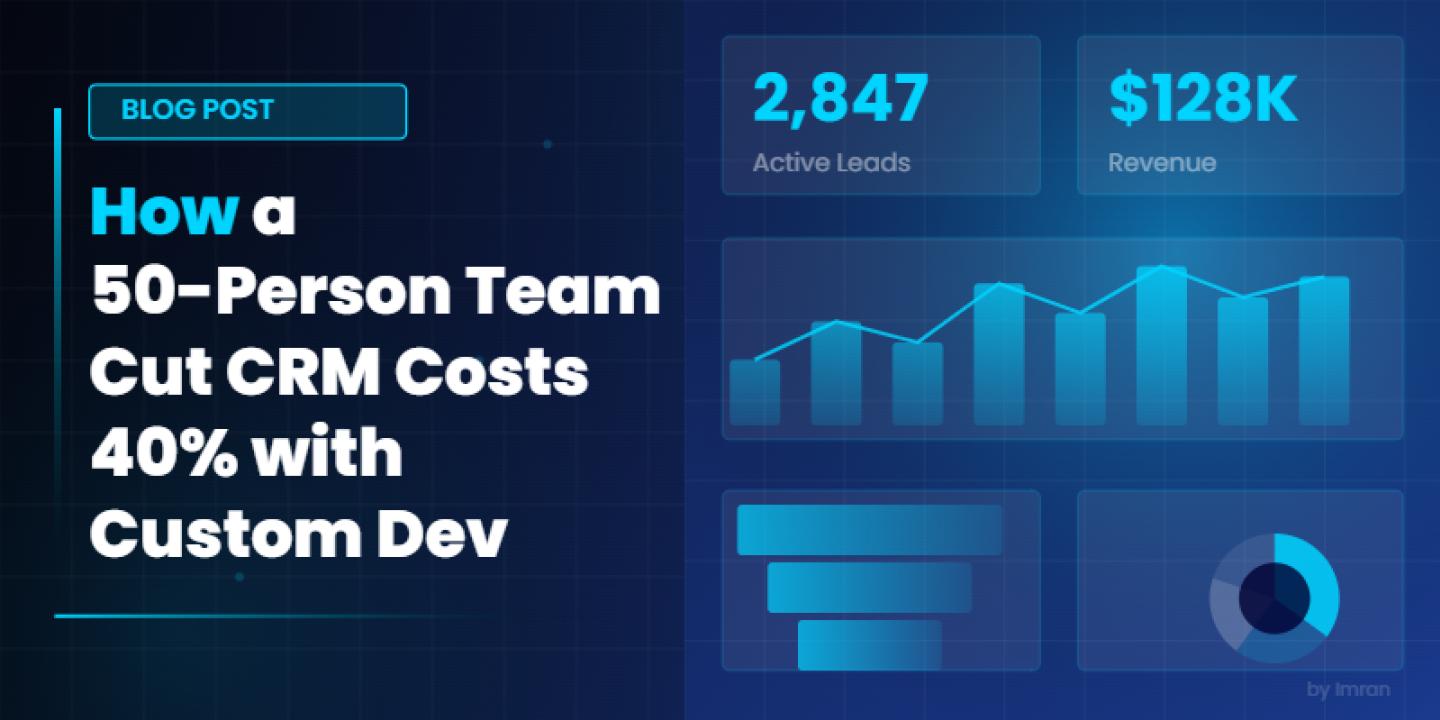
Most growing businesses hit the same wall around the 40–60 employee mark. The CRM they picked two years ago made sense at 15 people. Now it's slow, bloated with features nobody uses, and expensive enough that the finance team has started asking questions.
That's what happened to a mid-sized B2B sales operation — 50 people, three departments, and a Salesforce bill that was climbing every quarter regardless of whether the team was actually getting more value out of it.
The Problem with Paying for Platform Breadth
Enterprise CRM platforms are built for the widest possible customer base. You pay for marketing automation you don't use, AI forecasting that doesn't fit your sales cycle, and integrations built for industries completely unlike yours.
This team was using roughly 30% of their CRM's features. The remaining 70% was just overhead — financially and operationally. Every new hire added another seat license. Customizing anything required a certified consultant. Pulling reports meant exporting to spreadsheets because the built-in analytics didn't match how their pipeline actually worked.
Sound familiar?
What Custom CRM Development Actually Looked Like
They engaged a CRM software development company to audit their actual usage before writing a single line of code. That audit identified three things:
- Lead management and assignment — the daily workflow that needed to be fast and frictionless
- Pipeline tracking — tied directly to their internal sales stages, not a generic template
- Reporting — built around the four metrics their leadership actually reviewed each week
Everything else got cut. No bloat. No unused modules sitting in the sidebar.
The resulting system cost less to build than one year of their previous platform subscription — and carried no recurring per-seat licensing.
Where the 40% Cost Reduction Came From
It wasn't just license elimination. The savings came from multiple places:
- No per-seat fees as the team grew from 50 to 65 people during the same period
- Fewer manual workarounds — staff were spending hours each week exporting data and reformatting reports; that time was recovered
- Faster onboarding for new reps because the interface matched their actual process instead of requiring training around platform quirks
- One integration built properly between the CRM and their invoicing tool, replacing a three-step manual handoff that caused billing delays
None of these are abstract efficiency gains. Each one had a real number attached to it when the team reviewed costs twelve months later.
What to Look for in a Development Partner
The difference between a CRM that saves money and one that creates new problems is mostly in the discovery phase. A team offering CRM software development services should spend time understanding your sales workflow before proposing any architecture.
Questions worth asking:
- Do they document your existing process before scoping the build?
- Can they show examples of integrations with tools you already use?
- Do they include post-launch support, or hand off and disappear?
A platform that fits 30 businesses moderately well will always cost more to maintain than one built for your specific team.
The Decision Is Operational, Not Just Financial
Switching off a major CRM platform feels risky. You're moving contacts, retraining staff, and trusting that the new system won't break during a busy quarter.
But staying on a platform that doesn't fit your process has its own cost — and it compounds. Every quarter you spend on unused licenses is a quarter you're not spending on the team or tools that actually move revenue.
Arobit Business Solutions Pvt. Ltd. builds CRM systems around how your team actually works. If you're paying for a platform and using a fraction of it, it's worth talking through what custom CRM development services could look like for your setup.
Conclusion
A 50-person team cutting CRM costs by 40% isn't a surprising outcome when the root cause is straightforward — they were paying for software built for everyone, not for them. Custom development fixed that. The platform got smaller, faster, and cheaper. The team got a tool that matched their workflow from day one.
Frequently Asked Questions
How much does it cost to build a custom CRM compared to buying an off-the-shelf platform?
The upfront cost of building a custom CRM is typically higher than the first year of a SaaS subscription. But most teams recoup that within two to three years, especially once you factor in per-seat licensing that scales with headcount, paid add-ons, and consultant fees for platform customization. For teams above 30–40 people with stable workflows, custom development often costs less over a four-year window than a comparable enterprise platform license.
Will a custom CRM integrate with the tools we already use?
Yes, provided those tools have accessible APIs — which most business software does. Integrations with email platforms, invoicing tools, marketing automation, and support desks are standard in custom CRM builds. The advantage over off-the-shelf platforms is that integrations get built for your actual data flow, not a generic middleware connection that requires ongoing maintenance.
How long does it take to build a custom CRM for a mid-sized team?
A core CRM covering lead management, pipeline tracking, and reporting typically takes three to five months to build and deploy. More complex builds with multi-team workflows, advanced analytics, or deep third-party integrations run six to nine months. The timeline depends heavily on how clearly the requirements are defined upfront — which is why the discovery and scoping phase matters more than most teams expect.