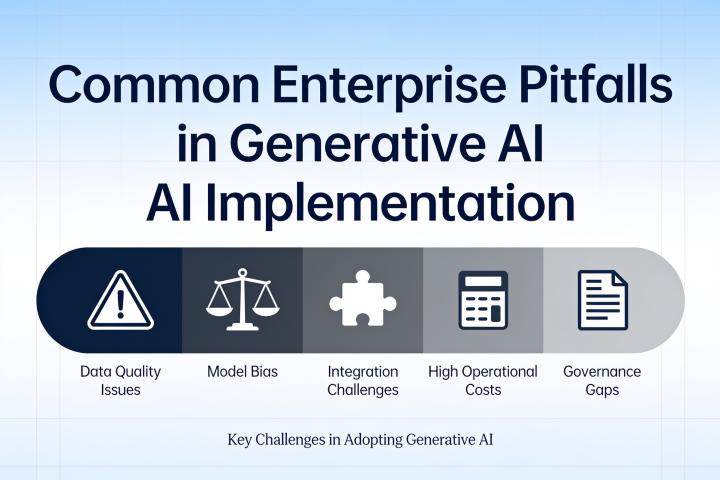
Generative AI has moved past the demo stage. The question for most enterprises in 2026 is no longer whether to build, but why so many builds stall. MIT's NANDA research found that roughly 95% of enterprise generative AI pilots deliver zero measurable return. The technology usually works. The execution around it does not.
Here are the pitfalls that derail enterprise generative AI projects and how to avoid them.
Why Do Most Generative AI Projects Fail?
Most generative AI projects fail because organizations start building before defining a measurable business outcome, lack AI-ready data, and underestimate integration with existing systems. The model is rarely the problem. Gartner expects 60% of AI projects without AI-ready data to be abandoned through 2026, and internal-only builds fail at roughly twice the rate of vendor-supported ones.
That gap between a working pilot and a production system is where budgets quietly disappear.
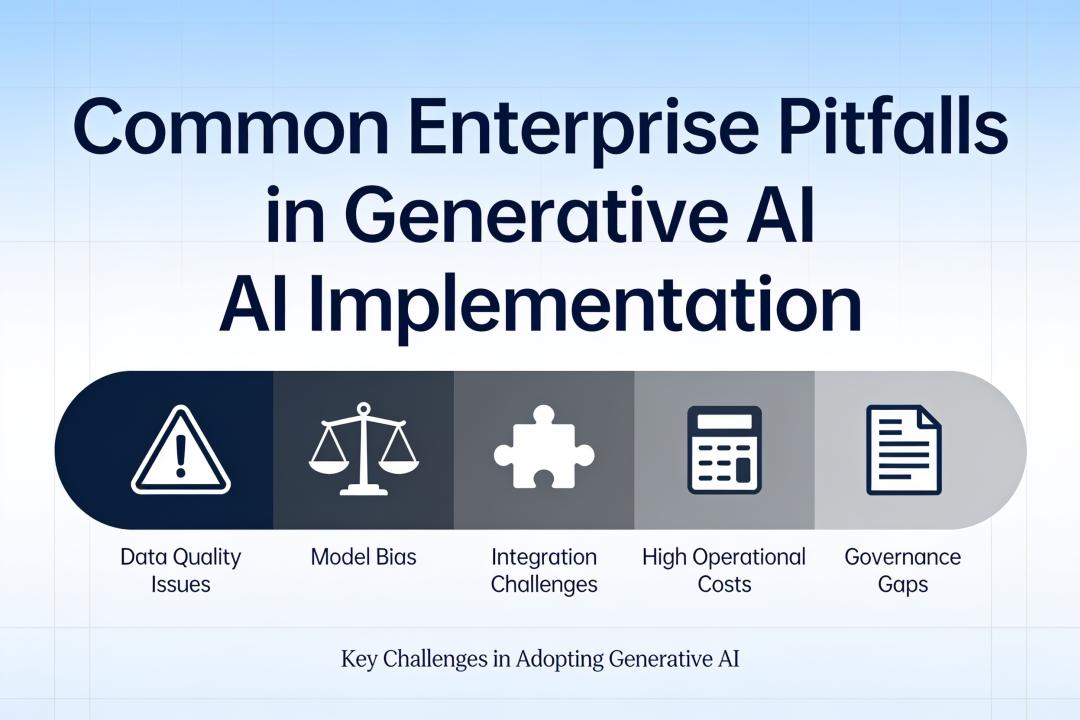
The Most Common Pitfalls in Generative AI Implementation
1. Starting With Technology Instead of a Business Problem
Teams often pick a model first and look for a use case later. Without a production success metric defined on day one (hours saved, error rate reduced, cycle time cut), nothing pushes a pilot toward deployment. Choose one outcome that shows up in the P&L, then pick the approach.
2. Treating Data Readiness as an Afterthought
Generative AI solutions are only as reliable as the data feeding them. Scattered, unlabeled, or permission-tangled data produces inconsistent output and compliance risk. Before any build, audit where your data lives, who can access it, and how current it stays.
3. Underestimating Integration Complexity
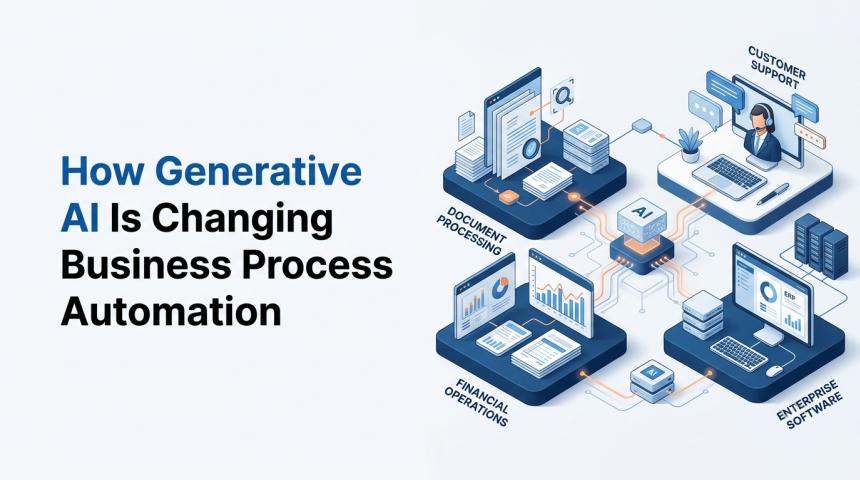
A pilot that talks to a clean sandbox is easy. Connecting generative AI to ERP layers, ticketing systems, CRMs, and knowledge bases is where projects multiply in difficulty. This integration layer is the single most underestimated cost. Strong Generative AI Integration Services plan for it from the start rather than bolting it on later.
4. Ignoring Accuracy and Hallucination Risk
A model that sounds confident and is wrong creates more work than no model at all. Retrieval-augmented generation (RAG), which grounds output in your own verified sources, has become the default fix in 2026. Pair it with evaluation checks and human review for high-stakes decisions.
5. No Plan for Cost at Scale
Infrastructure costs frequently run three to five times initial projections once a system hits real volume. Large-model and multimodal inference is expensive. Many teams now mix smaller, domain-specific models for routine tasks and reserve larger models for complex ones, keeping spend predictable.
6. Skipping Change Management
A 10/20/70 split (roughly 10% algorithms, 20% technology, 70% people and process) separates programs that scale from pilots that die. If the people meant to use the tool were not part of building it, adoption stalls no matter how good the output is.
2026 Trends Shaping Enterprise Generative AI
Several shifts are changing how successful teams build this year:
- Agentic AI. Gartner expects 40% of enterprise applications to embed task-specific AI agents by the end of 2026. The move is from chatbots that answer to agents that plan and act under human oversight.
- Smaller, domain-specific models. Narrow models fine-tuned on industry data now beat general-purpose giants on accuracy, cost, and compliance fit.
- RAG as a governed knowledge layer. Retrieval is no longer a bolt-on. It is becoming the controlled source of truth, with permissions, freshness rules, and audit logs.
- AI governance as engineering. With the EU AI Act in force, explainability and auditability are product requirements, not policy slides. Chief AI Officer roles are now common in large organizations.
The pattern is consistent: less experimentation, more disciplined, production-grade builds.
How to Choose a Generative AI Development Company
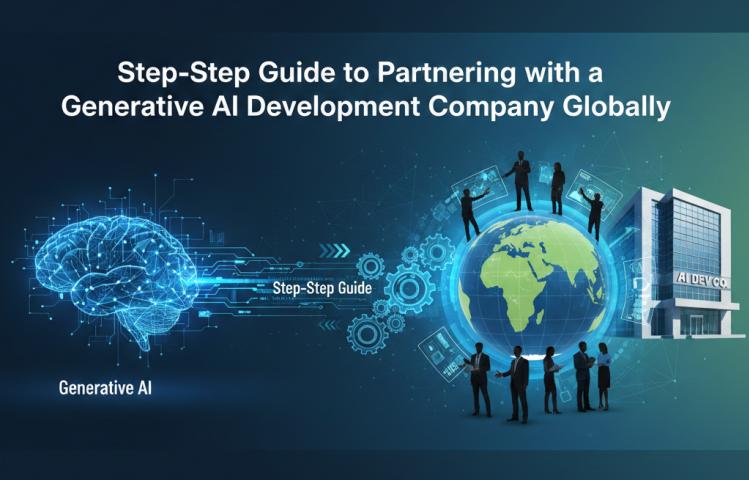
The data is clear on one point. Buying from a specialized vendor reaches production far more often than building everything in-house. When evaluating a Generative AI development company or AI Consulting Company, weigh these factors:
- Production track record, not just demos. Ask for systems running in the P&L, not proofs of concept.
- Integration depth. Can they connect to your actual systems of record, not a sandbox?
- Governance and security. Audit logs, access controls, and a clear answer on data handling.
- Knowledge transfer. The capability should stay with your team after the engagement, not walk out with the consultant.
Good AI Integration Services treat your existing stack, data, and people as the starting point, not an obstacle.
Frequently Asked Questions
- What is the biggest reason enterprise generative AI projects fail? The most common cause is starting development without a defined, measurable business outcome. Without a production target, pilots never build the momentum to scale.
- What are Generative AI Development Services? They cover strategy, data preparation, model selection, custom build or fine-tuning, integration with business systems, and ongoing support to take a use case from idea to production.
- How long does generative AI implementation take? For projects that reach production, the typical path from prototype to deployment runs around eight months, shortened by clear scope and AI-ready data.
- Should an enterprise build in-house or hire a generative AI development company? Specialized vendors reach production roughly twice as often as internal-only builds, mainly because of integration and governance experience. Many enterprises use a hybrid model.
Moving From Pilot to Production
The companies pulling ahead in 2026 are not the ones with the flashiest demos. They are the ones treating generative AI as an engineering and change-management problem, grounded in real data, measurable goals, and proper integration.
If you are planning an enterprise build and want to avoid these pitfalls, exploring proven Generative AI Development Services is a practical next step toward a system that actually reaches production.