Enterprise AI adoption is accelerating at a pace few organizations anticipated. AI copilots are helping employees draft content, analyze data, summarize meetings, answer questions, and automate repetitive tasks. What began as isolated productivity experiments is quickly becoming a core component of enterprise operations.
For CIOs, this presents both an opportunity and a challenge.
The opportunity is clear: AI assistants can improve efficiency, reduce manual work, and help organizations scale knowledge across the enterprise. The challenge is maintaining visibility and control once these systems are deployed.
Many organizations invest heavily in model selection, prompt engineering, and deployment strategies. Far fewer invest in understanding how their AI assistants behave after they go live.
This is where AI assistant observability becomes critical.
Without observability, enterprises have limited visibility into what AI systems are doing, what information they are accessing, how they are making decisions, and whether they are operating within organizational policies.
Before deploying AI copilots at scale, CIOs must ensure they have the monitoring and governance capabilities necessary to manage risk, maintain compliance, and build trust in AI systems.
Why AI Copilots Are Becoming Enterprise Infrastructure
AI assistants are no longer experimental tools.
Organizations are embedding them into:
- Customer service operations
- Employee productivity platforms
- IT service management
- Sales enablement
- Knowledge management systems
- HR workflows
- Financial operations
Modern AI copilots often connect to:
- Enterprise databases
- Internal documentation
- CRM platforms
- ERP systems
- Collaboration tools
- External APIs
As these integrations expand, AI assistants become deeply embedded within business processes.
The result is that AI assistants increasingly influence decisions, workflows, and outcomes across the organization.
For CIOs, this raises an important question:
How do you monitor systems that continuously learn, reason, retrieve information, and interact with enterprise applications?
What Is AI Assistant Observability?
AI assistant observability is the practice of continuously monitoring and analyzing AI system behavior in production environments.
Unlike traditional application monitoring, observability focuses on understanding how AI systems generate outcomes and interact with users, data, and connected systems.
It provides visibility into:
- User interactions
- Prompts
- Responses
- Retrieval events
- Tool usage
- Agent actions
- Policy violations
- Performance metrics
The goal is not simply to know whether the system is available.
The goal is to understand whether the system is behaving appropriately, securely, and consistently.
Observability transforms AI governance from a reactive process into a proactive capability.
The Hidden Risks CIOs Cannot See Without Observability
Many AI-related risks emerge only after deployment.
Without observability, organizations often discover problems after damage has already occurred.
Hallucinated Responses
AI copilots may generate inaccurate or misleading information while appearing highly confident.
Observability helps identify patterns of unreliable outputs before they affect customers or employees.
Sensitive Data Exposure
AI assistants often access enterprise knowledge repositories containing confidential information.
Monitoring retrieval activity and responses can help detect potential data leakage incidents.
Prompt Injection Attacks
Malicious users may attempt to manipulate AI systems through carefully crafted prompts.
Observability enables organizations to identify suspicious interaction patterns and investigate potential attacks.
Unauthorized Tool Usage
Agentic AI systems may interact with applications and perform actions on behalf of users.
Without monitoring, organizations may have limited visibility into what actions are being executed.
Compliance Violations
Organizations operating in regulated industries require evidence of governance controls and oversight.
Observability provides the data necessary to support compliance reporting and audits.
The Five Pillars of AI Assistant Observability
To effectively govern AI assistants, CIOs should focus on five key observability capabilities.
1. Prompt Monitoring
Understanding user interactions is essential.
Prompt monitoring helps organizations:
- Detect misuse
- Identify emerging risks
- Analyze adoption patterns
- Improve governance policies
Visibility into prompts provides valuable context for understanding AI behavior.
2. Response Monitoring
Organizations should continuously evaluate AI-generated outputs for:
- Accuracy
- Consistency
- Safety
- Policy compliance
Response monitoring helps identify quality issues that traditional system monitoring cannot detect.
3. Retrieval Observability
Many enterprise copilots rely on Retrieval-Augmented Generation (RAG).
Organizations need visibility into:
- Which documents are accessed
- Why information was retrieved
- How retrieved data influences responses
Retrieval observability is critical for maintaining trust and preventing data exposure.
4. Tool and Agent Monitoring
As AI assistants gain autonomy, monitoring tool usage becomes increasingly important.
Organizations should track:
- API calls
- System interactions
- Workflow execution
- Agent decisions
This visibility helps ensure AI assistants operate within approved boundaries.
5. Governance and Compliance Monitoring
Governance requires more than visibility.
Organizations must monitor:
- Policy violations
- Access control failures
- Security events
- Audit requirements
Governance-focused observability helps organizations demonstrate accountability and maintain compliance.
Why Traditional Monitoring Is Not Enough
Most enterprise monitoring tools were designed for deterministic software systems.
AI systems operate differently.
Traditional monitoring focuses on metrics such as:
- CPU utilization
- Memory consumption
- Response times
- System availability
While these remain important, they do not answer critical AI governance questions.
For example:
- Why did the AI generate that response?
- Which data sources influenced the answer?
- Was sensitive information accessed?
- Did the AI follow policy requirements?
- What action did the AI agent execute?
Traditional monitoring tools cannot provide these answers.
AI assistant observability fills this gap.
How Observability Supports Enterprise AI Governance
AI governance is increasingly moving beyond policies and documentation.
Modern governance programs require operational controls.
Observability enables organizations to:
Improve Accountability
Detailed records create transparency around AI interactions and decisions.
Strengthen Security
Continuous monitoring helps detect threats and suspicious behavior.
Support Compliance
Organizations can generate evidence needed for regulatory reviews and audits.
Reduce Operational Risk
Visibility helps identify problems before they impact business operations.
Build Trust
Employees and stakeholders are more likely to trust AI systems when governance mechanisms are visible and effective.
For CIOs, observability is becoming a foundational component of enterprise AI governance.
What CIOs Should Look for in an AI Observability Platform
Not all observability solutions provide the same capabilities.
Organizations evaluating AI observability platforms should prioritize:
Comprehensive Monitoring
Visibility across prompts, responses, retrieval events, and agent actions.
Audit Trails
Detailed records that support investigations and compliance reporting.
Policy Enforcement
The ability to monitor and validate governance controls.
Risk Detection
Automated identification of suspicious or high-risk behavior.
Compliance Reporting
Evidence generation for regulatory and internal governance requirements.
Agent Oversight
Monitoring capabilities designed specifically for autonomous AI systems.
The best platforms combine observability, governance, security, and compliance into a unified operational framework.
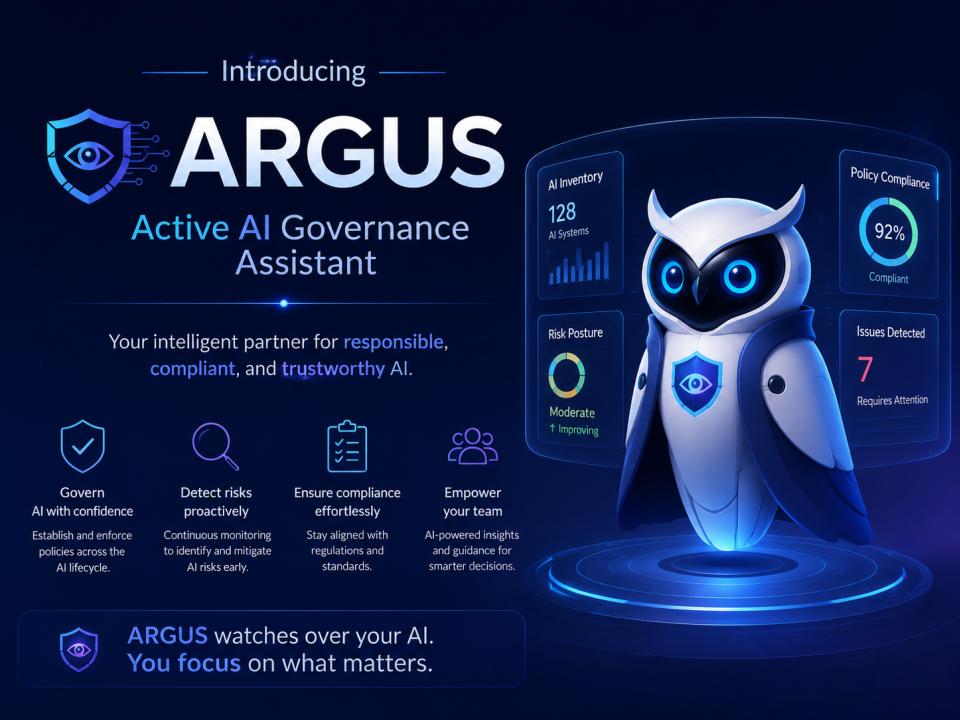
How Argus AI Assistance Enables AI Observability
As enterprises deploy AI copilots, governance challenges grow alongside adoption.
Argus AI Assistance helps organizations establish visibility and control across AI-powered workflows.
Key capabilities include:
- Continuous monitoring of AI interactions
- Audit trails for prompts, responses, and system actions
- Risk detection and governance insights
- Policy enforcement support
- AI assistant and agent oversight
- Compliance-focused reporting and traceability
By providing observability across the AI lifecycle, organizations can better understand how AI systems operate and respond proactively to emerging risks.
Conclusion
AI copilots are rapidly becoming part of enterprise infrastructure.
As organizations expand deployment across departments and business functions, visibility becomes just as important as functionality.
CIOs who focus solely on deployment risk creating governance blind spots that can lead to security incidents, compliance challenges, and operational failures.
AI assistant observability provides the transparency necessary to monitor AI behavior, investigate incidents, enforce policies, and maintain trust in enterprise AI systems.
The organizations that successfully scale AI will not be those that deploy the most copilots.
They will be the ones that can observe, govern, and control them effectively.
In the era of enterprise AI, observability is no longer optional—it is a prerequisite for responsible deployment.