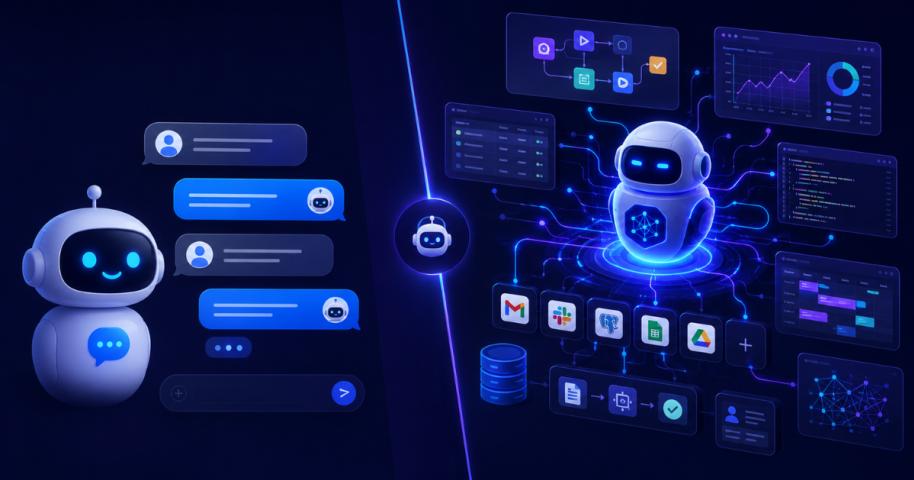
Generative AI has largely focused on producing responses, summarizing information, and assisting employees. The next stage is more action-oriented: AI agents can work toward defined goals, use business tools, interact with enterprise systems, and execute multi-step workflows with varying levels of autonomy.
For businesses, however, the challenge is not simply determining whether AI agents are technically possible. The more important questions are where they should be deployed, which processes are suitable, how much autonomy they should have, and how they can operate reliably at scale.
This is where AI agent consulting becomes valuable. A structured consulting approach connects business objectives with AI agent architecture, implementation planning, governance, and measurable outcomes, helping organizations move from an AI idea to a production-ready strategy.
What Is AI Agent Consulting?
AI agent consulting is the process of identifying, designing, validating, and planning AI agents around specific business workflows and objectives. It goes beyond building a chatbot or connecting an LLM to a few APIs.
Depending on the organization and use case, AI agent consulting services can include:
- Business and workflow assessment
- AI readiness evaluation
- AI agent use-case discovery
- AI agent architecture design
- Model and technology selection
- Tool and API integration planning
- Data and knowledge integration
- Security and governance planning
- Proof-of-concept development
- Evaluation and validation
- Production deployment planning
- Monitoring and optimization
The goal should be an actionable implementation plan rather than a generic strategy document. Effective consulting establishes what should be built, why it should be built, how it should operate, and what controls are required before development begins.
Why Businesses Need an AI Agent Strategy Before Development
Organizations can quickly build an impressive AI agent prototype. The harder task is determining whether that prototype solves a meaningful business problem and can operate reliably in production.
Starting development without an AI agent strategy can create several challenges. The selected workflow may have unclear ROI, insufficient data, complex integrations, sensitive permissions, or no practical way to evaluate agent performance.
A scalable strategy should define:
- The business objective and expected outcome
- The workflow the agent will handle
- Systems and data the agent can access
- Tools and APIs it can use
- Its level of autonomy
- Permission boundaries
- Human escalation requirements
- Performance and business metrics
- Security and governance controls
This distinction is important: AI strategy consulting identifies where AI can create value, while AI agent consulting translates those opportunities into an executable architecture and production roadmap.
How to Identify the Right AI Agent Use Cases
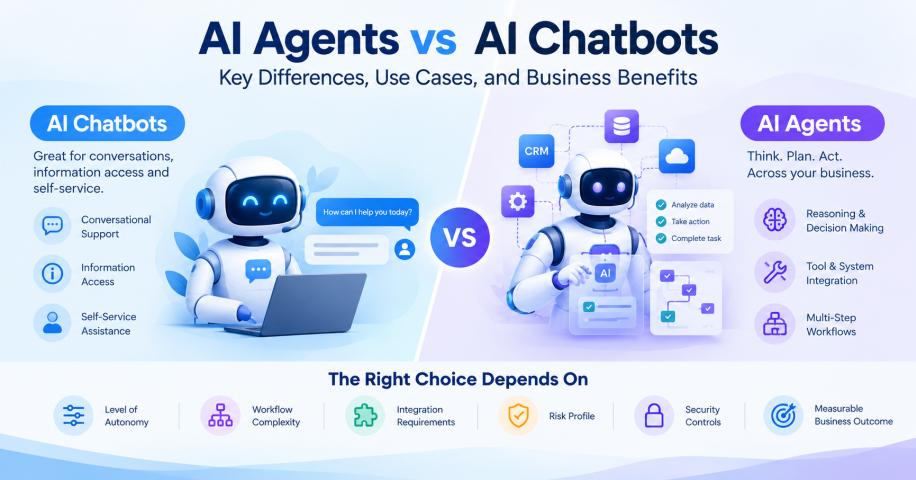
Not every business process needs an autonomous AI agent. In some situations, conventional software, workflow automation, a rules engine, or a chatbot may provide a simpler and more predictable solution.
AI agents become more relevant when workflows involve several characteristics, such as:
- Repetitive knowledge work
- Multiple systems or business tools
- Unstructured information
- Multi-step decision processes
- Frequent exceptions
- Significant manual coordination
- Decision support
- Clearly measurable outcomes
For example, an enterprise might evaluate an agent that gathers information from multiple internal systems, analyzes documents, prepares a recommendation, and routes the result to an employee for approval.
The objective is not maximum autonomy. It is appropriate automation.
Organizations should therefore assess each opportunity according to business value, workflow complexity, feasibility, data readiness, integration requirements, risk, and the level of human oversight required.
Building a Scalable AI Agent Architecture
A scalable AI agent architecture should be designed around the business workflow rather than around a particular model or technology.
Depending on the use case, an architecture may include:
- Foundation models or LLMs
- Agent reasoning and planning
- AI agent tools
- API and enterprise system integrations
- Retrieval-augmented generation (RAG)
- AI agent memory and context management
- Orchestration
- Multi-agent systems
- Observability and logging
- AI agent evaluation
- Security and permission controls
- Human-in-the-loop workflows
Tool-using LLM agents can retrieve information, call APIs, update systems, or initiate predefined actions. RAG can connect agents with enterprise knowledge, while orchestration coordinates tasks across tools, models, or multiple specialized agents.
Multi-agent architectures may be useful when different agents have clearly defined responsibilities, but they should not be introduced simply because they are technically interesting. Additional agents also introduce more complexity in communication, monitoring, evaluation, and governance.
Current enterprise architectures are also increasingly concerned with standardized tool and context connectivity, including approaches such as the Model Context Protocol (MCP). The underlying principle remains the same: integrations should be secure, controlled, observable, and aligned with the business process.
From AI Agent Prototype to Production
A successful demonstration is not necessarily a production-ready AI agent.
A practical progression looks like this:
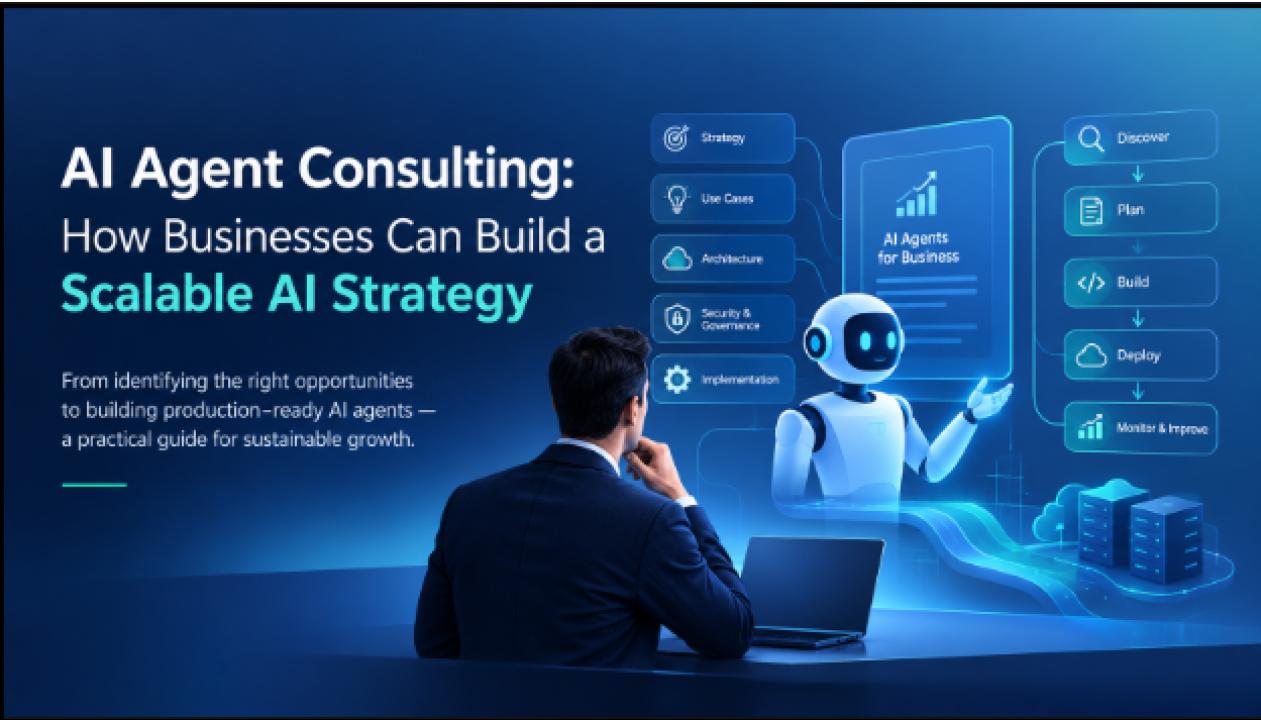
Use-case discovery → feasibility assessment → architecture → PoC → evaluation → controlled pilot → production deployment → monitoring → optimization
During the proof-of-concept stage, teams can validate whether the agent can perform its intended workflow. Before production deployment, however, organizations need to evaluate additional factors.
These include:
- Accuracy and task completion
- Reliability
- Response latency
- Operating cost
- Tool and API failures
- Hallucinations
- Security
- Permission boundaries
- Auditability
- Human escalation
- Performance monitoring
A controlled pilot can help identify problems that may not appear during a limited demonstration.
This is where an experienced AI agent development company can connect consulting with implementation. Once the strategy and architecture are validated, development teams can build, test, integrate, deploy, and continuously improve the system.
Security, Governance and Human Oversight
Enterprise AI agents require controlled autonomy. An agent that can access business systems or perform actions needs clearly defined boundaries around what it can see and what it can do.
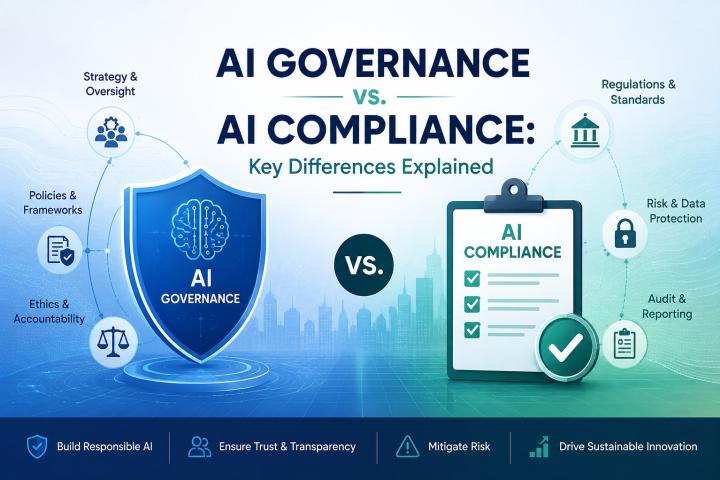
An enterprise AI governance framework may include:
- Role-based permissions
- Controlled tool access
- Authentication and authorization
- Data privacy controls
- Audit trails
- Guardrails
- Human approval for sensitive actions
- Monitoring and evaluation
- Fail-safe mechanisms
Human-in-the-loop AI is particularly important for workflows involving financial transactions, sensitive customer information, legal decisions, privileged system access, or other high-impact actions.
Governance should be treated as an engineering layer of the AI agent architecture rather than something added after deployment.
How AI Agent Consulting Creates Business Value
The business case for AI agents should be based on measurable outcomes rather than broad claims about AI transformation.
Depending on the workflow, organizations may target outcomes such as:
- Reduced manual workload
- Faster business processes
- Improved employee productivity
- Faster customer response
- Better access to organizational knowledge
- More consistent workflows
- Improved decision support
- Greater operational scalability
The important step is establishing a baseline before implementation.
For example, if an existing process takes several hours of employee effort, the organization can measure how much time the AI agent actually saves while also tracking accuracy, exceptions, cost, and employee intervention.
This makes AI agent implementation a measurable business initiative rather than an open-ended technology experiment.
Choosing an AI Agent Development Partner
Businesses evaluating an AI agent development company should look beyond demonstrations and model expertise.
Useful evaluation criteria include:
- AI agent architecture expertise
- Enterprise integration experience
- LLM and RAG capabilities
- Tool and API integration
- Multi-agent expertise where appropriate
- Security and governance practices
- AI agent evaluation methodology
- Production deployment experience
- MLOps or LLMOps capabilities
- Ability to connect strategy with development
- Relevant case studies
- Post-deployment support
- The right partner should be able to explain not only how an agent can be built, but also why a particular architecture is appropriate, what its limitations are, how it will be evaluated, and how it can be operated safely in production.
This is where AI agent development services can naturally follow consulting. Once business priorities and technical requirements are established, development can focus on implementing a clearly defined solution rather than experimenting without measurable objectives.
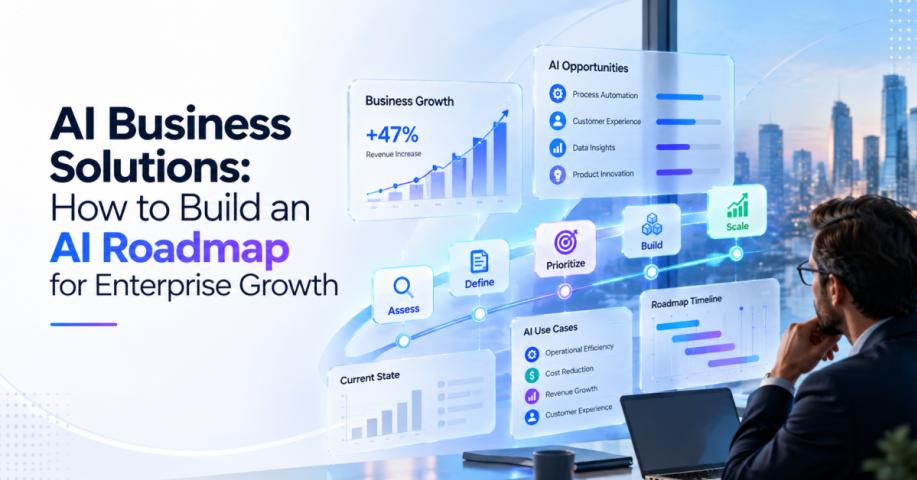
A Practical AI Agent Implementation Roadmap
A structured AI implementation roadmap can help organizations move from opportunity identification to production.
1. Discover — Identify business problems, workflows, bottlenecks, and potential AI agent use cases.
2. Assess — Evaluate data, systems, integrations, feasibility, security requirements, and risks.
3. Prioritize — Select the use case with a practical balance of business value, complexity, feasibility, and measurable outcomes.
4. Design — Define the agent architecture, models, tools, memory, integrations, permissions, and human controls.
5. Prototype — Build a focused proof of concept around the core workflow.
6. Evaluate — Test quality, reliability, cost, latency, security, and failure scenarios.
7. Deploy — Introduce the agent through a controlled production rollout with appropriate monitoring and governance.
8. Optimize — Continuously evaluate performance, improve workflows, refine prompts and tools, and adjust the architecture as business requirements evolve.
Conclusion
Successful enterprise AI adoption is not simply about deploying an autonomous AI system. The real challenge is choosing the right workflow, designing the right architecture, establishing appropriate controls, and continuously measuring business outcomes.
AI agent consulting provides a structured path between business strategy and implementation. It helps organizations determine where AI agents can create meaningful value, what level of autonomy is appropriate, which technologies and integrations are required, and how to move from proof of concept to scalable production deployment.
For organizations ready to turn that strategy into implementation, the next step is typically AI Agent Development Services, where validated use cases can be transformed into secure, integrated, production-ready AI agents.