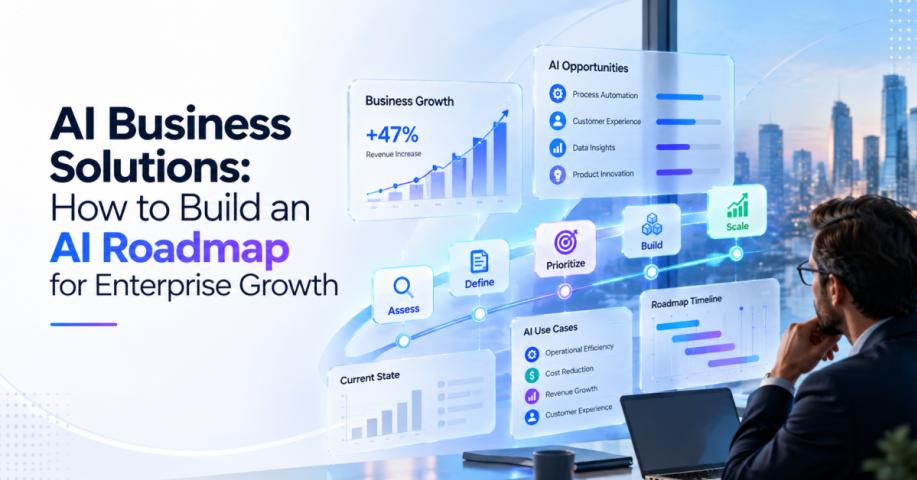
Enterprise AI adoption is moving beyond isolated experiments. Businesses are looking for practical ways to connect artificial intelligence with revenue growth, operational efficiency, customer experience, and long-term competitiveness. Machine learning consulting can help organizations evaluate data-driven opportunities as part of a broader AI roadmap, while AI business solutions can bring together machine learning, generative AI, intelligent automation, predictive analytics, and AI agents to address specific business priorities.
The challenge is not finding ways to use AI. Most enterprises can identify dozens of potential applications. The challenge is deciding which opportunities deserve investment, what capabilities are required, how they should be implemented, and how their business impact will be measured.
A strong enterprise AI roadmap answers one practical question:
What should we implement, why does it matter, and how will we measure the value?
What Should an Enterprise AI Roadmap Contain?
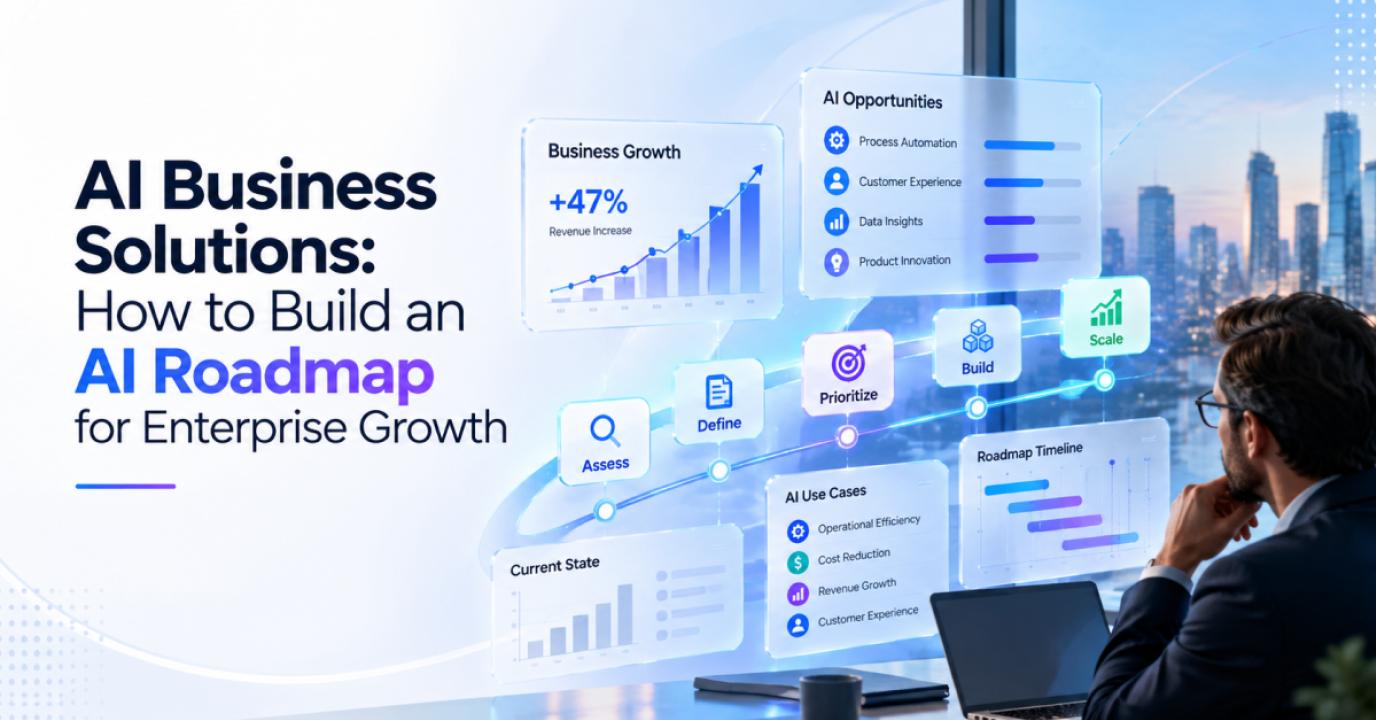
An enterprise AI roadmap should provide a structured path from identifying business opportunities to implementing and scaling AI.
A comprehensive roadmap typically covers: Business objectives and strategic priorities AI opportunity discovery Business process assessment AI use-case prioritization Data and infrastructure readiness Technology selection Generative AI opportunities Machine learning and predictive analytics AI agents and intelligent automation Security and governance Implementation phases Investment requirements ROI and performance measurement
This structure helps organizations avoid treating every AI idea as an immediate development project.
Instead, the roadmap creates a sequence for deciding which initiatives should be explored, validated, implemented, and scaled.
Step 1: Start With Business Objectives
An enterprise AI roadmap should begin with the business strategy.
Before selecting an AI technology, identify the outcomes the organization needs to improve.
These may include: Increasing revenue Reducing operating costs Improving customer retention Increasing employee productivity Accelerating decision-making Improving forecasting Reducing operational risk Creating new digital products or services
For example, a company focused on improving customer retention may prioritize churn prediction, personalized recommendations, or AI-powered customer support.
An organization focused on operational efficiency may instead prioritize workflow automation, document processing, predictive maintenance, or intelligent process optimization.
The technology should support the objective, not become the objective itself.
Step 2: Discover High-Value AI Opportunities
Once business priorities are established, assess where AI can create measurable value.
Review major business processes across functions such as: Sales and Marketing: Potential opportunities include lead qualification, customer segmentation, recommendation systems, sales forecasting, personalization, and content automation. Customer Service: Businesses can explore conversational AI, knowledge assistants, automated ticket classification, sentiment analysis, and agent-assisted support. Operations: AI can support demand forecasting, anomaly detection, predictive maintenance, workflow automation, and resource optimization. Finance: Potential applications include fraud detection, risk analysis, forecasting, document processing, and transaction monitoring. Human Resources: Organizations can explore employee knowledge assistants, workforce analytics, skills analysis, and workflow automation while maintaining appropriate privacy and governance controls.
The objective is to create an opportunity portfolio rather than immediately approve every idea.
Step 3: Assess Business Processes Before Selecting Technology
AI opportunities should be evaluated within the context of the existing business process.
A process assessment should examine Current workflow Manual activities Decision points Data inputs and outputs Systems involved Bottlenecks Error rates Processing time Customer impact Employee effort Existing automation
This helps identify where AI can improve an existing process instead of creating an additional disconnected application.
For example, if employees spend hours reviewing documents before entering information into a business system, the opportunity may involve combining AI-powered document extraction with workflow automation.
The goal is to improve the complete process, not simply add an AI feature.
Step 4: Prioritize AI Use Cases
Most enterprises will discover more AI opportunities than they can implement at once.
That makes prioritization essential.
A practical prioritization framework can evaluate each opportunity based on: Business Value: Estimate its potential contribution to revenue, cost reduction, productivity, customer experience, or risk reduction. Feasibility: Consider data availability, technical complexity, integrations, infrastructure, and organizational readiness. Time to Value: Estimate how quickly the organization can move from implementation to measurable business results. Risk: Evaluate privacy, security, regulatory, operational, model, and reputational considerations. Scalability: Determine whether the solution can expand across departments, business units, products, or geographic markets.
This approach helps organizations distinguish between an interesting AI experiment and an initiative that can become a meaningful business solution.
Step 5: Decide Where Generative AI Fits
Generative AI has expanded the range of enterprise AI applications.
Businesses can use it for activities such as: Enterprise knowledge retrieval Document summarization Content generation Code assistance Customer support Information extraction Report generation Internal productivity assistants Natural-language interfaces
However, enterprises should evaluate generative AI according to the business process and risk profile.
For example, an internal knowledge assistant may require strong access controls and reliable retrieval, while a customer-facing application may require additional testing, monitoring, human oversight, and output controls.
Generative AI should therefore appear in an enterprise roadmap as a business capability with defined controls, not simply as a collection of AI tools.
Step 6: Evaluate AI Agents and Intelligent Automation
AI agents introduce another option for business workflows that involve multiple steps, systems, and decisions.
Traditional automation generally follows predefined rules. AI agents can potentially interpret context, retrieve information, select actions, and execute tasks within defined boundaries.
Potential enterprise applications include: IT service workflows Customer support operations Sales research Internal knowledge workflows Document-driven processes Procurement activities Business process orchestration
However, agent-based solutions are not automatically appropriate for every workflow.
The roadmap should evaluate the level of autonomy required, the systems the agent must access, the consequences of incorrect actions, and the controls needed around those actions.
When a workflow requires multi-step reasoning, system interaction, and controlled task execution, an AI agent development company can help translate the prioritized opportunity into an appropriate agent architecture and implementation plan.
Step 7: Include Machine Learning and Predictive Analytics
Not every enterprise AI opportunity requires generative AI or AI agents.
Traditional machine learning remains relevant for problems involving prediction, classification, forecasting, recommendation, and anomaly detection.
Examples include: Demand forecasting Customer churn prediction Fraud detection Predictive maintenance Risk scoring Recommendation engines Sales forecasting Inventory optimization
Predictive analytics can be particularly valuable when organizations already have substantial historical data and need better decision support.
The roadmap should determine whether a problem is better suited to machine learning, generative AI, rules-based automation, agentic workflows, or a combination of approaches.
Step 8: Build the Data and Infrastructure Foundation
AI solutions depend on the quality of the underlying data and technology environment.
An enterprise roadmap should assess: Data availability Data quality Data governance Data integration APIs and system connectivity Cloud and computing requirements Storage Model access Identity and access management Monitoring Security controls
Data readiness can determine whether a use case can move directly into implementation or requires a preparation phase first.
Infrastructure planning also becomes more important as AI applications move from experimentation into production.
The roadmap should therefore consider not only how an AI system will be developed but also how it will operate, scale, integrate, and remain maintainable over time.
Step 9: Establish AI Governance and Security
Enterprise AI cannot be separated from governance.
Organizations need clear policies for how AI systems are selected, developed, deployed, monitored, and changed.
Key areas include: Data privacy Access control Security Model evaluation Human oversight Auditability AI system monitoring Third-party risk Incident management Regulatory requirements Documentation
Governance should be built into the roadmap from the beginning rather than added after implementation.
This becomes especially important when AI systems access sensitive enterprise data, make recommendations that influence business decisions, or interact directly with customers and employees.
Step 10: Create Phased AI Implementation
An enterprise AI roadmap should not attempt to implement everything simultaneously.
A phased approach can reduce implementation risk and create opportunities to validate business value.
Phase 1: Discover
Identify business priorities, assess processes, evaluate AI opportunities, and understand data readiness.
Phase 2: Prioritize
Evaluate use cases based on business value, feasibility, risk, time to value, and scalability.
Phase 3: Validate
Develop selected proofs of concept or pilots and measure them against predefined success criteria.
Phase 4: Implement
Move validated initiatives into production with the required integrations, security, governance, and monitoring.
Phase 5: Scale
Expand successful solutions across additional teams, workflows, business units, or markets.
This creates a controlled progression from opportunity discovery to enterprise adoption.
Connect AI Strategy With Business Implementation
An enterprise AI roadmap needs a bridge between strategic objectives and technology execution.
AI strategy consulting can help organizations connect business priorities with AI opportunity assessment, readiness evaluation, use-case prioritization, governance, and implementation planning.
This strategic layer is important because individual AI projects should contribute to a coherent enterprise direction rather than operate as disconnected experiments.
The roadmap should also establish clear ownership across business, technology, data, security, and compliance teams so that implementation does not become isolated within a single department.
Bring Broader AI Capabilities Into the Roadmap
Enterprise AI rarely involves one technology alone.
A mature roadmap may combine machine learning, predictive analytics, generative AI, intelligent automation, computer vision, natural language processing, and AI agents depending on the organization's requirements.
When businesses need to evaluate these capabilities together, an artificial intelligence company can help assess potential AI applications, development requirements, ML capabilities, predictive analytics opportunities, automation needs, and the broader technology environment.
The important consideration is not how many AI technologies an enterprise adopts. It is whether each capability contributes to a defined business outcome.
Measure AI ROI and Business Impact
An AI roadmap should define how success will be measured before implementation begins.
Depending on the initiative, relevant metrics may include: Revenue generated Operating costs reduced Employee hours saved Conversion rate Customer retention Processing time Error reduction Forecast accuracy Customer satisfaction Adoption rate
Technical metrics also matter, but they should connect to business outcomes.
For example, improving model accuracy is useful only when that improvement leads to better decisions or measurable operational results.
A business case should also account for the full cost of ownership, including development, infrastructure, integrations, licensing, monitoring, maintenance, security, and employee training.
Common Enterprise AI Roadmap Mistakes
Several issues can prevent an AI roadmap from producing meaningful results.
Starting With Tools
Selecting an AI platform before defining the business problem can lead to unnecessary complexity.
Treating Every AI Idea as a Priority
A large list of use cases does not create an effective strategy. Prioritization is essential. Ignoring Data Readiness: AI projects can stall when required data is inaccessible, inconsistent, incomplete, or poorly governed. Separating AI From Existing Workflows: An AI system creates limited value if employees cannot easily use its output within their existing processes. Treating Governance as an Afterthought: Security, privacy, evaluation, and monitoring should be considered throughout the AI lifecycle. Measuring Activity Instead of Outcomes: The number of AI pilots launched does not demonstrate business value. Enterprises need measurable outcomes tied to business objectives.