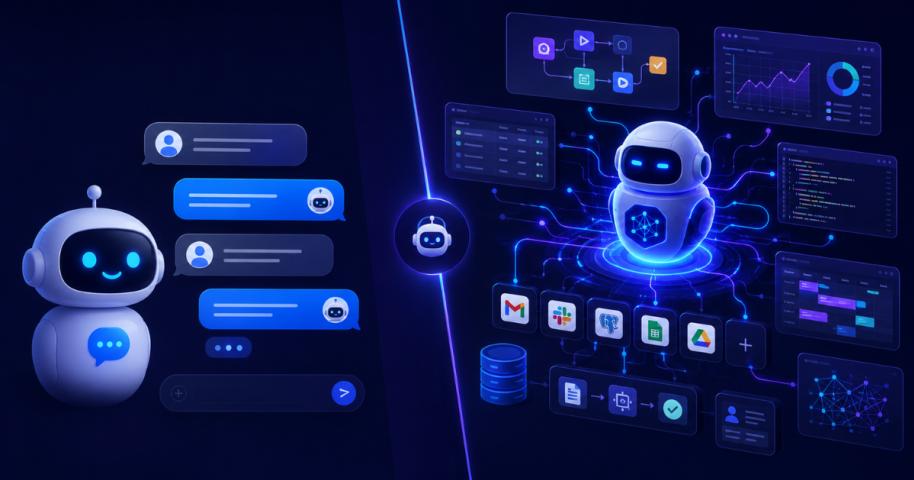
The evolution of conversational AI has moved from rule-based chatbots and scripted support flows to sophisticated AI-powered chatbots that can understand natural language, retrieve information, and respond contextually. The next step is increasingly agentic: AI systems that can pursue goals, use tools, interact with enterprise applications, and execute multi-step workflows.
That shift creates a practical question for business and technology leaders: Should we build an AI chatbot or an AI agent?
The answer depends less on which technology is newer and more on what the business needs the system to accomplish. Chatbots remain highly effective for conversation, information access, and self-service. AI agents become relevant when a workflow requires planning, tool use, decision-making, and controlled action.
This guide compares AI agents vs chatbots across capabilities, architecture, use cases, business benefits, implementation requirements, and security considerations, helping organizations determine when AI agent development services, AI chatbot development, or a combination of both makes sense.
AI Agents vs AI Chatbots: What's the Difference?
An AI chatbot is primarily a conversational system designed to understand user requests and generate useful responses. Modern chatbots may use large language models, RAG, APIs, CRM integrations, and other capabilities, so the distinction is not simply that chatbots can only answer questions.
An AI agent, by contrast, is generally designed around a goal or task. It can interpret that goal, determine what steps are required, select appropriate tools, interact with external systems, evaluate results, and continue or escalate the workflow based on defined rules.
The fundamental distinction is:
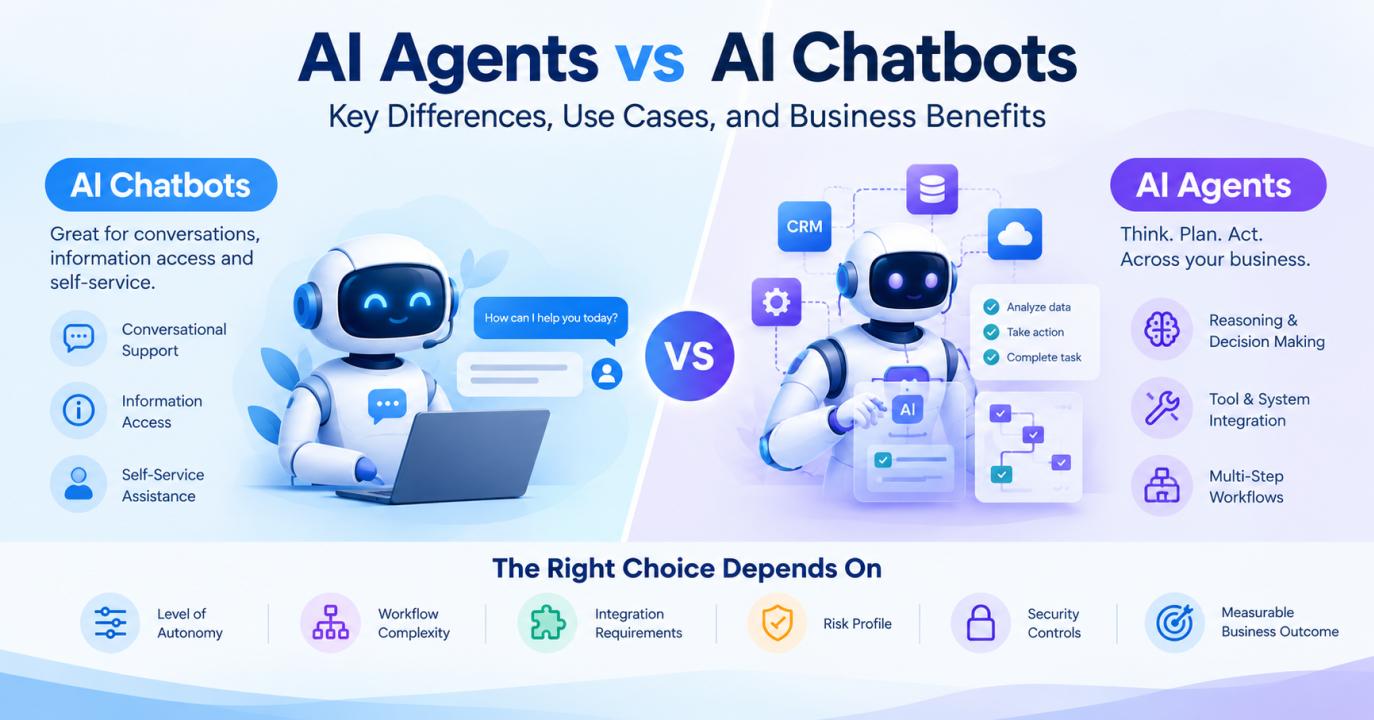
A chatbot primarily communicates. An AI agent can communicate, reason, use tools, and act.
There is considerable overlap. A sophisticated chatbot can trigger an API or perform a transaction, while an agent may communicate through a chat interface. The difference is therefore best understood as an architectural and operational distinction rather than a strict product category.
AI Agents vs AI Chatbots: Key Differences
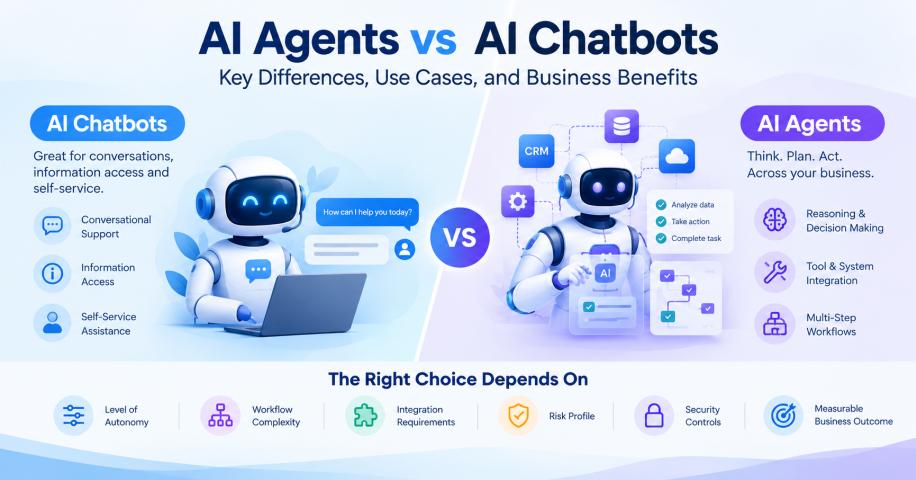
AI chatbots and AI agents differ mainly in how they interact with users and execute tasks. AI chatbots are primarily designed for conversation and assistance, with interactions usually driven by the user. They typically have lower autonomy, may use integrations, and handle simple or limited workflows. Their memory and context are mainly focused on the current conversation. Chatbots primarily generate responses and are commonly used for FAQs, customer support, engagement, and self-service. They can integrate with APIs, CRMs, helpdesks, and knowledge bases.
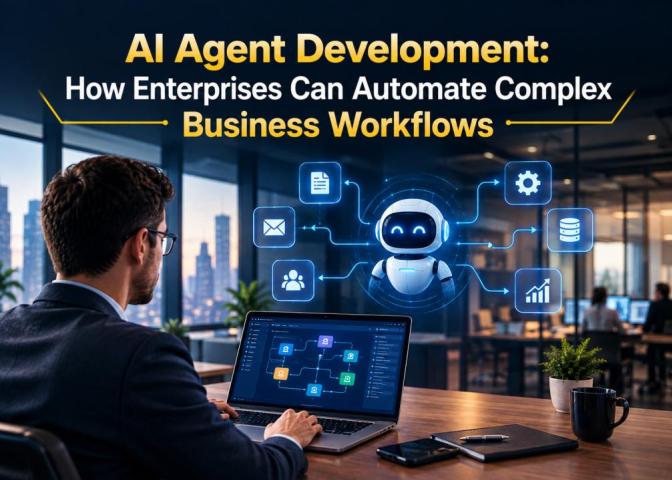
AI agents, on the other hand, are designed for goal-oriented task execution. They can operate proactively within defined boundaries and typically have greater autonomy. AI agents are built to use tools and external systems, execute multi-step and complex workflows, maintain task-specific or persistent context, and make decisions based on goals and available information. They can integrate with APIs, databases, enterprise applications, and other tools, making them well suited for automation, operations, research, and complex business workflows.
These are general patterns, not universal rules. An AI chatbot development company can build highly integrated conversational systems, while an AI agent development company can implement tightly constrained agents with very limited autonomy.
How AI Agents Work Differently From Chatbots
A typical chatbot interaction can be represented as:
User → Intent/Prompt → AI Model → Response
The system may retrieve information or call an API, but the primary objective remains responding to the user.
An agentic workflow is more iterative:
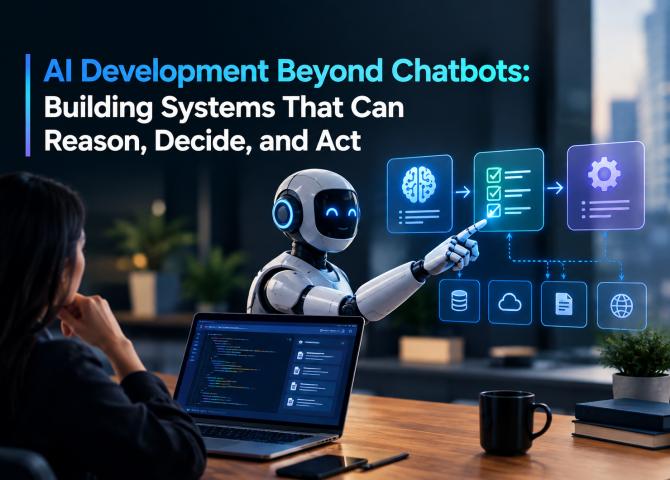
Goal → Reason → Select Tool → Execute → Observe → Reason Again → Complete or Escalate
A production AI agent may involve several components:
Goal definition: The user or business system provides an objective.
Reasoning and planning: The agent determines the steps required.
Context and memory: Relevant conversation, business data, or previous actions are considered.
Tool selection: The agent determines which API, database, application, or function is needed.
Action execution: The selected tool performs an approved operation.
Observation: The agent receives the result.
Additional reasoning: It determines whether another step is necessary.
Escalation: A human is involved when the task exceeds defined permissions or risk thresholds.
This additional loop is what makes AI agent architecture more powerful for complex workflows, but also more difficult to test, secure, monitor, and operate.
AI Chatbot Use Cases for Businesses
Chatbots continue to address a large and important category of business requirements. They are particularly effective when users primarily need information, assistance, or guided interaction.
Common applications include:
Customer support and FAQ automation
Lead qualification
Product recommendations
Appointment scheduling
Internal employee assistance
Knowledge-base search
Order tracking
Basic troubleshooting
Customer engagement
Self-service support
For example, an ecommerce chatbot can help a customer find a product, explain shipping policies, recommend alternatives, and provide order information. If the underlying workflow is relatively predictable, introducing autonomous AI agents may add unnecessary complexity.
Organizations evaluating these capabilities can explore AI Chatbot Development Services for conversational AI applications involving knowledge retrieval, integrations, analytics, and enterprise use cases.
AI Agent Use Cases for Businesses
AI agent use cases become more compelling when the system must complete a sequence of actions rather than simply provide an answer.
Customer service agents
A customer service agent could retrieve account information, investigate an issue, update a record, initiate an approved process, and escalate exceptions to a human representative.
Sales agents
Sales-oriented agents can research approved prospect information, qualify leads against business rules, update CRM records, prepare follow-up information, and coordinate subsequent actions.
Research agents
Research agents can search approved information sources, collect relevant material, synthesize findings, and produce structured reports. Human review can remain part of the process for important outputs.
IT and enterprise support agents
An IT agent could investigate incidents, retrieve logs or documentation, identify likely causes, execute approved remediation steps, and escalate issues requiring privileged intervention.
Operations agents
Operations workflows often involve several applications and conditional decisions. An agent can coordinate information and actions across those systems while operating within predefined permissions.
Finance agents
Finance-focused agents can assist with invoice processing, reconciliation workflows, reporting, and exception handling. Sensitive financial actions should generally incorporate appropriate approval and audit controls.
Knowledge agents
Enterprise knowledge agents can combine RAG with connected tools to retrieve information from approved documents, databases, and business applications.
These examples illustrate why enterprise AI agents require more than an LLM. They need clear permissions, reliable integrations, guardrails, observability, and defined escalation paths.
Business Benefits of AI Agents vs AI Chatbots
Both technologies can create business value, but they address different layers of work.
AI chatbots can help organizations:
Provide 24/7 conversational assistance
Reduce repetitive support interactions
Improve self-service
Deliver faster access to information
Support customer and employee engagement
Handle high volumes of routine conversations
AI agents can extend those benefits into workflow execution by:
Automating repetitive multi-step processes
Reducing manual handoffs
Connecting multiple business systems
Supporting employees with task execution
Coordinating autonomous workflows
Improving operational consistency
Turning enterprise knowledge into actionable assistance
The important distinction is that a chatbot primarily helps users get information or interact, whereas an agent can potentially help the organization complete work.
The actual business value still depends on the quality of the implementation, workflow design, integrations, governance, and measurable outcomes.
When Should a Business Choose an AI Chatbot?
A chatbot may be the appropriate architecture when:
The primary requirement is conversation.
Users mostly need information or guidance.
Workflows are simple and predictable.
Human employees remain responsible for actions.
The system primarily handles FAQs or support.
Enterprise integrations are limited.
A simpler deployment is preferable.
Organizations should not introduce autonomous agents simply because agentic AI is a newer technology. If a well-designed chatbot solves the underlying business problem effectively, additional autonomy may not provide enough value to justify the added engineering and governance requirements.
When Should a Business Choose an AI Agent?
An agentic approach becomes more relevant when:
A workflow contains multiple steps.
Several tools or systems must be used.
Tasks require conditional decisions.
The system needs to plan before acting.
Business processes involve repetitive coordination.
The system must take actions rather than only provide information.
Human approvals can be inserted at critical points.
Task completion and other business outcomes can be measured.
This is where AI agent development and structured AI agent implementation become particularly relevant. Businesses can use custom AI agents for narrowly defined processes rather than attempting to create unrestricted autonomous systems.
For larger organizations, AI agent solutions can also evolve into multi-agent systems where specialized agents handle different responsibilities under an orchestration layer.