According to IMARC Group's report titled "India Petrochemicals Market Size, Share, Trends and Forecast by Type, Application, End Use Industry, and Region, 2026-2034", the report offers a comprehensive analysis of the industry, including market share, growth, trends, and regional insights.
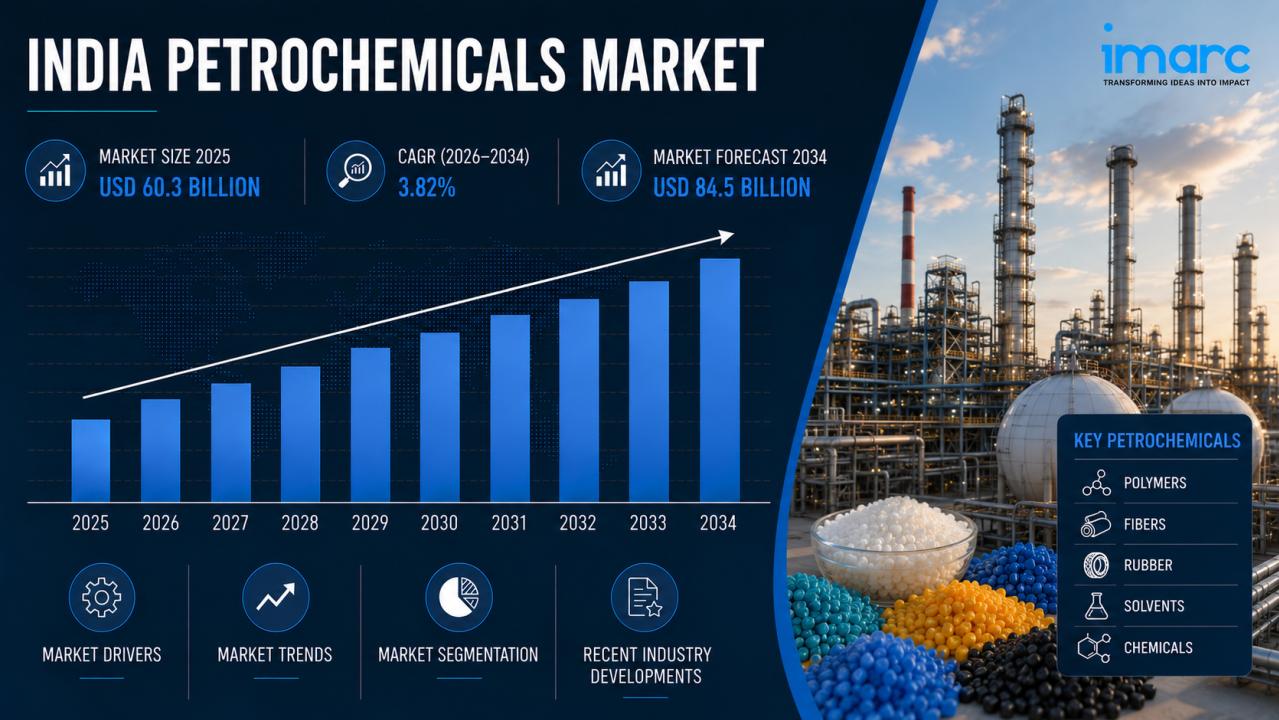
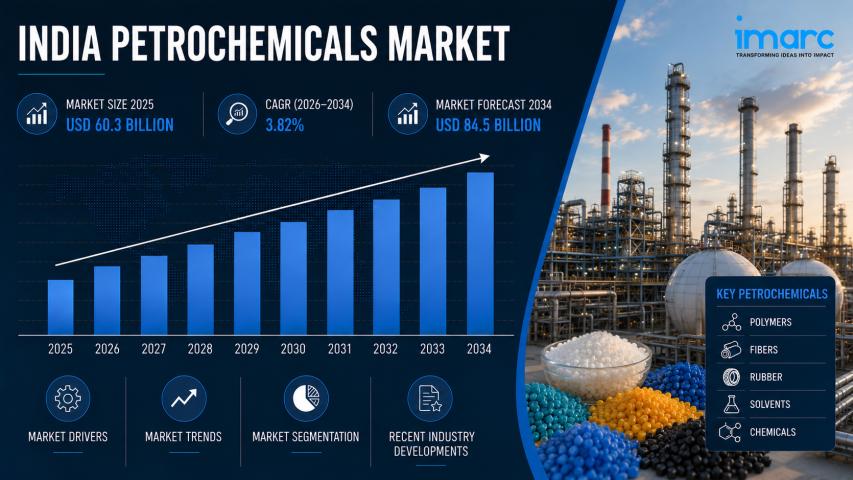
India's petrochemicals sector is large, strategically important, and quietly undergoing a meaningful transformation the market stood at USD 60.3 Billion in 2025 and is expected to reach USD 84.5 Billion by 2034, supported by expanding refinery capacity, rising end-use industry demand, and a gradual shift toward sustainable chemical production.
- The petrochemical industry in india is growing at a CAGR of 3.82% during 2026–2034 steady rather than spectacular, reflecting the sector's foundational role across packaging, automotive, construction, and healthcare rather than speculative demand cycles.
- India ranks fourth globally in refining capacity, with approximately 256.816 MMTPA across 23 refineries a production base that gives the country real competitive standing in both domestic supply and export markets.
- Key petrochemical types including ethylene, propylene, benzene, toluene, and methanol serve a wide application base spanning polymers, paints and coatings, rubber, adhesives, and surfactants.
- The PLI scheme for the chemical sector, the Plastic Waste Management Rules, and the Extended Producer Responsibility framework are all actively shaping how the industry invests and operates.
- Major capacity commitments including Adani's INR 35,000 Crore PVC plant in Gujarat and Haldia Petrochemicals' USD 10 Billion oil-to-chemical project in Tamil Nadu signal that both domestic and international players see India as a long-term petrochemical production hub.
The Strategic Market Challenge: Navigating the Petrochemicals Market in India
India's petrochemicals sector faces a structural tension that is easy to underestimate: the industry is simultaneously being asked to expand production capacity to meet domestic demand and reduce its environmental footprint through bio-based alternatives and circular economy frameworks. These are not naturally compatible objectives in the short term. Companies investing in large-scale conventional petrochemical infrastructure face the risk of regulatory and market headwinds as sustainability norms tighten while bio-based and recycled alternatives still lack the cost competitiveness and production scale to replace conventional chemicals at commercially viable price points across most end-use applications.
➤ Access Industry-Focused Insights and Future Forecasts - Request Sample Report
India's Strategic Vision for the Petrochemicals Market:
- Oilfields Amendment Bill 2025 and HELP policy expanding upstream access: India's Hydrocarbon Exploration and Licensing Policy aims to expand exploration area to 1 million square kilometers by 2030 and grow crude oil reserves to 651.8 MMT and natural gas reserves to 1,138.6 BCM providing the upstream feedstock foundation that supports long-term petrochemical production capacity expansion.
- PLI scheme for chemical sector supporting domestic manufacturing: The Production Linked Incentive scheme for chemicals provides financial incentives tied to incremental domestic production encouraging both existing players and new entrants to invest in expanding petrochemical manufacturing capacity and reducing India's import dependency in specialty chemical categories.
- Extended Producer Responsibility framework accelerating circular economy adoption: The EPR framework, administered under the Plastic Waste Management Rules, places formal responsibility on producers for end-of-life plastic management creating commercial incentives for companies to invest in recycled content, biodegradable polymers, and bio-based chemical alternatives.
- Export positioning as a strategic objective: India is actively developing its identity as a petrochemical exporter to Southeast Asia and Africa, supported by competitive production costs, improving refinery-integrated chemical complex infrastructure, and growing foreign investment in new production facilities.
Regulatory Landscape & Policy Catalysts in India:
- PLI Scheme for chemicals Ministry of Chemicals and Fertilizers: The Production Linked Incentive scheme for the chemical sector provides financial incentives calibrated to incremental domestic production, encouraging manufacturers to invest in expanding petrochemical output and reducing reliance on imported specialty chemicals and polymer categories.
- Plastic Waste Management Rules Ministry of Environment, Forest and Climate Change: These rules establish mandatory standards for plastic waste collection, recycling, and disposal and their 2022 update banning specific single-use plastics has directly accelerated manufacturer investment in alternative polymer formulations and bio-based packaging materials.
- Extended Producer Responsibility (EPR) framework: Administered under the Plastic Waste Management Rules, EPR places formal collection and recycling obligations on plastic producers and importers creating structural commercial incentives for the petrochemical industry to develop and scale recycled content and biodegradable polymer alternatives.
- Oilfields Amendment Bill 2025 and HELP policy Ministry of Petroleum and Natural Gas: This legislative and policy framework is designed to expand upstream hydrocarbon exploration coverage to 1 million square kilometers by 2030 securing the domestic feedstock base that underpins long-term petrochemical production capacity planning for refinery-integrated chemical complexes.
- National Chemical Policy Ministry of Chemicals and Fertilizers: India's evolving national chemical policy framework aims to position the country as a global chemical manufacturing hub by 2030, with specific targets for import substitution, export growth, and domestic value addition providing a directional mandate that aligns government and industry investment priorities in the petrochemical sector.
- Foreign Direct Investment policy for chemicals manufacturing: India permits 100% FDI under the automatic route in the chemicals sector, facilitating international partnerships such as the Adani-Indorama joint venture for PVC manufacturing and enabling technology and capital transfer from global petrochemical producers into Indian production infrastructure.
Why Invest in the India Petrochemicals Market: Key Growth Drivers & ROI
- Refinery-integrated petrochemical complexes delivering cost and scale advantages: India's refining infrastructure 23 refineries with 256.816 MMTPA capacity provides a cost-competitive feedstock platform for downstream petrochemical production. The sector's GVA of INR 2.12 lakh crore in 2022–23 reflects an industry with genuine economic weight, and ongoing investments in refinery-integrated chemical complexes are improving per-unit production economics in ways that standalone chemical plants cannot match.
- Multi-sector end-use demand providing diversified revenue exposure: Petrochemical demand in India is distributed across packaging, automotive and transportation, construction, electrical and electronics, and healthcare meaning revenue is not concentrated in a single industry cycle. As urbanization deepens and disposable incomes rise, all of these end-use sectors are expanding their consumption of plastics, polymers, coatings, and specialty chemicals in parallel, creating a durable multi-decade demand base.
- Large-scale capacity investment signaling long-term market confidence: In January 2025, Adani Petrochemicals launched Valor Petrochemicals in partnership with Thailand's Indorama Resources, committing INR 35,000 Crore to build India's largest PVC manufacturing plant in Gujarat a 2 million tonne facility targeting completion by 2027. In April 2025, Haldia Petrochemicals announced a USD 10 Billion oil-to-chemical project in Cuddalore, Tamil Nadu, targeting 3.5 million metric tonnes of ethylene and propylene annually by 2028–2029. These are not marginal bets they reflect institutional conviction in India's petrochemical demand trajectory.
- Sustainability transition creating a higher-margin product opportunity: The shift toward bio-based chemicals, biodegradable polymers, and recycled content materials driven by EPR compliance requirements and consumer preference in FMCG, healthcare, and automotive packaging is creating a premium product segment within the broader petrochemicals market. Companies like Reliance Industries and Indian Oil Corporation are already expanding bio-based portfolios, positioning themselves for a segment where margins are structurally higher than conventional commodity chemicals.
➤ Explore the Complete TOC and Data Coverage - Get Full Brochure
India Petrochemicals Market Trends & Future Outlook:
- The India Petrochemicals Market is expected to reach USD 84.5 Billion by 2034 at a CAGR of 3.82%, according to IMARC Group with growth anchored in end-use industry expansion, capacity additions, and improving export competitiveness rather than demand volatility.
- Bio-based and biodegradable polymer development is moving from early-stage investment to commercial portfolio expansion among major Indian petrochemical producers a trend driven by both regulatory pressure and genuine consumer demand for eco-friendly packaging across FMCG and healthcare categories.
- India's emergence as a petrochemical exporter to Southeast Asia and Africa is becoming more concrete as new production capacity comes online and competitive pricing advantages relative to established Asian producers improve market access in these regions.
- The Plastic Waste Management Rules and EPR framework are accelerating investment in recycling infrastructure and circular economy business models creating a new operational and compliance dimension for petrochemical manufacturers that is reshaping how products are formulated, packaged, and recovered at end of life.
- Hydrogen and green fuel investments by major industry players are gradually integrating with petrochemical operations a longer-horizon trend, but one that is beginning to influence capital allocation decisions at companies planning capacity additions through the 2030s.
Market Segmentation Breakdown:
Type Insights:
- Ethylene
- Propylene
- Butadiene
- Benzene
- Toluene
- Xylene
- Methanol
- Others
Application Insights:
- Polymers
- Paints and Coatings
- Solvents
- Rubber
- Adhesives and Sealants
- Surfactants and Dyes
- Others
End Use Industry Insights:
- Packaging
- Automotive and Transportation
- Construction
- Electrical and Electronics
- Healthcare
- Others
Regional Analysis:
- North India
- West and Central India
- South India
- East India
By the IMARC Group, the Top Competitive Landscape & their Positioning:
Covering an in-depth analysis of the competitive landscape, market structure, key player positioning, competitive dashboards, top winning strategies, and detailed profiles of all major industry participants you will gain access to all these exclusive insights within the full research report.
Note: If you need specific information that is not currently within the scope of the report, we can provide it to you as a part of the customization.
➤ Tailor the Research to Your Exact Business Needs - Request Customization
Frequently Asked Questions (FAQs):
Q1: What is the current value and projected size of the India Petrochemicals Market?
According to IMARC Group, the India Petrochemicals Market reached USD 60.3 Billion in 2025 and is expected to reach USD 84.5 Billion by 2034, growing at a CAGR of 3.82% during 2026–2034. This growth is supported by rising demand from packaging, automotive, and construction end-use industries, ongoing refinery capacity expansion, and supportive government manufacturing policy frameworks.
Q2: What are the key petrochemical types and applications covered in the India market?
The market spans ethylene, propylene, butadiene, benzene, toluene, xylene, and methanol as primary chemical types. These feed into applications including polymers, paints and coatings, solvents, rubber, adhesives and sealants, and surfactants and dyes with polymers representing the largest application category given their foundational role across packaging, automotive, and construction material supply chains.
Q3: Which end-use industries drive the most petrochemical demand in India?
Packaging is the largest end-use segment, followed by automotive and transportation, construction, electrical and electronics, and healthcare. The breadth of this end-use base is one of the market's structural strengths demand is not dependent on any single industry cycle, and all major segments are expanding consumption as India's economy grows and urbanization deepens.
Q4: How is India's refining capacity supporting petrochemical market development?
India's 23 refineries with approximately 256.816 MMTPA of combined refining capacity place the country fourth globally in refining scale behind only the USA, China, and Japan. This infrastructure provides a cost-competitive domestic feedstock base for petrochemical production, supports refinery-integrated chemical complex development, and underpins India's growing credibility as a petrochemical exporter to Southeast Asian and African markets.
Q5: What sustainability-related trends are reshaping the India Petrochemicals Market?
Three regulatory and market forces are driving sustainability change in the sector. The Plastic Waste Management Rules and EPR framework are compelling manufacturers to invest in recycled and biodegradable polymer alternatives. Consumer preference for eco-friendly packaging in FMCG and healthcare is creating commercial demand for bio-based chemicals. And major producers including Reliance Industries and Indian Oil Corporation are actively expanding their bio-based product portfolios signaling that sustainability is becoming a mainstream commercial consideration rather than a peripheral compliance exercise.
Strategic Insight & Verdict
We at IMARC Group have observed that the India Petrochemicals Market presents a well-grounded long-term investment case one where large-scale capacity additions, a diversified end-use demand base, and a structural shift toward sustainable chemical production are all developing in parallel. Investors focused on refinery-integrated petrochemical infrastructure, bio-based polymer development, and export-oriented production capacity will find the most durable positioning as the market moves from USD 60.3 Billion toward USD 84.5 Billion by 2034.
Verified Data Source: India Petrochemicals Market Report by IMARC Group