
Running a business today is more challenging than ever. Companies must manage customer inquiries, employee collaboration, project deadlines, invoices, reports, and countless repetitive tasks every single day. While these activities are necessary, handling them manually often leads to delays, human errors, and increased operational costs.
This is where workflow automation becomes a game changer. By replacing repetitive manual processes with intelligent automated workflows, businesses can save time, improve accuracy, and allow employees to focus on strategic work instead of routine administrative tasks. Organizations across industries are increasingly adopting workflow automation to streamline operations, enhance productivity, and improve customer experiences.
What Is Workflow Automation?
Workflow automation is the process of using software and technology to perform repetitive, rule-based tasks with minimal human intervention. Instead of manually moving information between departments or waiting for approvals through emails, automated systems handle these processes according to predefined rules.
For example, when a customer submits an online inquiry, an automated workflow can instantly assign the lead to the appropriate sales representative, send a confirmation email, create a CRM record, and notify the management team—all within seconds.
These automated workflows reduce delays and ensure every task follows the same standardized process.
Benefits of Workflow Automation
1. Increased Productivity
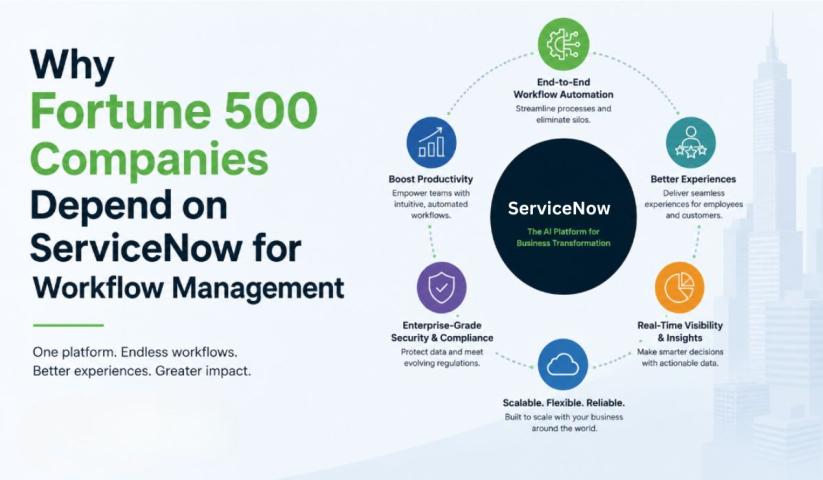
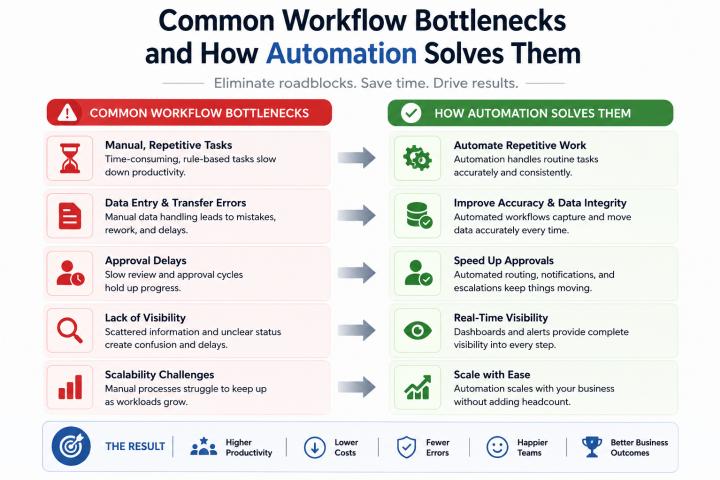
Employees often spend several hours every week performing repetitive tasks such as data entry, document approvals, email notifications, and report generation. Automation eliminates much of this manual work, allowing teams to dedicate more time to innovation, customer service, and business growth.
2. Improved Accuracy
Manual processes are prone to mistakes. A single incorrect entry can create significant problems across multiple departments. Automated workflows minimize human error by following predefined rules consistently, resulting in more accurate business operations.
3. Faster Decision Making
Automation accelerates approvals, notifications, and task assignments. Instead of waiting for multiple emails or manual follow-ups, decision-makers receive instant alerts, enabling faster responses and shorter project timelines.
4. Better Visibility
Modern workflow platforms provide dashboards that allow managers to monitor every stage of a business process. This transparency helps identify bottlenecks, measure performance, and continuously optimize operations.
5. Lower Operational Costs
Automating repetitive work reduces labor costs while increasing efficiency. Businesses can handle larger workloads without proportionally increasing staffing expenses, making automation a cost-effective long-term investment.
Industries That Benefit from Automation
Workflow automation is no longer limited to large enterprises. Small and medium-sized businesses across various industries are adopting automation to improve efficiency.
Some common industries include:
- Healthcare
- Finance and Banking
- Manufacturing
- Retail and E-commerce
- Real Estate
- Human Resources
- Customer Support
- Information Technology
- Logistics
- Marketing Agencies
Each industry has unique workflows that can be optimized through automation.
Common Business Processes That Can Be Automated
Businesses automate a wide variety of everyday operations, including:
- Lead management
- Employee onboarding
- Invoice approvals
- Purchase requests
- Customer support ticket routing
- Marketing email campaigns
- Data synchronization
- Report generation
- Inventory updates
- Document approvals
Automating these repetitive activities creates smoother operations while improving consistency throughout the organization.
Choosing the Right Automation Partner
Although many automation platforms are available, successful implementation depends on understanding business requirements and designing workflows that align with organizational goals.
Professional Workflow automation services help businesses analyze existing processes, identify inefficiencies, integrate multiple software systems, and build customized automation solutions that deliver measurable improvements. Whether the objective is reducing manual work, improving collaboration, or accelerating digital transformation, experienced automation specialists can create scalable workflows tailored to business needs.
The Future of Business Operations
Automation is rapidly becoming a standard component of digital transformation strategies. As artificial intelligence, machine learning, and cloud technologies continue to evolve, workflow automation will become even more intelligent and capable of handling increasingly complex business operations.
Organizations that embrace automation today will be better positioned to scale efficiently, respond quickly to market changes, and deliver superior customer experiences in the years ahead.
Conclusion
Business success increasingly depends on efficiency, speed, and accuracy. Manual processes can no longer keep pace with the growing demands of modern organizations. Workflow automation empowers businesses to eliminate repetitive tasks, reduce operational costs, improve collaboration, and increase productivity without sacrificing quality.
Whether you're a startup or an established enterprise, investing in workflow automation is no longer just an option—it's a strategic decision that can transform the way your organization operates and prepares for future growth.