There is no doubt that the fitness industry has undergone dramatic digital transformation in recent years. Using workout tracking, creating nutrition programs, conducting virtual training, and integrating with wearables, fitness apps become an important part of the lives of modern users. With the increasing demands of users for more complicated services, the development of fitness applications becomes essential for companies.
But creating a successful app does not mean designing it nicely and distributing it via app stores. Nowadays, it is necessary to provide the proper performance of an application, analyze health data, synchronize user activity, use AI to offer recommendations, and provide data security.
Regardless of whether you are a startup, a healthcare company, a gym owner, or an entrepreneur, it is necessary to understand the main challenges of fitness app development in order not to waste time and money on your project.
Why Fitness Apps Are More Challenging Than Ever
The contemporary apps for fitness go far beyond simply step counting or keeping track of activities. Consumers expect to have a whole suite of tools that can help monitor their progress. integrate with wearable technologies, provide a custom workout routine, monitor their nutritional intake, and give instant feedback on their performance.
On the other hand, companies face numerous challenges such as growing competition, changes in technology, stringent privacy legislation, and changing demands of consumers. Taking these things into account during development is crucial for creating a valuable app.
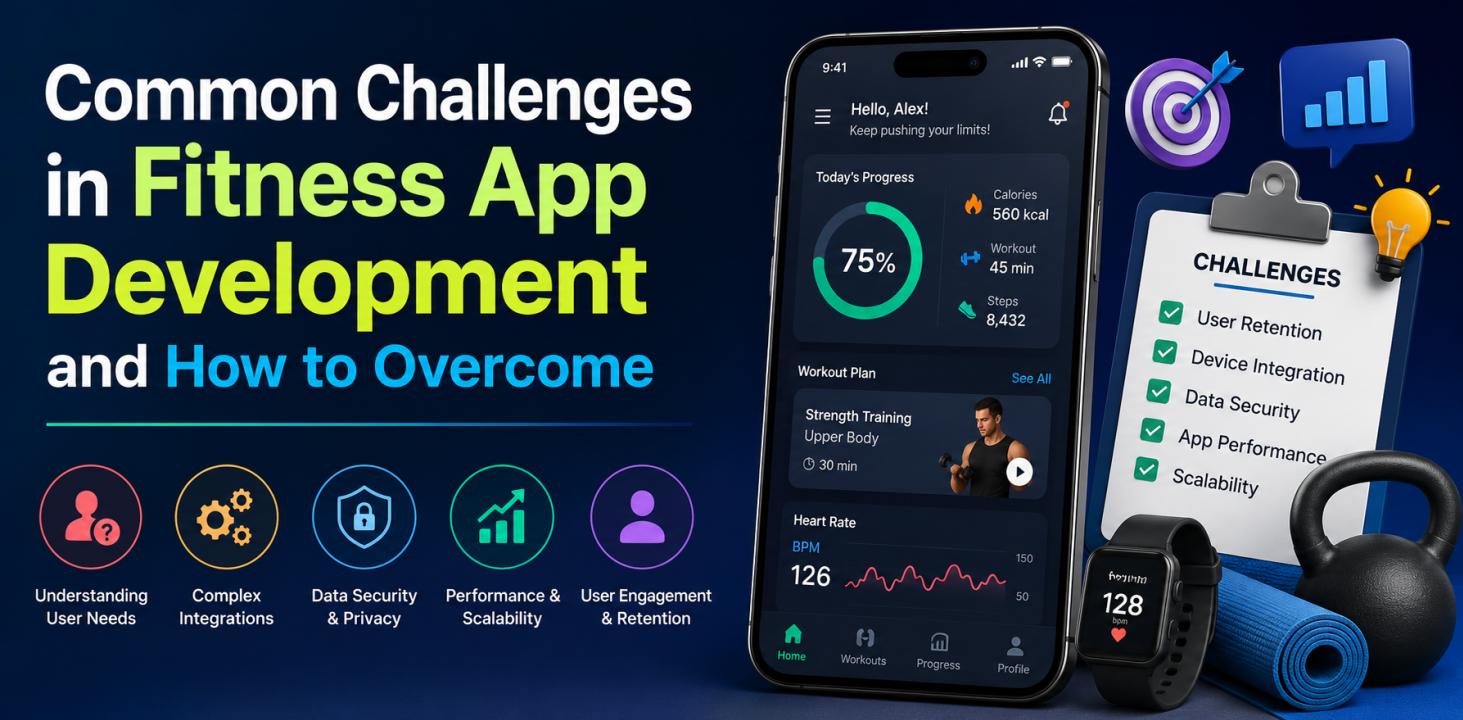
Common Challenges & Solutions in Fitness App Development
1. Understanding User Expectations
One of the hardest tasks in this case will be determining the exact requirements of the users. Some may want to lose weight, some will need to gain muscles, practice yoga, run marathons, etc. In any case, the solution won’t work for everyone.
How to Overcome It
Perform thorough market analysis prior to product development. Study your competition, get feedback from your clients, create personas, and figure out which features bring maximum value to your target audience.
2. Creating Personalized Fitness Experiences
Every individual has different fitness goals, activity levels, body types, and health conditions. Generic workout plans often fail to keep users motivated.
How to Overcome It
Implement intelligent personalization, where workout advice, nutrition programs, and fitness goals can be personalized based on the preferences and progress of the users. Personalization greatly increases the retention rates and ensures continuous usage of the app.
3. Maintaining Long-Term User Engagement
Many fitness apps experience high download rates but struggle with long-term user retention. Users often abandon applications after only a few weeks.
How to Overcome It
Gamification can be used to increase engagement via elements like earning achievement badges, participating in fitness challenges, daily streaks, getting progress reports, having leaderboards, and getting motivational notifications.
4. Integrating Wearable Devices
Modern users expect seamless synchronization with smartwatches, fitness bands, heart-rate monitors, and other wearable technologies. Supporting multiple devices can be technically challenging.
How to Overcome It
Create standardized integration layers through official APIs provided by leading wearable device brands. Compatibility testing will ensure proper synchronization of the wearable devices in different operating systems and hardware.
5. Managing Real-Time Data
Fitness applications process continuous streams of information, including step counts, calories burned, heart rate, GPS tracking, and workout statistics. Delays or inaccuracies reduce user confidence.
How to Overcome It
Implement scalable cloud infrastructure, optimized databases, and efficient data synchronization mechanisms. Real-time processing enables users to receive accurate insights while maintaining excellent application performance.
6. Protecting Sensitive User Information
Fitness applications often collect health records, activity history, payment information, and personal details. Security breaches can damage both customer trust and business reputation.
How to Overcome It
Implement end-to-end encryption, secure authentication, multi-factor login, role-based access control, and regular security testing. Compliance with healthcare and privacy regulations should be considered throughout development.
7. Designing an Intuitive User Interface
Even feature-rich applications fail if users struggle to navigate them. Complex interfaces increase abandonment rates and reduce engagement.
How to Overcome It
Focus on clean layouts, simple navigation, consistent design elements, readable typography, and minimal user interactions. Conduct usability testing with real users to identify and eliminate friction points before launch.
8. Ensuring Cross-Platform Performance
Users expect identical experiences across Android smartphones, iPhones, tablets, and wearable devices. Maintaining consistency across platforms presents additional complexity.
How to Overcome It
Adopt a well-planned architecture and responsive design principles. Comprehensive testing across multiple screen sizes and operating systems helps maintain consistent performance and user experience.
9. Integrating Third-Party Services
Fitness platforms often depend on external APIs for maps, payments, nutrition databases, wearable devices, video streaming, and notifications. Managing multiple integrations increases technical complexity.
How to Overcome It
Choose reliable service providers with stable APIs and strong documentation. Regular monitoring, version updates, and fallback mechanisms help minimize disruptions when external services change.
10. Maintaining High Performance
Slow loading screens, delayed workout tracking, or application crashes quickly frustrate users and result in negative reviews.
How to Overcome It
Optimize application performance through efficient coding practices, image compression, database optimization, lazy loading, and continuous performance monitoring. Fast applications deliver better user satisfaction and higher retention.
Why Choosing the Right Development Partner Matters
The success of fitness applications is greatly dependent on the experience of the developers working behind the project. A good, experienced fitness app development company would have all the information related to industry requirements, scalable architecture, user behavior, security, and latest technologies. The technical expertise could help companies reduce the risk of developing products and speed up the process.
Similarly, a good fitness app development company would be offering complete services in terms of strategy, UI/UX design, backend development, testing, deployment, and even post-deployment. Companies that want to grow in the future must consider the technical expertise of the best fitness app development services with experience in wearables, cloud-based solutions, and AI applications.
Comprehensive fitness app development services ensure continuous product improvement through regular updates, feature enhancements, performance optimization, and technical support, allowing businesses to remain competitive in an evolving digital fitness landscape.
Conclusion
Creating a winning fitness app demands the solution of a number of challenges related to technology, business operations, and user experience. Each element from personalization, the integration of wearables, security, scalability, and user engagement should be carefully planned and executed.
The businesses that will solve these problems beforehand will be able to develop successful apps that attract loyal users and ensure business growth. With the help of advanced technologies and innovative approaches, the companies can create high-quality fitness apps.