Building a specialized consumer AI product around a trust-sensitive domain
General-purpose AI products compete on breadth, but a specialized product can win by making one complicated subject easier to explore. The tradeoff is responsibility: the narrower the domain, the more carefully the product must explain what it does, where its information comes from, and what users should not infer from the output.
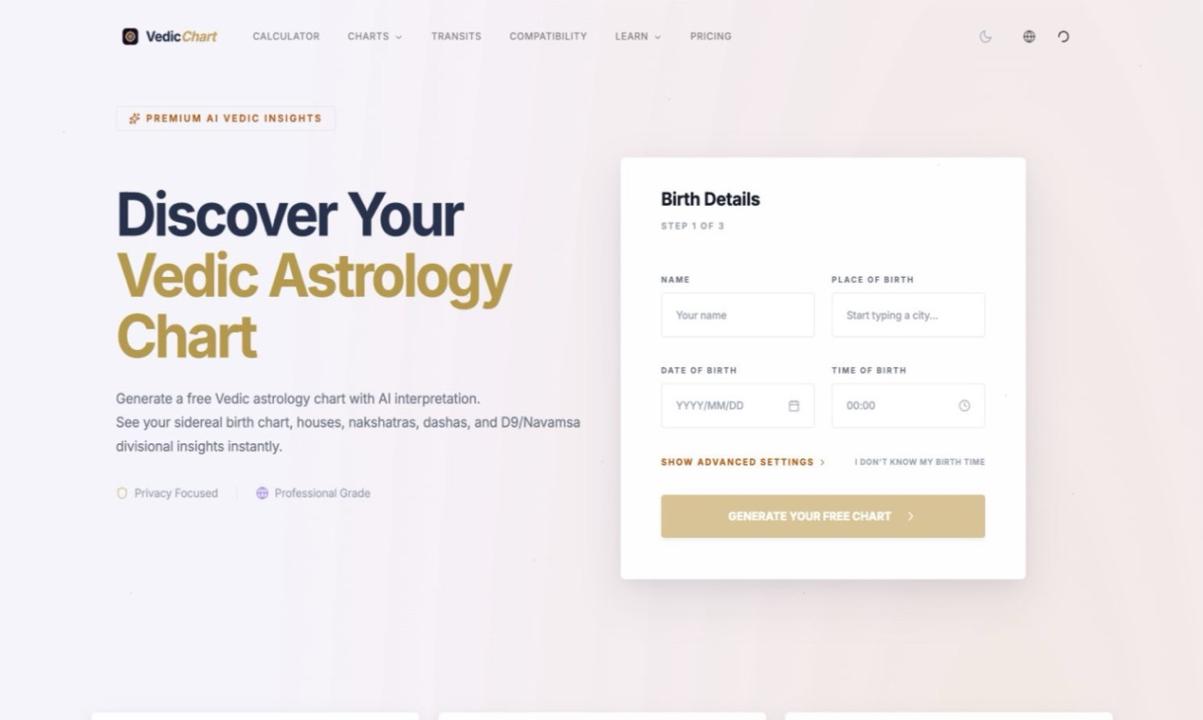
Vedic astrology is a useful example of this product-design challenge. A chart calculation involves structured inputs such as birth date, time, and place, along with domain concepts including the sidereal zodiac, houses, nakshatras, dashas, and divisional charts. A raw calculation is not enough for most users. They also need clear navigation and explanations that separate calculation from interpretation.
Make the first job obvious
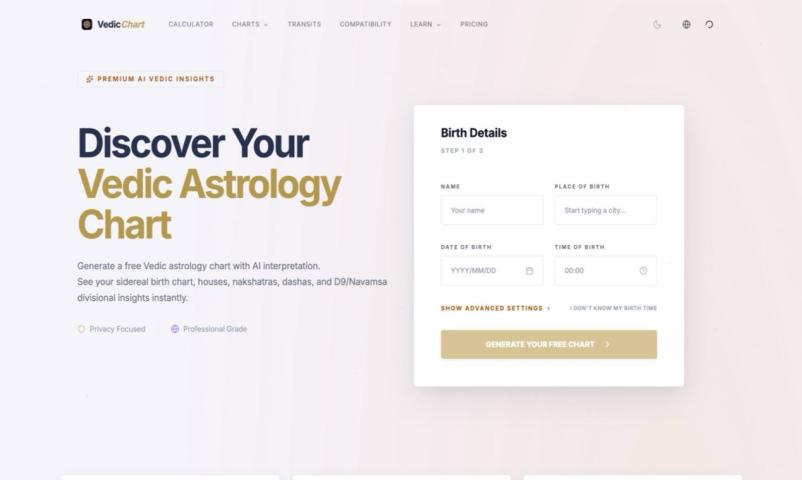
A focused onboarding flow should ask only for information required to generate the chart. It should explain why accurate birth time matters and what changes when a user does not know it. This is better than showing dozens of settings before the user sees any value.
After calculation, the product can progressively reveal complexity. The main chart comes first, followed by planetary positions, houses, and short definitions. Deeper views such as D9 or D10 divisional charts can appear as optional paths. Progressive disclosure keeps the first experience approachable without removing depth for experienced users.
Separate facts, calculations, and interpretations
Trust improves when a product distinguishes astronomical calculation from interpretive text. Planetary positions and chart geometry can be presented as computed data. Interpretations should be labeled as reflective or educational material rather than objective predictions.
This distinction also guides AI use. A language model may help turn structured chart data into readable explanations, but the interface should show which placements the explanation refers to. Users should be able to move from a paragraph back to the underlying chart elements instead of treating the output as a black box.
Design privacy into the workflow
Birth details are personal. A responsible product should collect only what is needed, explain retention choices, protect account access, and give users a clear way to manage their data. Teams should also avoid using emotional urgency or deterministic claims to push purchases. Helpful software can invite reflection without pretending to replace human judgment.
These principles shape Vedic Astrology Chart, a browser-based calculator with sidereal chart data, divisional views, and AI-assisted interpretation. Disclosure: I work with the team behind the product and am describing the product decisions from that perspective.
Choose metrics that reward understanding
Engagement alone can be misleading for a consumer AI tool. Better signals include the percentage of users who complete the chart flow, whether they can move from an interpretation to the referenced placement, how often they use explanatory guides, and which concepts generate support questions.
Qualitative feedback matters too. If users repeatedly confuse Moon sign, Ascendant, or divisional charts, the problem may be information architecture rather than missing features. Clear labels and short examples can deliver more value than another layer of automated text.
The startup lesson
Specialized AI products do not need to imitate a universal assistant. Their advantage is a coherent domain model, grounded terminology, transparent inputs, and an interface that helps users understand what happened. When the product is built around those strengths, AI becomes an explanation layer inside a useful workflow rather than the whole value proposition.