In the lithium battery industry, spec sheets are easy to dress up. Wh/kg, C-rate, cycle life — anyone can make those numbers look good on paper. What actually separates a battery manufacturer that gets chosen by major clients from one that doesn't is usually the unglamorous work behind those numbers: years of process refinement, real test data from extreme conditions, and engineering capability that has been validated by a top-tier automaker.
That's the quieter, harder path LiTrue has taken.
18 Years Isn't Just a Marketing Number
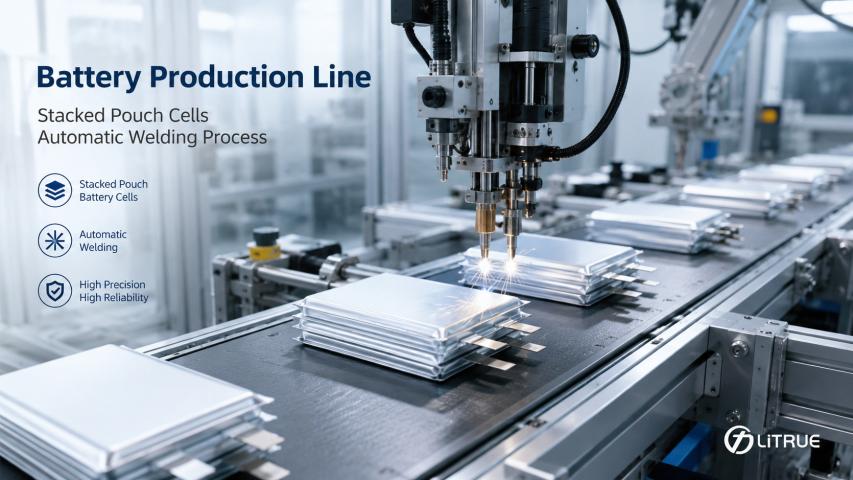
LiTrue specializes in the R&D and manufacturing of high-performance lithium battery cells and custom battery packs, covering LiFePO₄, NMC, and LCO chemistries for B2B industrial applications including UAVs, electric motorcycles, energy storage (BESS), and forklifts/AGVs. More than 18 years of engineering experience, 85+ product series, 100+ in-house patents, and 230+ global partners — together, these numbers tell one story: this isn't a company that jumped onto the "solid-state" trend overnight. It's a manufacturer that built its foundation in conventional liquid-electrolyte lithium cells first, then kept pushing the technology envelope forward from there.
That's precisely why, as solid-state and semi-solid-state batteries become the industry's focal point, LiTrue isn't just talking concepts — it has products actively moving toward mass production: the PE49N-EF (49Ah, 495Wh/kg solid-state anode-free cell), the PE42N-EF (42Ah, 490Wh/kg, rated to -43°C), and the PE40N-EF (40Ah, also crossing the 495Wh/kg threshold). This solid-state anode-free cell lineup is LiTrue's concrete answer on the energy-density front.
Validated by Volkswagen Is the Kind of Proof That Actually Matters
This year, LiTrue entered into a cooperation agreement with PowerCo, the battery subsidiary of the Volkswagen Group, securing two specialized R&D trial manufacturing orders focused on the development, validation, and small-batch production of next-generation lithium-ion and sodium-ion batteries. It marks the first time LiTrue's integrated engineering capabilities have been officially recognized and contracted by a top-tier European automotive subsidiary — a result of the company's sustained investment in rapid engineering response and custom development capability.
For procurement and engineering teams evaluating battery suppliers for UAV, EV, or energy storage projects, "who has validated this supplier" often carries more weight than anything printed on a spec sheet.
Beyond Cell Specs: Solutions Built Around Real-World Scenarios
A closer look at LiTrue's product line shows it isn't simply slapping "high energy density" and "high C-rate" onto the same cell and calling it a universal solution. Instead, the lineup is clearly segmented by application:
- Long-endurance UAVs chasing maximum flight time: the solid-state anode-free series (PE49N-EF / PE42N-EF / PE40N-EF), built around 495Wh/kg-class energy density and -43°C wide-temperature operation.
- High-maneuverability scenarios needing strong instantaneous current: the high C-rate NMC pouch cell series (such as the PR30N-P, 10C continuous / 20C pulse discharge), addressing voltage sag during high-load moments like takeoff and climbing.
- Energy storage and industrial power applications with strict safety and cycle-life requirements: LFP prismatic cells (such as the 100Ah high-rate LFP cell), rated for 3,000+ cycles.
- Full-pack delivery needs: LiTrue has extended beyond selling bare cells into delivering complete power systems — from 48V 76Ah UAV battery packs to custom 83.2V forklift batteries.
Behind this segmentation is sustained investment across four core technology areas: cell technology, multi-source power conversion, high-voltage energy storage, and battery management systems — including self-developed BMS localization solutions, high-precision SOC/SOH estimation, and remote battery data management. These are usually the deciding factors in whether a battery pack survives its full service life, even though they rarely make it into marketing copy.
The Bottom Line
In an industry where everyone talks about "high energy density" and "solid-state batteries," the real dividing line is whether those numbers come from a lab theoretical model or from real performance data validated at -43°C, under 5C loads, on a customer's actual equipment. LiTrue's answer: 18 years of engineering accumulation, backed by a cooperation order from Volkswagen's PowerCo.
If you're sourcing a battery cell supplier for UAVs, electric motorcycles, energy storage systems, or industrial power equipment — one that can hold up under extreme conditions and still support deep customization — it's worth taking a look at LiTrue's product lineup, or sending your application scenario and key requirements directly to their engineering team for a free quote.