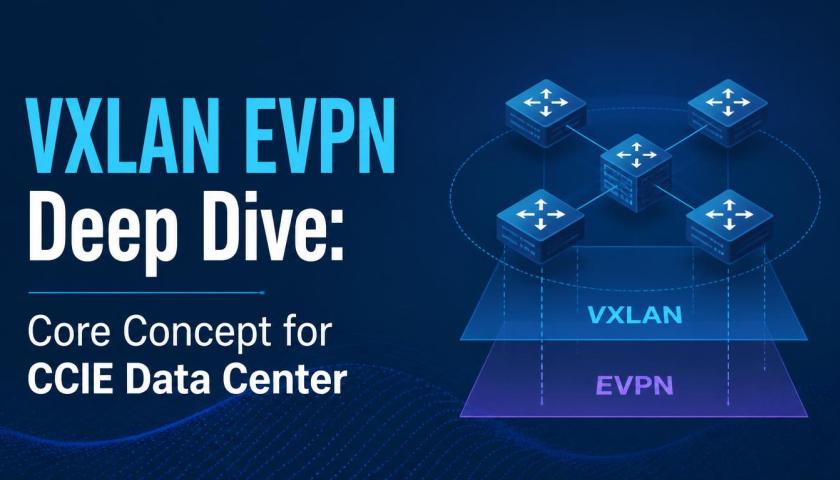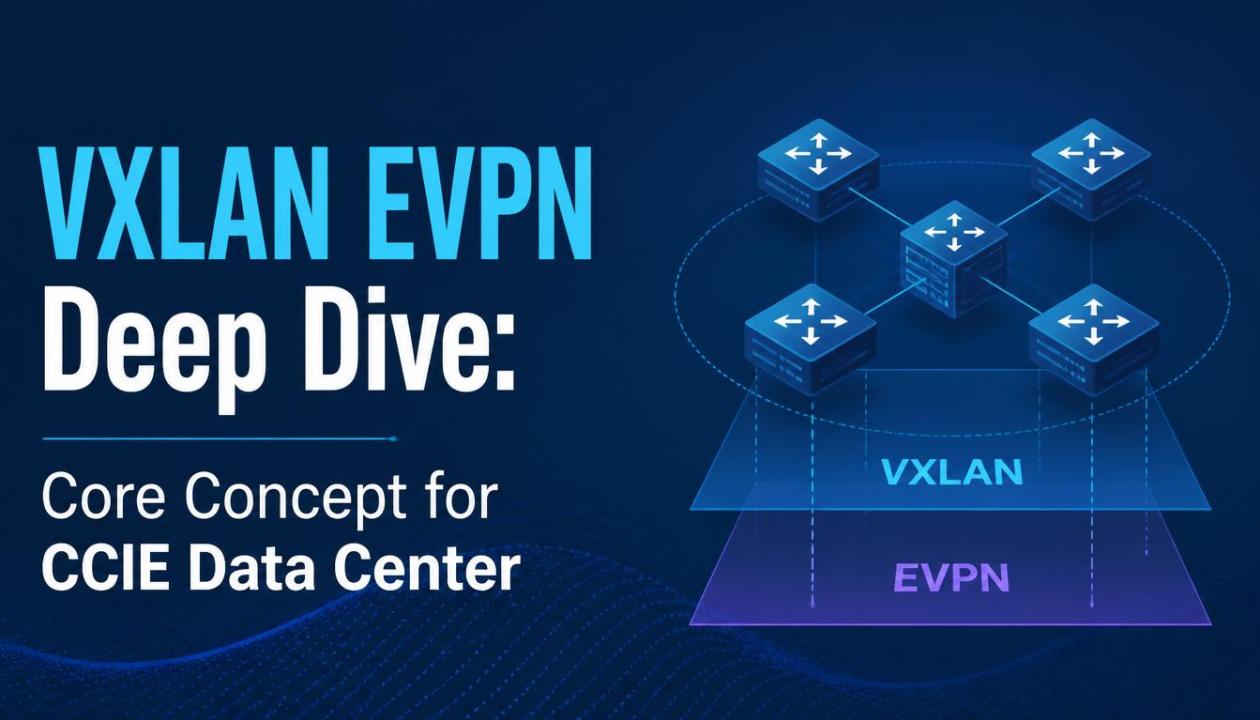
VXLAN EVPN is a modern data center networking architecture that combines VXLAN’s scalable Layer 2 overlay with EVPN’s BGP-based control plane. It is widely used in enterprise, cloud, and multi-tenant environments and is an important topic for professionals pursuing CCIE Data Center Training.
What Is VXLAN EVPN?
VXLAN extends Layer 2 networks across a Layer 3 infrastructure by encapsulating Ethernet frames in UDP packets.
EVPN uses MP-BGP to distribute MAC and IP reachability information between VTEPs.
Together, they overcome limitations of traditional VLAN-based networks, including limited scalability, STP dependency, and mobility challenges.
VXLAN Fundamentals
VXLAN uses a 24-bit VXLAN Network Identifier (VNI), supporting approximately 16 million logical segments compared with the 4,096 VLAN limit.
A VTEP (VXLAN Tunnel Endpoint) encapsulates and decapsulates VXLAN traffic. The underlay provides the Layer 3 IP transport, while the overlay creates virtual Layer 2 connectivity.
EVPN Control Plane
EVPN replaces traditional flood-and-learn mechanisms with MP-BGP-based endpoint learning. Key capabilities include:
MAC and IP advertisement
ARP suppression
Host mobility
Multi-homing
Reduced flooding
Important EVPN route types include:
Type 1: Ethernet Auto-Discovery
Type 2: MAC/IP Advertisement
Type 3: Inclusive Multicast Ethernet Tag
Type 5: IP Prefix Advertisement
Key Benefits
VXLAN EVPN provides:
Scalability: Millions of logical network segments
Efficiency: Reduced broadcast and flooding
High availability: Multi-homing and ECMP support
Flexibility: Better workload and VM mobility
Cloud readiness: Suitable for enterprise, private cloud, and multi-tenant environments
VXLAN EVPN and CCIE Data Center
CCIE Data Center candidates should understand VXLAN architecture, EVPN route types, MP-BGP, Anycast Gateway, Layer 2/Layer 3 VNIs, multi-site deployments, and troubleshooting.
Hands-on practice should include verifying BGP EVPN routes, VTEP status, VNI mappings, endpoint learning, and underlay/overlay connectivity.
Best Practices
A successful deployment requires:
A stable, redundant Layer 3 underlay
Consistent configuration standards
Automation for provisioning
Continuous monitoring
Strong troubleshooting practices
Conclusion
VXLAN EVPN provides the scalability, resilience, and flexibility required by modern data centers. Mastering its architecture, control plane, data plane, and troubleshooting techniques is essential for both real-world networking and advanced certification preparation. A comprehensive CCIE Data Center Course can help engineers develop these practical skills.