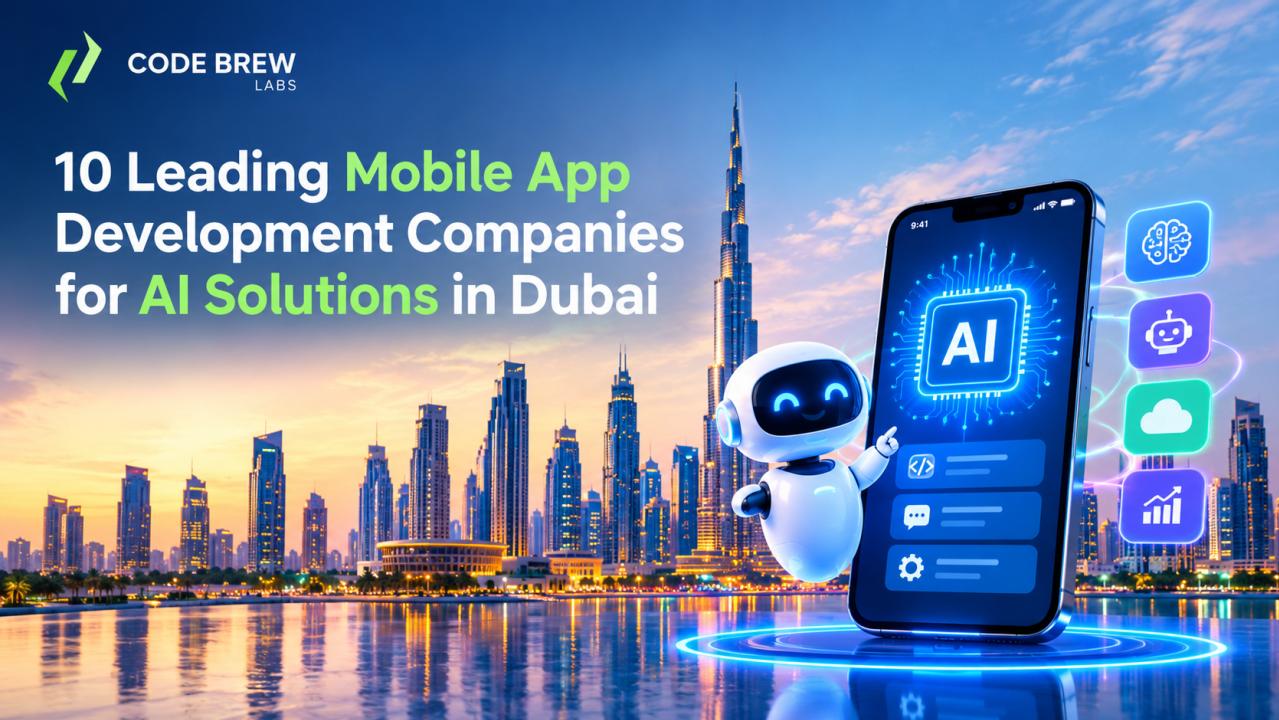
10 Leading Mobile App Development Companies for AI Solutions in Dubai
A mobile app can still work perfectly without artificial intelligence. But if the product needs to predict demand, personalize content, automate support, understand Arabic conversations, detect fraud, or make decisions from large datasets, traditional app development is no longer enough.
That is where the right technology partner matters.
Dubai has a particularly interesting market for AI-powered applications because businesses often need more than a standard iOS or Android product. They may need Arabic and English interfaces, RTL support, UAE-focused compliance, cloud infrastructure, payment integrations, enterprise APIs, analytics, and AI models within the same product.
We have reviewed companies offering mobile application engineering and AI capabilities for businesses operating in Dubai and the wider UAE. The following list focuses on the type of technical capabilities, regional positioning, AI services, and development experience that can matter when choosing a Mobile App Development Company in Dubai.
What Should Businesses Look for in an AI Mobile App Development Partner?
Before comparing vendors, we recommend separating ordinary mobile development from genuine AI engineering.
A company may be excellent at building an iOS or Android interface but have limited experience integrating machine learning models, LLMs, recommendation engines, computer vision, or AI agents.
For an AI-first project, we would assess five areas.
First is mobile engineering. The team should be comfortable with native iOS and Android development as well as frameworks such as Flutter or React Native when cross-platform development makes commercial sense.
Second is AI integration. This can include NLP, generative AI, predictive analytics, computer vision, recommendation systems, voice interfaces, AI agents, and workflow automation.
Third is data architecture. AI features are only as useful as the data pipeline behind them. A serious project therefore needs secure APIs, databases, analytics infrastructure, model monitoring, and an architecture that can handle increasing volumes of data.
Fourth is UAE localization. Arabic UX, RTL interfaces, regional payment systems, identity services, data governance, and integrations with existing enterprise platforms can significantly affect the development process.
Finally, we would examine the company's post-launch capabilities. AI-powered applications require ongoing model evaluation, security updates, performance monitoring, and feature improvements rather than a one-time app-store release.
With those factors in mind, here are ten companies worth considering.
1. Code Brew Labs – AI-Powered Mobile App Development in Dubai
Code Brew Labs has a strong focus on mobile app development in Dubai alongside AI engineering and other emerging technologies.
Its Dubai-focused mobile development offering includes AI capabilities such as machine learning, natural language processing, predictive analytics, computer vision, AI automation, and custom AI applications.
For enterprises, the broader value is the ability to bring mobile development and AI into the same product roadmap. Instead of treating AI as a separate experiment, businesses can incorporate intelligence into customer-facing applications, internal workflows, analytics systems, and digital platforms.
Key services include:
- AI-powered mobile application development
- iOS and Android development
- Machine learning solutions
- NLP applications
- AI automation
- Predictive analytics
- Computer vision
- AI consulting
- Custom software development
- Enterprise digital solutions
For a startup, this can be useful when the goal is to move from an MVP toward a scalable product. For an enterprise, the emphasis can shift toward integrations, automation, data, security, and modernization.
2. Royo Apps – Product-Focused Mobile Application Development
Royo Apps is another established name in Dubai's app development market, particularly around on-demand platforms, marketplaces, logistics, delivery, transportation, and SaaS-based products.
The company's Dubai mobile development offering covers iOS and Android applications and includes configurable product foundations designed to shorten the path from an idea to a market-ready application. Its published portfolio includes solutions for sectors such as taxi, food delivery, grocery, fitness, finance, and on-demand services.
This makes Royo Apps particularly relevant when AI is being added to an established operational model.
For example, an on-demand application could incorporate intelligent dispatch, personalized recommendations, demand forecasting, route optimization, fraud detection, or automated customer support.
The key consideration here is the relationship between AI and the underlying business model. A delivery or marketplace company does not necessarily need a standalone AI product. It needs intelligence embedded into the workflows that already generate revenue.
3. Blocktech Brew – AI, Machine Learning, and Intelligent Applications
Blocktech Brew approaches AI development from a broader technology perspective.
Its AI services cover deep learning, machine learning, NLP, computer vision, neural networks, generative AI, adaptive AI, and AI chatbot development.
That breadth can be useful for businesses that expect AI to become an important part of their overall technology environment rather than simply adding a chatbot to a mobile application.
Consider a financial application that needs customer-facing AI assistance, fraud analysis, document processing, and predictive analytics. The architecture behind those functions can be considerably more complicated than a conventional mobile application.
Blocktech Brew is therefore worth considering for projects where AI engineering and broader digital product development need to work together.
4. Dubai App Developers – AI Agents, Mobile Apps, and AWS Cloud
Dubai App Developers focuses specifically on the UAE market, combining mobile development, AI agentic development, AWS cloud services, and cloud migration.
Its published services include native iOS and Android development, Flutter, React Native, AI agents, NLP, predictive analytics, automation workflows, AWS infrastructure, and cloud migration.
The regional focus is particularly relevant for companies building products for Gulf audiences. The company highlights Arabic-first and RTL capabilities as well as UAE data-residency considerations.
This combination could suit an enterprise that is modernizing an existing application while introducing AI capabilities.
Rather than developing an AI feature in isolation, businesses can evaluate the mobile layer, backend, cloud infrastructure, and AI architecture as one connected system.
5. DeviceBee – Dubai-Based Mobile and AI App Development
DeviceBee positions itself as a Dubai-based mobile and AI application development company serving startups, enterprises, and government-related organizations.
Its published services include iOS, Android, Flutter, React Native, AI-powered applications, web development, backend/API development, DevOps, and ongoing product support.
DeviceBee also highlights projects involving organizations and brands such as Emaar, Unilever, LG, Honeywell, and Mubadala on its website.
Its Dubai presence can be useful for businesses that want a local development partner while still requiring conventional mobile engineering and AI capabilities.
The company is especially worth examining for businesses that need end-to-end application development, from strategy and UI/UX through development, deployment, cloud operations, and maintenance.
6. Cubix – AI-Driven Mobile Application Engineering
Cubix combines mobile application development with a substantial AI development offering for the UAE market.
Its AI mobile development capabilities include natural language processing, generative AI, LLM-powered functionality, predictive analytics, workflow automation, and voice experiences.
Cubix also describes experience across iOS, Android, and cross-platform applications and says its team includes more than 350 experts.
This makes the company a potential fit for businesses that need AI integrated into an existing mobile product architecture.
For instance, an ecommerce application could combine recommendation models with customer-service automation, while a healthcare application could use conversational interfaces and predictive analytics alongside traditional mobile functionality.
7. TekRevol – AI/ML Mobile Apps for Startups and Enterprises
TekRevol has a Dubai presence and offers mobile app development alongside AI, machine learning, cloud, and other software engineering services.
Its Dubai mobile development offering covers native iOS and Android apps, cross-platform development, MVP development, AI/ML applications, predictive analytics, personalization, and workflow automation.
This broad technical scope can be valuable when an AI mobile application also needs complex backend infrastructure.
A startup might use the company for MVP development and progressively add AI capabilities. An established organization could instead use the same type of engineering partner for legacy modernization, enterprise integration, and new mobile experiences.
We would pay particular attention to architecture during the discovery phase because AI features can increase infrastructure and operational requirements substantially.
8. TechnoYug – AI-Powered Mobile App Development for Emerging Businesses
TechnoYug is a software development company offering mobile application development, artificial intelligence, machine learning, and custom software solutions for startups and growing businesses.
Its development capabilities cover iOS and Android applications as well as cross-platform technologies, giving businesses flexibility when deciding how to build and scale their products. Its AI capabilities can be applied to applications that require recommendation engines, conversational functionality, predictive analytics, automation, and intelligent data processing.
For startups entering the Dubai market, this type of development partner can be useful when the product needs to move beyond a basic MVP. An initial application might begin with core customer and transaction features, while AI functionality can be introduced progressively as the business collects enough user and operational data.
The approach also makes sense for companies that want to control development costs during the early product stage. Rather than building every advanced AI feature from day one, businesses can prioritize the capabilities that have a direct connection to customer experience or revenue.
TechnoYug is therefore worth considering for startups, SMEs, and emerging digital businesses looking for a development partner capable of combining mobile engineering with AI functionality.
9. Appic Softwares – AI, Mobile, and Digital Product Development
Appic Softwares is another technology company that can be considered by businesses seeking a more startup-friendly development partner for AI-powered mobile products.
The company works across mobile application development, web development, artificial intelligence, machine learning, and custom software development, allowing businesses to bring multiple technical requirements under one development engagement.
For an AI-powered mobile application, its capabilities can support use cases such as AI chatbots, personalized experiences, predictive functionality, intelligent automation, recommendation systems, and data-driven application features.
This can be particularly relevant for startups that are still validating their product-market fit. Instead of investing immediately in a highly complex enterprise architecture, the development process can be structured around an MVP, followed by additional AI functionality once the core application has been validated.
For example, an emerging ecommerce business could launch with mobile shopping, payments, order management, and customer accounts before adding AI-powered product recommendations and personalized search. A logistics startup could begin with booking and tracking features and later introduce demand forecasting or intelligent route optimization.
The advantage of this staged approach is that AI becomes connected to a proven business requirement rather than being added simply for technical appeal.
For Dubai-based startups and growing companies evaluating development partners, Appic Softwares is worth considering when the project requires a combination of mobile development, custom software engineering, and AI capabilities.
10. Diginix AI – AI Agents and Mobile Application Development
Diginix AI combines AI engineering with mobile and web application development.
The company describes capabilities in AI agents, process automation, data training, mobile applications, web solutions, and full-stack development.
This combination is relevant for companies that want their mobile application to become an entry point into automated business processes.
For example, a field-service application could use AI to classify incoming requests, prioritize jobs, summarize technician reports, or assist employees through a conversational interface. The mobile application becomes the front end while AI agents and automation operate behind it.
That type of architecture can be more valuable than adding an isolated chatbot simply because AI is popular.
How AI Is Changing Mobile Apps for Dubai Businesses
The strongest AI mobile applications are not necessarily the ones with the most AI features. They are the ones where AI solves a measurable business problem.
Personalization
Recommendation engines can analyze user behavior and provide more relevant products, services, content, or offers.
For ecommerce, that might mean product recommendations. For real estate, it could mean matching buyers with suitable properties. For entertainment, it could mean personalized content discovery.
Conversational Interfaces
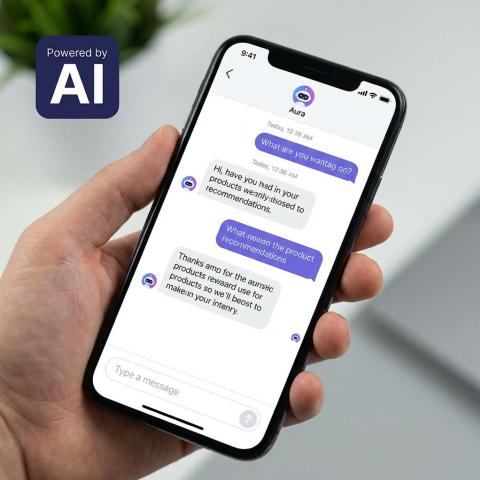
AI assistants can allow customers to search, ask questions, complete tasks, or receive support through natural language.
For Dubai businesses, Arabic and English language support can be particularly valuable, especially when the application serves a diverse regional audience.
Predictive Analytics
Historical and real-time data can be used to forecast demand, identify unusual behavior, predict churn, optimize inventory, or anticipate operational problems.
The value comes from connecting predictions to an action. A forecast that never reaches the operational team is simply another dashboard.
AI Automation
AI can classify documents, summarize conversations, route requests, process customer information, support employees, and automate repetitive workflows.
For enterprise applications, this can have a larger commercial impact than a consumer-facing AI feature because it can reduce manual workload across entire departments.
Computer Vision
Computer vision can support identity verification, quality inspection, visual search, document processing, object recognition, and other image-based workflows.
This is particularly relevant to sectors such as retail, logistics, real estate, manufacturing, security, and healthcare.
What Makes a Strong AI Mobile App Development Strategy in Dubai?
Choosing a Mobile App Development Company in Dubai should begin with the business problem rather than the technology.
We recommend starting with a clear use case.
If customer support consumes thousands of staff hours, investigate conversational AI. If users struggle to find relevant products, examine recommendation technology. If operational teams work from large historical datasets, predictive analytics may offer greater value.
The second step is data assessment.
AI requires appropriate data, and not every company has clean or sufficiently structured datasets. Before development begins, we should determine what data exists, where it resides, who can access it, how sensitive it is, and whether it can legally be used for the intended AI application.
The third step is architecture.
A modern AI mobile application may involve the mobile client, API layer, authentication, database, cloud infrastructure, AI model, vector database, analytics system, monitoring tools, and third-party services.
Designing those components independently can create technical problems later. We should instead establish how they will communicate before significant development begins.
Security also deserves early attention.
AI applications may process customer conversations, financial information, business documents, location information, or other sensitive data. Access controls, encryption, logging, model security, API protection, and appropriate data-governance practices should therefore be part of the architecture rather than something added shortly before launch.
Which Mobile App Development Company in Dubai Should You Choose?
There is no universally correct choice.
A startup launching an AI-enabled marketplace may need a very different partner from a bank modernizing an internal enterprise platform. A healthcare company will have different security and compliance requirements from a consumer ecommerce brand.
For a broad AI and mobile engineering engagement, Code Brew Labs, Cubix, and TekRevol are worth evaluating.
For businesses looking for a Dubai-centered technology partner, DeviceBee and Dubai App Developers offer particularly relevant local positioning.
For product models involving delivery, logistics, marketplaces, or on-demand services, Royo Apps is worth examining.
For projects where AI engineering is the primary requirement, Blocktech Brew and Diginix AI also deserve consideration.
The final decision should come after comparing technical proposals, architecture, relevant case studies, communication processes, security practices, ownership terms, estimated timelines, and post-launch support.
Final Takeaway: Choose the Partner That Fits the AI Use Case
The strongest AI mobile application is not necessarily the one with the longest feature list.
It is the one that solves a real customer or operational problem, works reliably at scale, protects business data, and gives the organization a clear path for future improvements.
Dubai businesses have plenty of options, but the shortlist should become much smaller once we define the actual requirements.
If the goal is to build a new AI-powered consumer application, we should prioritize mobile product engineering, UX, AI integration, scalability, and speed to market.
If we are modernizing an enterprise platform, we should put greater weight on security, APIs, data architecture, cloud infrastructure, governance, and integration experience.
And if the application is designed specifically for the UAE and GCC, Arabic UX, RTL support, regional infrastructure, regulatory requirements, and local integrations should be discussed before development begins not after the first version is already built.
The right development partner is ultimately the one that can connect AI capability with sound mobile engineering and a practical business outcome.