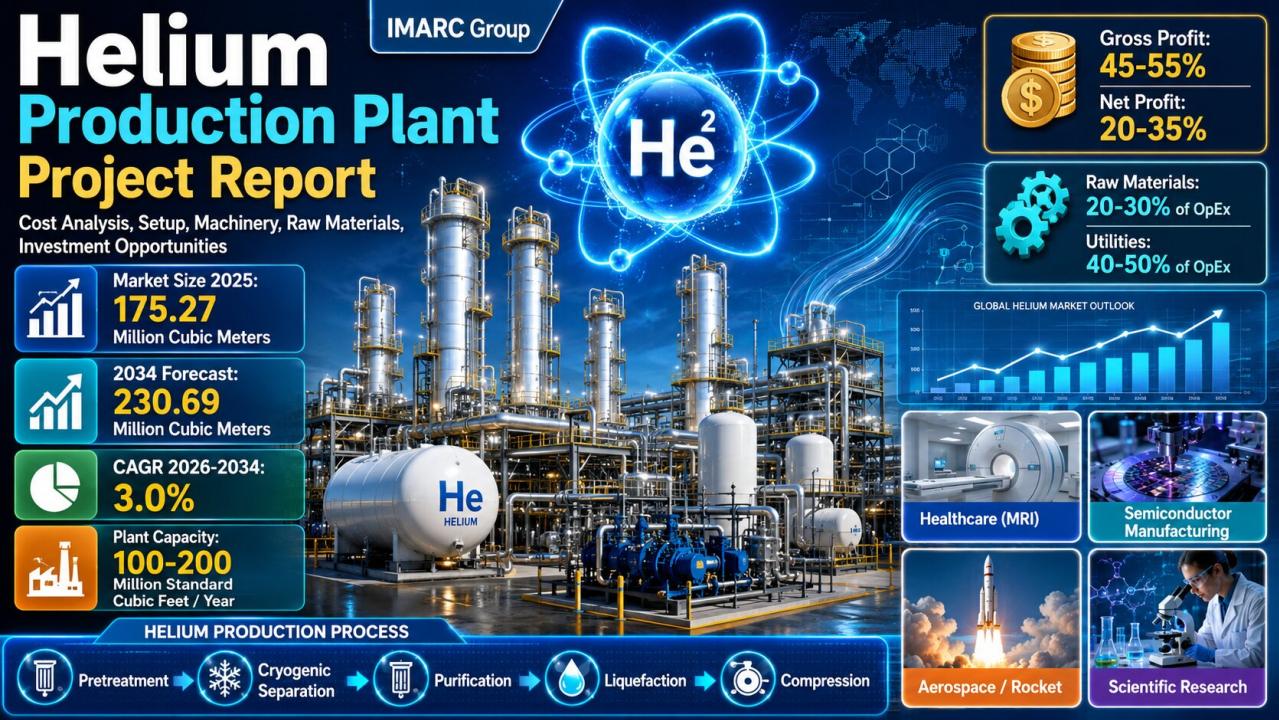

IMARC Group’s “Helium Production Plant Cost Analysis Report: Industry Trends, Plant Setup, Machinery, Raw Materials, Investment Opportunities, Cost and Revenue” provides a comprehensive roadmap for entrepreneurs, industrial manufacturers, investors, EPC companies, financial institutions, and business consultants seeking to evaluate the cost of helium production plant development and establish a commercially viable production facility. The report combines market intelligence, technical expertise, engineering insights, and financial modeling to deliver a detailed assessment of capital investment, operating expenses, plant setup requirements, machinery selection, and long-term financial feasibility, enabling stakeholders to make well-informed investment decisions.
The report offers detailed coverage of every stage of project development, including production technology, process flow, raw material procurement, utility requirements, infrastructure planning, machinery selection, manpower planning, quality control, packaging, transportation, regulatory requirements, and project implementation. It also includes an in-depth evaluation of project economics covering capital investment, operating costs, profitability analysis, return on investment (ROI), net present value (NPV), break-even analysis, and long-term financial feasibility.
What is Helium?
Helium is a colorless, odorless, non-toxic, and chemically inert noble gas primarily recovered from helium-rich natural gas reserves. Due to its extremely low boiling point and exceptional thermal conductivity, helium is essential for applications requiring cryogenic cooling, high-purity processing, leak detection, controlled atmospheres, and scientific research.
Commercial helium production involves natural gas pretreatment, cryogenic separation, purification, liquefaction, compression, storage, and cylinder filling to produce ultra-high-purity helium suitable for medical imaging, semiconductor manufacturing, aerospace systems, fiber optics, laboratories, and advanced industrial applications.
Helium Market Trends and Growth Drivers
The global helium industry continues to experience steady demand, supported by increasing deployment of MRI systems, expansion of semiconductor manufacturing, growth in aerospace programs, quantum computing research, and industrial gas applications. Helium remains a strategic industrial gas with limited natural reserves, making reliable production facilities increasingly valuable for long-term supply security.
Technological advancements in cryogenic separation, helium recovery systems, gas purification technologies, and liquefaction processes are improving production efficiency while reducing operational losses. Rising investments in semiconductor fabrication plants, healthcare infrastructure, and scientific research facilities are expected to sustain long-term market growth.
Request for a Sample Report: https://www.imarcgroup.com/helium-manufacturing-plant-project-report/requestsample
Why Invest in a Helium Production Plant?
Growing industrial demand and constrained global supply continue to strengthen the investment outlook for helium production. The increasing adoption of advanced medical equipment, semiconductor manufacturing, space exploration, fiber optic production, and precision engineering has created sustained demand for high-purity helium. Limited natural reserves and increasing emphasis on domestic industrial gas production further enhance the long-term attractiveness of new helium production facilities.
Key Investment Highlights
- Strong demand from healthcare and MRI systems
- Expanding semiconductor manufacturing capacity
- Increasing aerospace and defense applications
- Rising scientific and research activities
- Growing demand for ultra-high-purity industrial gases
- Long-term strategic importance due to limited supply
Helium Production Plant Feasibility Study
Before investing in a helium production facility, a detailed feasibility study helps determine whether the proposed project is technically, commercially, operationally, and financially viable. It provides investors with a clear understanding of project risks, investment requirements, production capabilities, and expected profitability.
The feasibility study includes:
- Technical feasibility assessment
- Commercial viability analysis
- Financial feasibility evaluation
- Market demand assessment
- Competitive landscape analysis
- Risk and sensitivity analysis
- Profitability evaluation
- Investment decision support
Helium Production Business Plan
A professionally prepared business plan provides a structured roadmap for establishing and operating a commercially successful helium production facility. It helps entrepreneurs define investment priorities, operational strategies, production planning, revenue generation models, and long-term expansion opportunities while supporting funding discussions with investors and financial institutions.
The business plan covers:
- Business model
- Revenue strategy
- Production planning
- Marketing and sales strategy
- Investment planning
- Operational framework
- Business expansion roadmap
Detailed Project Report (DPR)
The Detailed Project Report (DPR) provides a complete technical and financial blueprint for implementing a helium production project. It supports project financing, regulatory approvals, engineering planning, and execution by presenting detailed information on production technology, plant design, machinery selection, cost estimation, and financial performance.
The DPR includes:
- Executive summary
- Process technology
- Plant capacity planning
- Machinery selection
- Cost estimation
- Financial projections
- Risk assessment
- Project implementation strategy
Manufacturing Process Overview
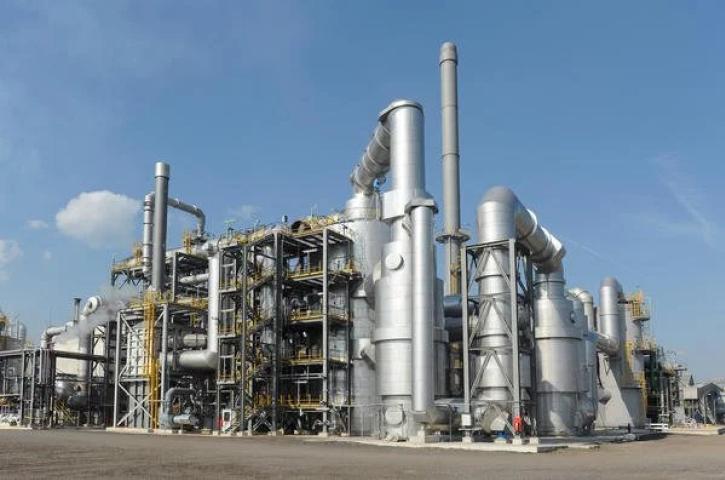
Commercial helium production begins with the extraction of helium-rich natural gas, followed by pretreatment to remove impurities. Cryogenic separation is then used to isolate helium from other gases, after which the product undergoes purification, liquefaction where required, compression, storage, and packaging before distribution to industrial customers. Modern production facilities incorporate advanced recovery and purification technologies to maximize helium yield while maintaining ultra-high product purity.
Plant Setup Requirements
Establishing a helium production plant requires careful planning of site selection, utilities, infrastructure, cryogenic processing equipment, storage systems, transportation facilities, environmental compliance, and skilled manpower. Efficient plant design improves operational reliability, product quality, and long-term production efficiency.
Major setup requirements include:
- Plant location
- Land and infrastructure
- Utility systems
- Plant layout
- Documentation
- Environmental compliance
- Industrial licenses
Machinery and Equipment
Machinery selection plays a critical role in determining production efficiency, operating costs, and product purity. Depending on plant capacity and technology, major equipment generally includes cryogenic separation units, compressors, heat exchangers, purification systems, liquefiers, storage tanks, cylinder filling systems, and process control equipment.
Raw Material Requirements
The primary feedstock for helium production is helium-bearing natural gas with commercially recoverable helium concentrations. Additional process materials may include cryogenic refrigerants, molecular sieves, activated carbon, catalysts, and other purification media required to achieve ultra-high-purity helium suitable for industrial and medical applications.
Capital Expenditure (CapEx) Analysis
The report provides a comprehensive analysis of the capital expenditure (CapEx) required to establish a helium production plant, enabling investors to estimate the overall project investment before commencing operations. It evaluates one-time capital requirements associated with land acquisition and site development, civil construction, plant infrastructure, cryogenic separation equipment, helium purification systems, liquefaction units, storage tanks, cylinder filling systems, utility installation, engineering and design, project management, installation and commissioning, pre-operative expenses, contingency provisions, and initial working capital requirements. This detailed assessment helps businesses develop realistic investment budgets, secure project financing, and optimize capital allocation for long-term operational success.
Operating Expenditure (OpEx) Analysis
The report presents a detailed evaluation of the operating expenditure (OpEx) associated with running a commercial helium production facility. It analyzes recurring operational costs, including raw material procurement, electricity and utility consumption, labor and manpower expenses, equipment maintenance, quality control and laboratory testing, packaging materials, transportation and logistics, administrative overheads, insurance, regulatory compliance, depreciation, taxes, and other operational expenses. By assessing these cost components, the report enables investors and manufacturers to understand production economics, improve cost efficiency, optimize resource utilization, and enhance long-term profitability.
Ask Analyst for Customization: https://www.imarcgroup.com/request?type=report&id=9046&flag=C
Helium Production Plant Cost Analysis
The overall investment depends on several technical and commercial factors, including plant capacity, production technology, automation level, location, utility infrastructure, and storage facilities. Capital expenditure generally includes land acquisition, civil construction, cryogenic processing equipment, storage systems, installation, utilities, and commissioning, while operating expenditure covers feedstock procurement, electricity, maintenance, manpower, logistics, and quality assurance.
Project Economics
The report provides a detailed techno-economic assessment covering capital investment, operating expenditure, production costs, income projections, taxation, depreciation, profitability, cash flow analysis, return on investment (ROI), net present value (NPV), payback period, sensitivity analysis, and overall financial feasibility to support informed investment decisions.
Who Should Buy This Report?
This report is designed for entrepreneurs planning new manufacturing facilities, industrial gas companies, investors, financial institutions, EPC contractors, industrial consultants, project developers, government agencies, corporate strategy teams, and organizations evaluating opportunities in the global helium industry.
Key Questions Answered in the Report
- How has the helium market performed and what is its future outlook?
- What factors are driving demand for helium globally?
- What are the major applications and end-use industries?
- What production technologies are commonly used?
- What machinery is required to establish a helium production plant?
- What are the raw material requirements?
- What utilities and infrastructure are needed?
- What are the major capital and operating cost components?
- What financial returns can investors expect?
- What regulatory approvals and certifications are required?
- What are the major investment risks and opportunities?
Report Customization
The report can be customized according to specific project requirements, including production capacity, plant location, country-specific regulations, manufacturing technology, machinery configuration, raw material sourcing, financial assumptions, utility requirements, and business model. This enables organizations to obtain project-specific insights aligned with their investment objectives.
Why Choose IMARC Group?
IMARC Group combines market research, technical consulting, feasibility analysis, financial modeling, and project implementation expertise to help businesses evaluate manufacturing opportunities with greater confidence. Its project reports are designed to support strategic planning, investment evaluation, financing discussions, and successful plant implementation across a wide range of industrial sectors.
Services
- Market Research
- Feasibility Study
- Detailed Project Report (DPR)
- Business Plan Development
- Plant Setup Consulting
- Factory Auditing
- Regulatory Approvals and Licensing
- Company Incorporation
- Procurement Consulting
- Recruitment Services
- Marketing and Sales Strategy
Contact Us:
IMARC Group
134 N 4th St. Brooklyn, NY 11249, USA
Email: sales@imarcgroup.com
Tel No:(D) +91 120 433 0800
United States: +1–201971–6302