A distributed music team loses time when a promising first test arrives without the context needed to judge it. A lyric sheet in one chat, a mood reference in another, and a revision request in a third leave the next person guessing which decision is settled. This AI music production handoff template turns that scattered context into one compact record that can travel with each test version.
Start with one decision owner
Name one person who can resolve competing notes for this test. That person is not necessarily the producer or the person entering a prompt; they are the tie-breaker for the brief. Put their name beside a short decision question: for example, “Does this version make the chorus feel more urgent without making the vocal line crowded?” A defined question gives reviewers a shared target and keeps feedback from becoming a list of unrelated preferences.
Use a compact handoff sheet
Copy this template into the team’s project space before a new test. Fill in the fields with decisions, not aspirations. “Warm but exciting” is hard to test; “warm electric piano under a restrained drum pattern, with a lift at the chorus” gives a reviewer something specific to hear.
AI music production handoff template
- Project and version: project name, date, and a draft label such as
handoff-v01. - Decision owner and review question: one owner plus the one decision this pass must inform.
- Lyrics or vocal direction: the approved lyric excerpt, or “instrumental”; note which lines must remain unchanged.
- Mood and listener moment: describe the intended emotional movement and where it should change.
- Arrangement roles: name the lead element, supporting elements, and elements to avoid.
- Constraints: duration target, edit points, prohibited references, language, vocal/instrumental choice, and any unresolved rights question that needs separate review.
- Test instruction: state which single variable this version changes from the prior test.
- Feedback deadline and closeout rule: name reviewers, deadline, and how the owner will record the next decision.
Keep rights and delivery decisions visible but separate from the creative brief. This template does not determine whether a result is cleared for a particular use, nor does it make a quality promise. Those questions need the applicable terms and the team’s own review.
Turn the sheet into a testable music brief
The point of the sheet is to preserve creative intent across handoffs, not to make a longer prompt. Read it from top to bottom and turn it into a short instruction that keeps the approved inputs and the current experiment together. For a lyric-led test, separate the lyric text from the music direction. For an instrumental test, state the absence of vocals and describe the space the arrangement should leave for other audio.
A current MusicMaker page for MiniMax Music 3.0 presents a workflow built around lyrics and a music prompt, with vocal and instrumental paths. That makes the completed brief a useful secondary input record, but it does not remove the need to listen, compare versions, or check the terms that apply to a team’s use.
Once the team has completed its handoff, it can use MiniMax Music 3.0 on MusicMaker as one secondary route for applying the brief in a music-generation workflow. Disclosure: I am the founder of MusicMaker AI. This article links to its MiniMax Music 3.0 page.
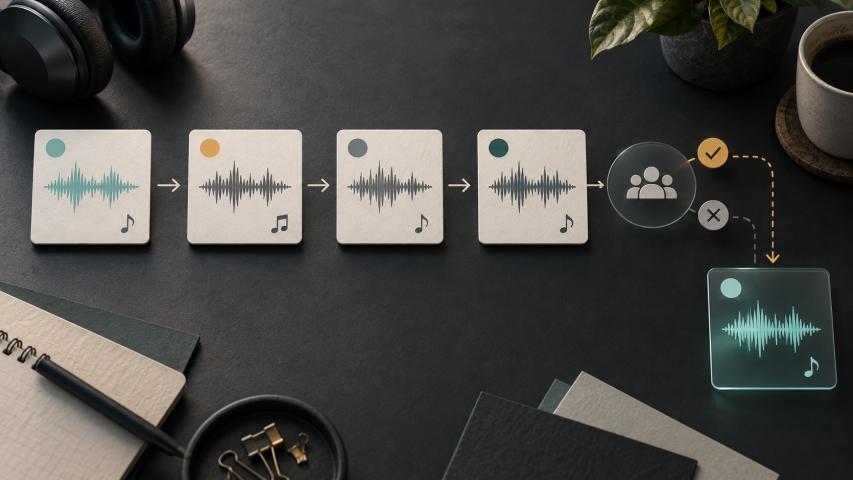
Log versions so reviewers can compare one change at a time
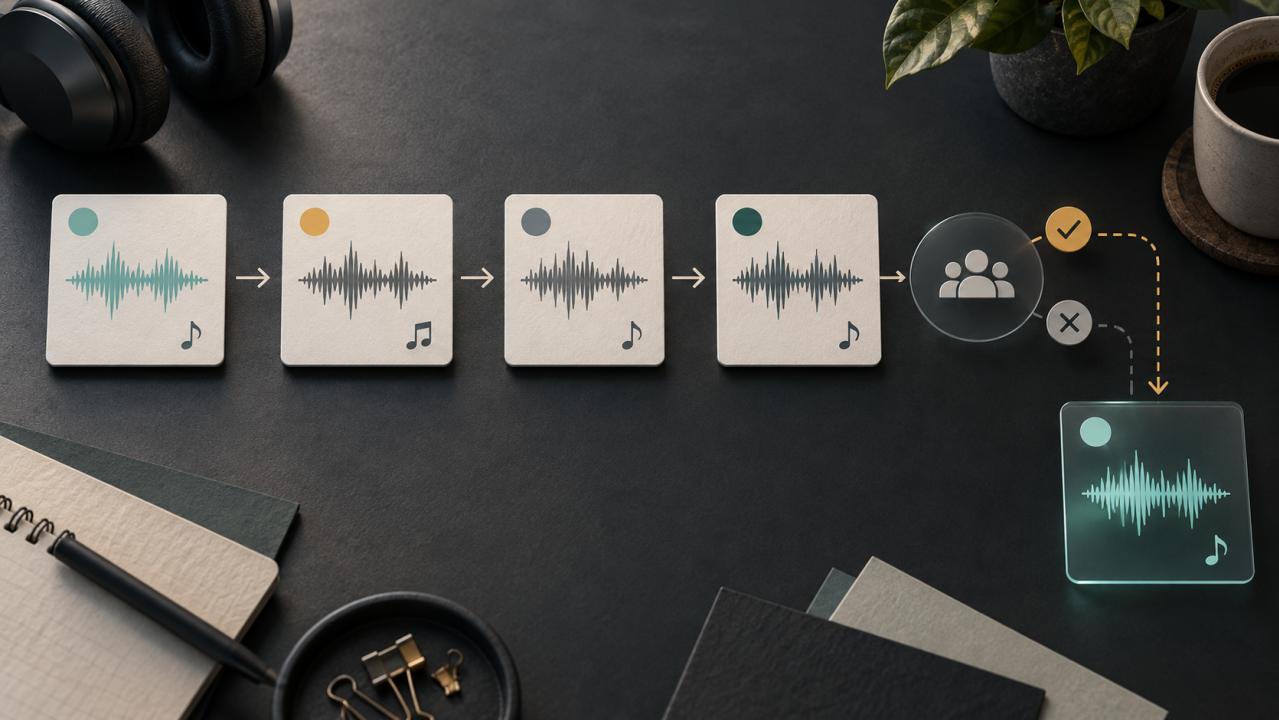
Every generated or exported test needs a version record. The Audio Engineering Society’s published naming guidance illustrates why a consistent filename can carry useful production context. For a compact team log, use a stable project label, a version number, and one short change label. Avoid renaming an old file after comments arrive; create the next version instead.
| Version | What changed | Review question | Decision |
|---|---|---|---|
| v01 | Baseline brief | Is the overall mood in scope? | Record owner note |
| v02 | Changed chorus energy only | Did the lift improve without crowding the vocal? | Keep, revise, or stop |
| v03 | Changed lead instrument only | Does the lead support the listener moment? | Record owner note |
The labels above are examples, not a required naming standard. What matters is that reviewers can find the brief, identify the change, and answer the same question. If two variables change at once, mark the comparison as exploratory rather than treating it as evidence for either change alone.
Make feedback actionable
Ask each reviewer to give one observation, one reason tied to the handoff, and one requested next action. “The second version feels off” becomes “the chorus arrives earlier than the brief’s lift point; test the same arrangement with a later transition.” The decision owner then records one of three outcomes: keep the version, run one named revision, or stop the direction.
Do not use a feedback thread as the source of truth. Copy the outcome back into the version log and update the handoff sheet if the team has made a new durable decision. That small step prevents a later contributor from restoring an option the team already ruled out.
Close the loop before the next handoff
Before moving a selected test to editing, recording, or another creative stage, the owner should close the record:
- Mark the selected version and the reason it was selected.
- List the still-open decisions rather than silently treating them as resolved.
- Archive the handoff sheet, version log, and review notes together.
- Give the next recipient a new decision question instead of forwarding an unfiltered comment history.
A handoff template cannot make a music result right for every purpose. It can, however, make the team’s intent, constraints, version history, and next decision easy to inspect. That is enough to make a remote review repeatable—and to make the next test more informative than the last.
Source notes
Workflow terminology and product-input boundary were checked against the MusicMaker MiniMax Music 3.0 page on September 18, 2026. The version-log rationale also consulted the Audio Engineering Society’s published mix-stem and version-naming guidance. Neither source is used here to establish pricing, rights, availability, output quality, or a publication result.