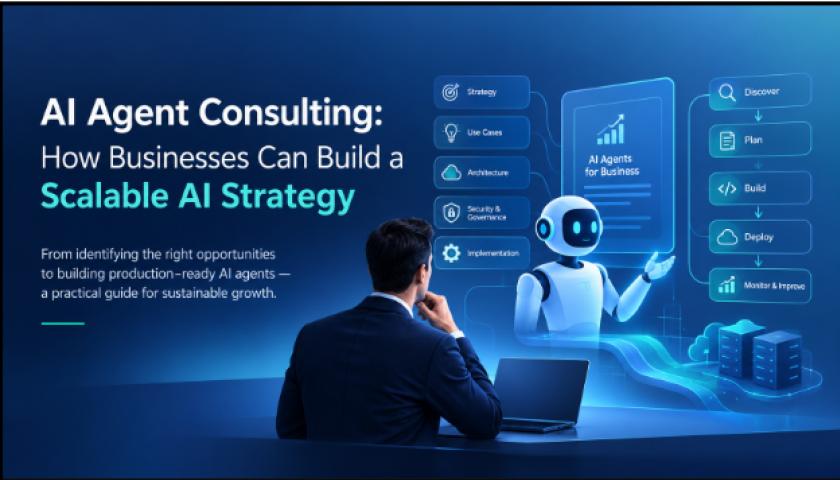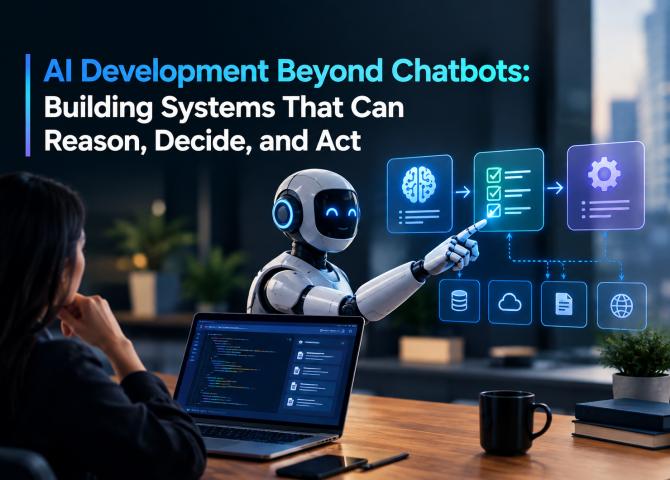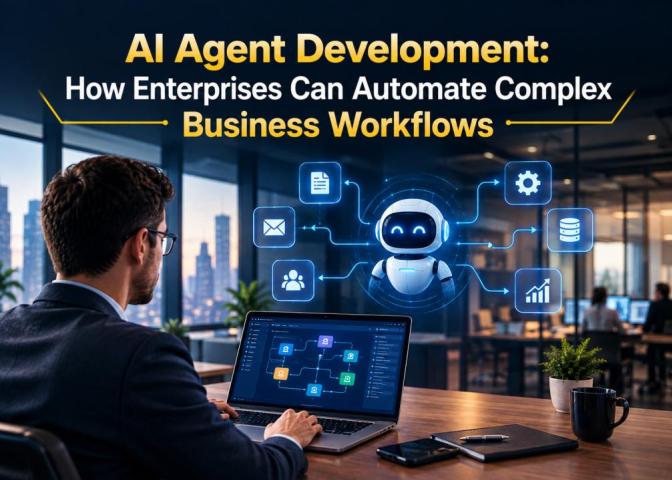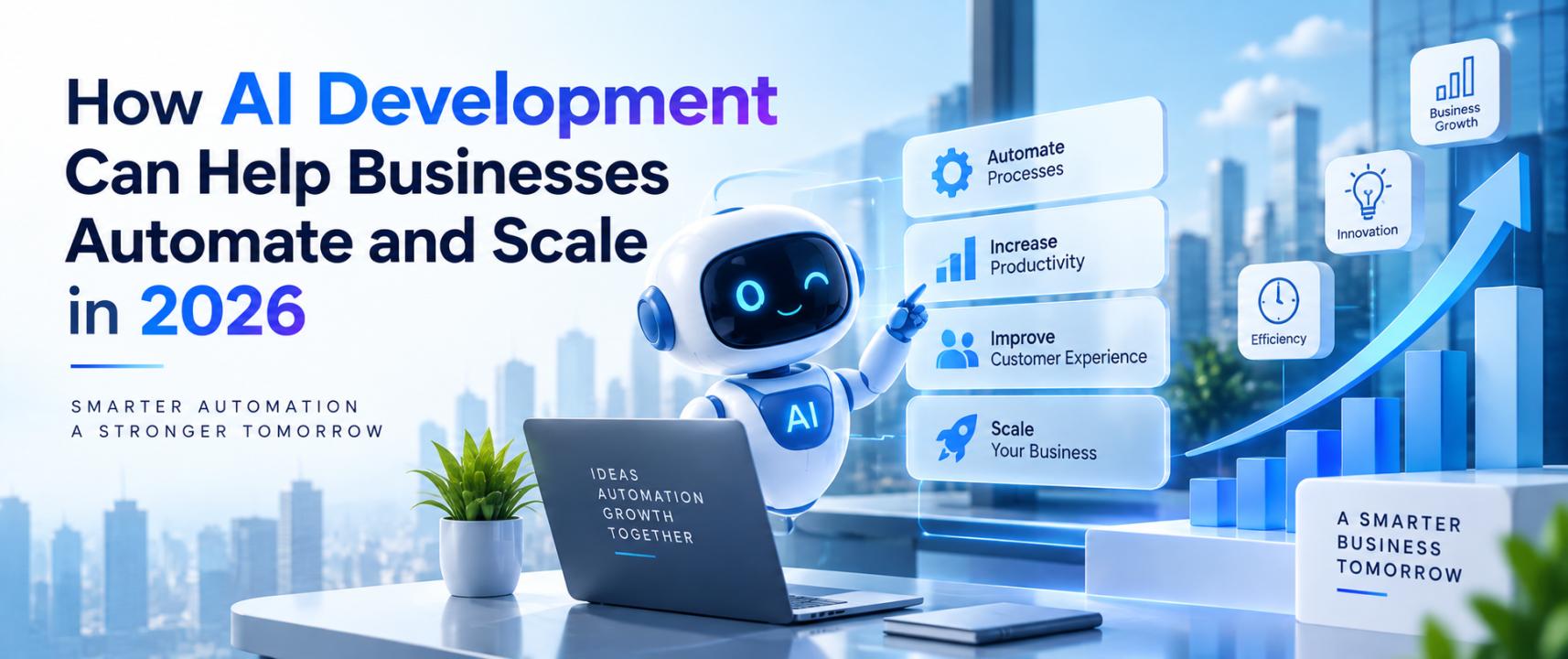
AI is moving beyond chatbots and content generation. In 2026, businesses are increasingly using AI development, AI agents, intelligent automation, and AI-powered applications to improve operations, reduce repetitive work, and scale processes more efficiently.
The shift is particularly important for business leaders because the value of AI is no longer only about generating information. Modern AI systems can connect with business data, use tools, support decisions, and execute parts of a workflow. Enterprise AI is increasingly being integrated into business operations and decision-making rather than remaining isolated as experimental tools.
Why AI Development Matters for Businesses in 2026
Traditional automation works well when processes are predictable and rule-based. However, many business processes involve unstructured documents, natural language, changing conditions, and human decisions.
AI development can add intelligence to these workflows.
For example:
Traditional automation:
Invoice received → predefined rules → process invoice
AI-powered automation:
Invoice received → understand document → extract information → validate data → identify exceptions → trigger workflow
This allows businesses to automate processes that previously required more manual intervention.
1. Automating Repetitive Business Processes
One of the most direct benefits of AI development is reducing repetitive manual work.
Businesses can use AI to assist with:
Document processing
Customer support
Data entry
Invoice processing
Email classification
Report generation
Lead qualification
Employee onboarding
Internal knowledge searches
AI can understand unstructured information while traditional automation can execute predefined steps.
Combining both can create more capable intelligent automation systems. Businesses looking to combine AI with process automation can explore AI-powered business solutions designed around specific operational requirements.
2. AI Agents Can Execute Multi-Step Workflows
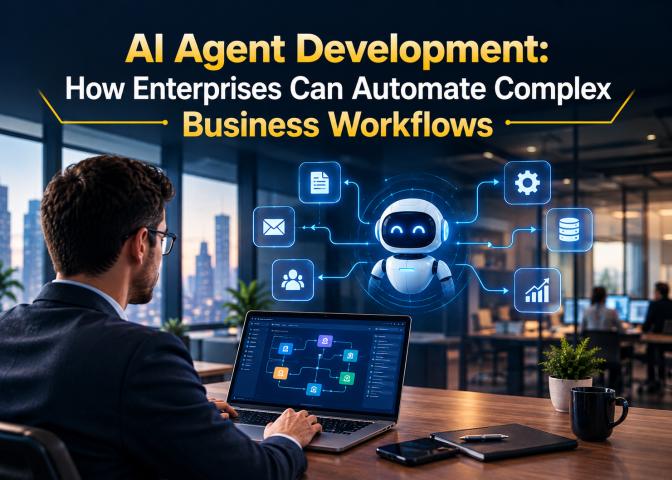
A major development in 2026 is the increasing use of AI agents.
Instead of simply responding to a request, an AI agent can potentially:
Understand → Plan → Use Tools → Execute → Evaluate → Continue
For example, a sales AI agent could receive a new lead, research relevant information, update a CRM, prepare a personalized communication, and create a follow-up task based on defined permissions.
This moves AI from answer generation toward workflow execution.
However, production agents require more than a capable model. Businesses also need identity, access controls, monitoring, governance, reliable data, and clear boundaries around what an agent can do.
3. Improving Customer Experience
AI development can help businesses provide faster and more personalized customer experiences.
AI-powered systems can:
Understand customer questions
Search company knowledge
Recommend relevant products or services
Summarize customer history
Assist support teams
Route complex cases
Automate routine responses
An AI application can also connect with CRM and other business systems, allowing customer interactions to become more context-aware.
The goal is not simply to replace human support. A better approach is often to let AI handle repetitive interactions while employees focus on complex or high-value customer situations.
4. Scaling Operations Without Scaling Manual Work
Business growth often creates an operational challenge: more customers, transactions, documents, and support requests require more employees and infrastructure.
AI can help businesses scale by automating parts of these processes.
For example:
More customers → More support requests → AI handles routine requests → Human team handles complex cases
This can improve operational capacity without requiring every additional workload to be handled manually.
AI-powered automation can be especially useful when combined with existing enterprise systems and RPA, where AI handles unstructured decisions and RPA handles predictable application-level tasks. Businesses can explore RPA automation solutions for workflows where rule-based automation and AI can complement each other.
5. Turning Business Data Into Actionable Intelligence
Most businesses already have large amounts of data across applications, databases, documents, emails, and operational systems.
The challenge is turning that data into useful decisions.
AI development can help organizations build systems for:
Predictive analysis
Business intelligence
Document intelligence
Demand forecasting
Customer insights
Risk detection
Automated reporting
For example, an AI system could analyze operational data and identify unusual patterns before they become larger business problems.
This makes AI more than a productivity tool—it can become part of the organization's decision-support infrastructure.
6. Connecting AI With Existing Business Systems
AI becomes significantly more useful when it can interact with the systems a business already uses.
These may include:
CRM
ERP
HRMS
Databases
Cloud platforms
APIs
Helpdesk systems
Financial applications
A modern AI architecture can connect the model to these systems through APIs, tools, retrieval systems, and controlled workflows.
The architecture can look like:
User → AI Application → AI Model → Business Data & Tools → Workflow → Result
This approach allows businesses to integrate AI into existing operations rather than creating another isolated application.
7. AI + RPA: A Powerful Automation Combination
AI and RPA solve different parts of the automation problem.
AI: Understands, analyzes, predicts, and handles unstructured information.
RPA: Executes structured and repetitive tasks based on defined rules.
Together, they can create intelligent end-to-end automation.
For example:
AI reads an invoice → extracts information → validates the details → RPA enters the approved data into an ERP → workflow sends confirmation
This combination can be valuable in finance, healthcare, logistics, HR, customer service, and other operational environments.
8. AI Development Must Focus on Governance
Scaling AI is not only a technology challenge.
As AI systems gain access to business data and the ability to perform actions, organizations need strong governance.
Important considerations include:
Data privacy
Access control
Human approval
Model evaluation
Monitoring
Auditability
Security
Cost management
AI usage policies
This is especially important with AI agents because an incorrectly configured agent can potentially take actions across connected systems. Recent enterprise guidance increasingly emphasizes governance, observability, and security as organizations move agents from prototypes into production.
How Businesses Should Approach AI in 2026
Businesses should not start with:
"Where can we use AI?"
A better question is:
"Which business process creates the most value if intelligence and automation are added?"
A practical approach is:
1. Identify a high-value process
Find repetitive, expensive, slow, or error-prone workflows.
2. Analyze the existing workflow
Understand the data, systems, people, and decisions involved.
3. Select the right AI capability
This could be Generative AI, RAG, AI agents, predictive AI, computer vision, or intelligent automation.
4. Integrate with existing systems
Connect AI to the business applications and data it actually needs.
5. Add governance and human oversight
Define permissions, approval points, monitoring, and security controls.
6. Measure business impact
Track metrics such as processing time, cost reduction, accuracy, productivity, and customer experience.
This approach helps organizations move from an AI proof of concept to a measurable business solution.
The Future of AI-Powered Business Operations
The biggest opportunity in 2026 is not simply deploying more AI tools. It is redesigning how work gets done.
AI agents, automation, enterprise data, and intelligent applications are increasingly being combined into systems that can coordinate multi-step processes. Industry discussions in 2026 are increasingly focused on operating these systems safely and reliably at enterprise scale.
For business leaders, this means AI strategy should focus on three areas:
Intelligence → Can AI understand the business problem?
Automation → Can it reduce manual work?
Scale → Can the solution operate reliably as the business grows?
When these three capabilities come together, AI can become a genuine business infrastructure rather than simply another software tool.
Final Thoughts
AI development in 2026 is becoming increasingly focused on business outcomes rather than AI experimentation.
From intelligent document processing and customer support to AI agents, predictive analytics, and RPA, businesses can use AI to automate repetitive work, improve decisions, and scale operations.
The organizations that benefit most will not necessarily be those using the largest models. They will be the ones that identify the right processes, connect AI with reliable business data, implement strong governance, and continuously measure the results.
The future of business automation is not just about making processes faster. It is about making them more intelligent, adaptive, and scalable.
Build AI-Powered Business Solutions with Gramosoft
Gramosoft helps businesses transform operations through AI development, Generative AI, Agentic AI, intelligent automation, RPA, custom software development, cloud solutions, and enterprise applications.
Whether you want to build an AI-powered application, automate business workflows, integrate AI with existing systems, or develop an intelligent agent, the right technology architecture can turn an operational challenge into a scalable business advantage.
Explore AI development services to build AI solutions tailored to your business requirements, or discover RPA services for structured and repetitive process automation.
Ready to automate and scale your business with AI? Connect with Gramosoft and start building your next intelligent business solution.
Visit Us : https://gramosoft.tech/