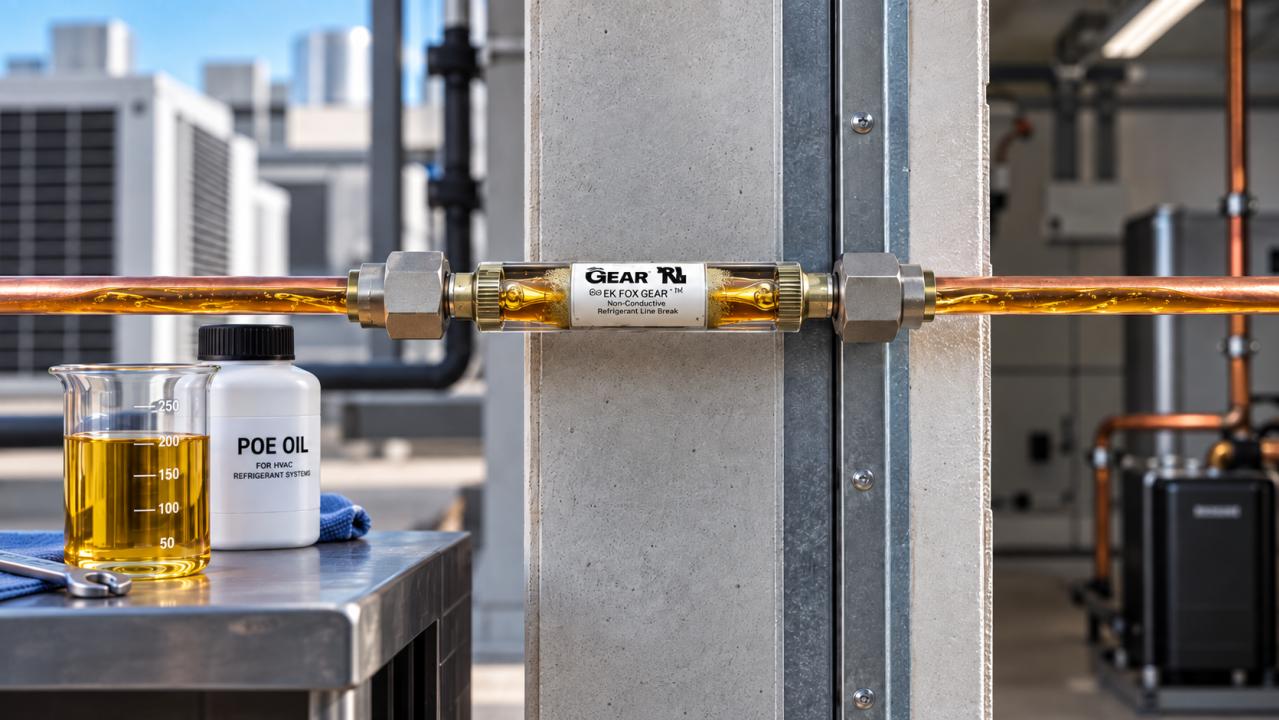
Polyolester oil is easy to overlook during design review. It sits on the mechanical schedule as a footnote to the compressor selection, and most engineers never think about it again. Yet POE oil travels everywhere the refrigerant goes, which means every fitting, valve, and specialty component in the circuit is exposed to it for the life of the system. That includes any dielectric isolation point in the piping.
If a project requires a non-conductive refrigerant line break, lubricant compatibility deserves the same attention as the pressure rating. POE interacts differently with many polymers, elastomers, adhesives, and contaminants than traditional mineral oils, which makes material compatibility an important part of component selection.
Why POE Oil Behaves Differently
POE lubricants are widely used with R-410A and many other HFC refrigerant systems. Unlike mineral oil, POE is a polar synthetic ester, and that chemistry changes how it behaves around non-metallic materials. Published compatibility studies document swelling, softening, and weight change in certain elastomers and plastics after exposure to specific refrigerant and lubricant combinations, which is why the outcome always depends on the particular POE formulation, the refrigerant, the material, and the operating conditions rather than on a general rule.
POE is also strongly hygroscopic. Once exposed to ambient air, POE begins absorbing moisture and retains it more readily than mineral oil. Moisture matters beyond the compressor: water and POE can react through hydrolysis, producing acids that circulate with the refrigerant and reach every material in the wetted path.
A Line Break Sits in the Wetted Path
A dielectric break installed in a refrigerant line is not a dry electrical accessory bolted to the outside of the pipe. It is a pressure-bearing section of the circuit. Refrigerant and entrained oil pass through it during system operation, on the suction line and the liquid line alike, through every heating and cooling cycle. Any polymer body, seal, or bonded joint inside the break therefore has to be evaluated for the actual operating conditions of the refrigeration circuit.
The Verification Checklist
Before a dielectric break goes on a drawing or into a submittal, a few specific questions are worth putting to the manufacturer.
• Wetted material compatibility. Ask which materials contact refrigerant and oil, and what exposure testing backs them up. Compatibility data may report changes in swell, weight, dimensions, or hardness after exposure. Engineers should compare those results with the manufacturer’s stated acceptance criteria for each wetted material.
• Test methodology. Sealed tube testing, such as the methodology described in ASHRAE Standard 97, is a recognized way to evaluate chemical stability among refrigerants, lubricants, and materials. It is a screening method rather than a full simulation of field service, so also look for component level or application specific validation when available.
• Bonded joints. If the assembly contains bonded joints, ask whether the adhesive or bonding system has been evaluated for continuous exposure to the specified refrigerant and lubricant combination. Initial pressure testing alone does not establish long term chemical compatibility.
• Refrigerant match. Compatibility should be evaluated for the specific refrigerant and lubricant combination. A component proven on an R-410A and POE system should be applied to that service. If the project uses a different refrigerant, ask for test data specific to it rather than assuming carryover.
• Pressure ratings by line size. Working and burst pressures are published per model, and they can differ between smaller and larger line sizes. Verify the rating for the exact size on your drawings against the manufacturer’s current data sheet.
• Temperature range. Suction and liquid lines run at different temperatures, and plenum or mechanical room placements add their own conditions. Confirm the rated range covers the actual line the break will serve.
• Moisture discipline. Since hydrolysis acids attack materials system-wide, the installation spec should reinforce deep evacuation, properly sized filter driers, and careful handling of oil containers. A well-chosen component can still be undermined by a wet system.
• Installation limits. Brazing heat near a polymer assembly, bending loads, and placement restrictions can all void the design assumptions. Read the installation instructions before the piping layout is frozen.
Where This Matters in Secure Facilities
For SCIF perimeter penetrations, metallic utilities may require TEMPEST countermeasures such as dielectric isolation or grounding when recommended by the Certified TEMPEST Technical Authority. Refrigerant piping can make that requirement more complicated because the isolation point also becomes part of a sealed, pressurized refrigeration circuit. The construction details behind SCIF refrigerant line penetrations cover sealing, acoustics, and electrical isolation together, and the isolation component has to satisfy the mechanical requirements at the same time.
A component intended for plumbing or another piping service should not automatically be assumed suitable for a refrigeration circuit. Where a non-conductive refrigerant line break is specified, manufacturer documentation should address the refrigerant and lubricant combination, electrical isolation, working pressure, temperature range, and installation limitations.
The Takeaway
None of this calls for exotic analysis. Find out what the wetted materials are, get compatibility data for the refrigerant and oil the system will actually run, and check the ratings for the exact line size against the current data sheet. Then put those answers in the submittal where they belong. A submittal checklist for non-conductive line breaks can keep that step organized. If a manufacturer cannot produce the answers, that tells you something too.
Meta: A practical guide to POE oil compatibility in refrigerant line breaks, including material testing, pressure ratings, temperature limits, and SCIF applications.