Introduction
Plastic parts are used in a wide variety of fields,
including the automotive industry, electronics, medical devices, packaging,
consumer products, and industrial applications. In order to achieve consistent
dimensions and quality when producing these parts, properly engineered tooling
is necessary Custom
plastic mold manufacturers play an important role in the production
process. They create the moulds based on the shape of the product, the material
to be used, the required tolerance, and the manufacturing specifications.
Unlike standard tooling, custom solutions can be designed to meet the
particular requirements of each component. A thoughtfully planned mould can
enable repeated production, efficient cycling, less waste, and reliable
performance over long periods of manufacturing.
Understanding Custom Plastic Molds
A plastic mold is made to give the desired shape and
characteristics to a component that is produced by the injection moulding
process; it can have cavities, cores, cooling channels, runners, gates, and an
ejection system. When standard tooling cannot meet their particular needs,
companies usually have to use custom molds for plastic parts. Such
custom solutions are able to handle complicated geometries, intricate details, various
surface finishes, and close dimensional tolerances. Because of this
flexibility, they are appropriate for use in cases where accuracy and
repeatability of the component are important. Moreover, the correct choice of
tooling also enables manufacturers to keep the quality of production consistent
over a number of manufacturing cycles.
Starting With
Product Requirements
The process of development starts with a thorough
examination of the product and the requirements for its manufacturing.
Generally, the engineers look at the product drawings, the dimensions, the
tolerances, the specifications regarding materials, the production volume, and
the conditions of use. They also consider the wall thickness, the draft angles,
any undercuts, the shrinkage, and other design features that can affect the
molding. On the basis of this information, manufacturers of custom plastic
mold manufacturers are able to decide on an appropriate tooling approach.
By identifying possible problems at an early stage, it is possible to avoid
unnecessary changes later on and to establish a more realistic basis for mold
design, manufacturing, testing, and production.
Key Factors Considered
●
Product dimensions and tolerances
●
Plastic material and shrinkage
●
Component geometry and complexity
●
Required production quantity
●
Cavity configuration
●
Gate and runner arrangement
●
Cooling system requirements
●
Ejection method and surface finish
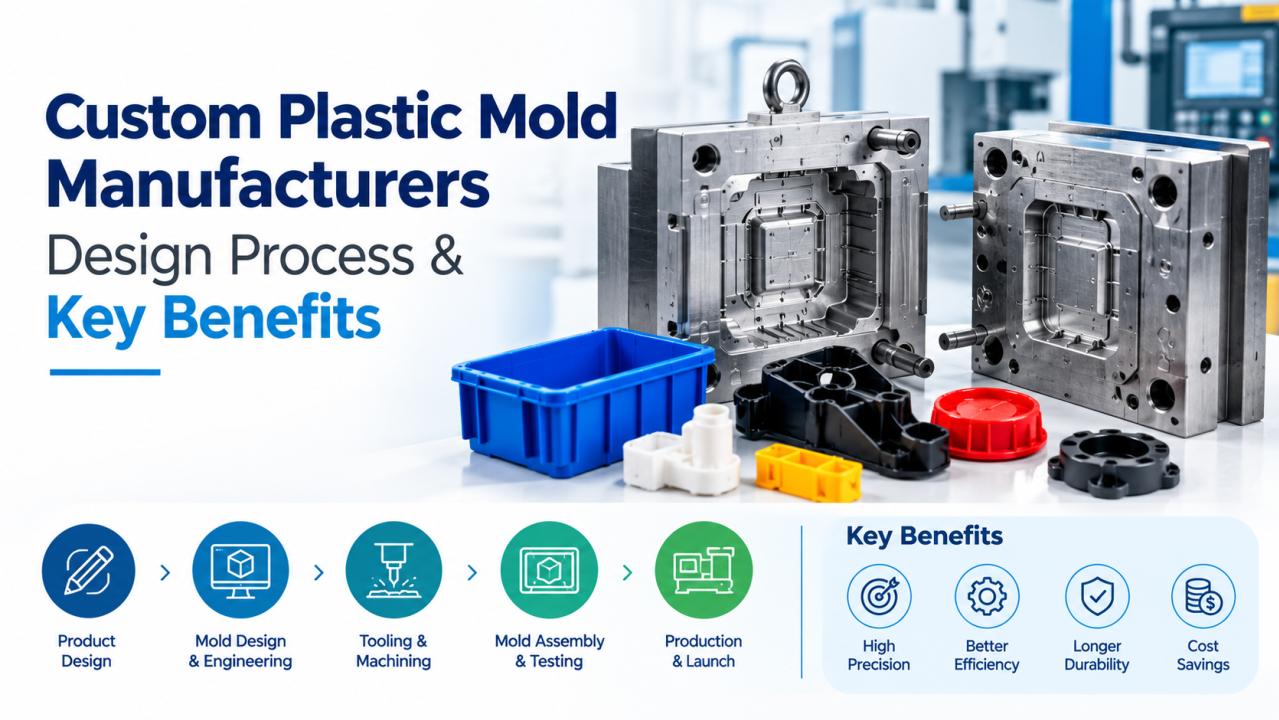
Developing the mold design
After the product requirements have been determined, the
engineers work out the concept for the tooling. In planning the mould layout,
the engineers take into account various important factors such as the
arrangement of the cavities, the parting lines, the positions of the gates, the
cooling channels, and the ejection mechanisms. The aim is to produce a
well-balanced design that enables the material to flow, cool, and be ejected
efficiently. While developing the plastic mold design process, the
engineers also take the selected plastic material into consideration since
different materials have different shrinkage and flow properties. Careful
planning contributes to the development of tooling that ensures reliable
operation and consistent production of the components.
Manufacturing And
Precision Machining
Once the design has been approved, the manufacturers produce
the individual parts of the mould by means of appropriate precision machining
methods. The type of machining used will depend on the tooling requirements and
may include CNC machining, electrical discharge machining, grinding, polishing,
and other finishing operations. It is vital that the machining be accurate
since even minor differences in dimensions can have an effect on the final
moulded component. Experienced custom
plastic mold manufacturers carefully examine and assemble the
components to make certain of correct alignment and proper operation. The mould
has to provide accurate cavity dimensions, exhibit smooth movement, and have
reliable interaction between its mechanical parts before it is sent on to the
production trials.
Testing And
Quality Inspection
It is important to carry out testing since this enables
engineers to assess how well the mold works before regular production starts.
When a trial run is carried out, manufacturers are able to spot problems like
incomplete filling, flash, warpage, dimensional variation, or difficulties when
ejecting the parts. They can then make adjustments to the tooling in order to
improve the quality of the components. Inspection also confirms that the molded
parts comply with the specified requirements. For companies that are investing
in a custom plastic mold, adequate testing gives them more confidence
that the tooling will be able to maintain consistent production and perform as
expected under the intended manufacturing conditions.
Benefits of plastic injection molds
Injection molding is so popular because it is able to
produce large amounts of consistent plastic parts. After the appropriate
tooling has been created, production can be carried out repeatedly with
dimensions and shapes that are fairly consistent. The molds used in injection
molding allow for complex designs, reliable production, efficient cycle times,
and compatibility with a wide variety of thermoplastic materials. Because of
these benefits, injection molding is appropriate for industries that need both
precision and high production efficiency. Tooling that is properly designed can
also enable manufacturers to decrease the amount of manual handling and ensure
more predictable outcomes during continuous production.
Improving
Production Efficiency
The design of the tool has a direct impact on manufacturing
efficiency. A good cooling system can aid in controlling cycle times, and a
well-designed ejection system can enable the smooth and consistent removal of
the parts. Where necessary, multi-cavity tooling can produce a number of
components in a single injection cycle. Furthermore, custom molds for
plastic parts can be made to satisfy the product's particular geometry and
material requirements. This in turn helps to overcome moulding difficulties and
results in a more stable production process. Tooling planning carried out
properly can thus enhance productivity and consistency in repeated
manufacturing operations.
Applications Across Industries
Since different products call for different component
designs and performance features, custom plastic molding solutions are used by
a wide range of industries. In the automotive sector, such solutions can be
used for covers, clips, housings, and interior parts, whereas medical products
often need small and precise components. Electronics manufacturers might
require intricate housings and protective elements, and consumer products
usually demand attractive surfaces and complicated shapes. The benefits of
plastic injection molds mean that this method of manufacturing is
appropriate for both simple and highly detailed components. By using the right
tooling, companies are able to carry out repeatable production while satisfying
specific design and quality requirements.
Major Advantages
●
Consistent component dimensions
●
Support for complex product geometries
●
Efficient high-volume production
●
Repeatable manufacturing performance
●
Compatibility with various plastic materials
●
Reduced manual production requirements
●
Potentially lower material and production waste
Choosing The Right
Manufacturing Partner
The choice of a competent tooling partner can
have a major impact on the success of a plastic molding project. Krishani Product Development, a
manufacturer of custom plastic molds, can assist you at every stage,
from product evaluation and mold design through to machining, assembly,
testing, and any necessary modifications. The team can also help identify
potential manufacturing issues before tooling production begins. Clear
communication between the product designer, mold engineer, and production team
is essential, as design decisions can directly influence tooling performance
and manufacturing costs. By working with an experienced manufacturer like
Krishani Product Development, companies can make the development process more
structured while meeting their required production and quality goals.
Considering Long-Term Mold Performance
Since a mold represents a substantial investment,
particularly when it comes to large-scale production, companies should pay
attention to the long-term performance of the tool rather than concentrating
solely on the first costs of manufacturing. Choosing the right materials,
ensuring accurate machining, providing sufficient cooling, and applying the
correct surface finish all contribute to dependable mold operation. In
addition, regular inspection and maintenance can aid in maintaining performance
and minimizing unexpected disruptions to production. When deciding on a custom
plastic mold, manufacturers must take into account the anticipated
production volume, the maintenance needs, the complexity of the component, and
the intended service life of the tooling.
Conclusion
A well-engineered mold forms the basis for manufacturing
plastic parts that are both accurate and consistent. Every step in the process,
starting with reviewing the product specifications and continuing through
designing, machining, testing, and maintaining the tooling, can have an effect
on the final production performance. If businesses understand the plastic
mold design process, they will be in a position to make sound decisions
regarding their tooling needs and manufacturing goals. Choosing a skilled
manufacturing partner can also make the development process easier and help
overcome possible design difficulties. By using the correct tooling, manufacturers
are able to achieve efficient production, consistent quality, and reliable
performance in a wide variety of plastic molding applications.