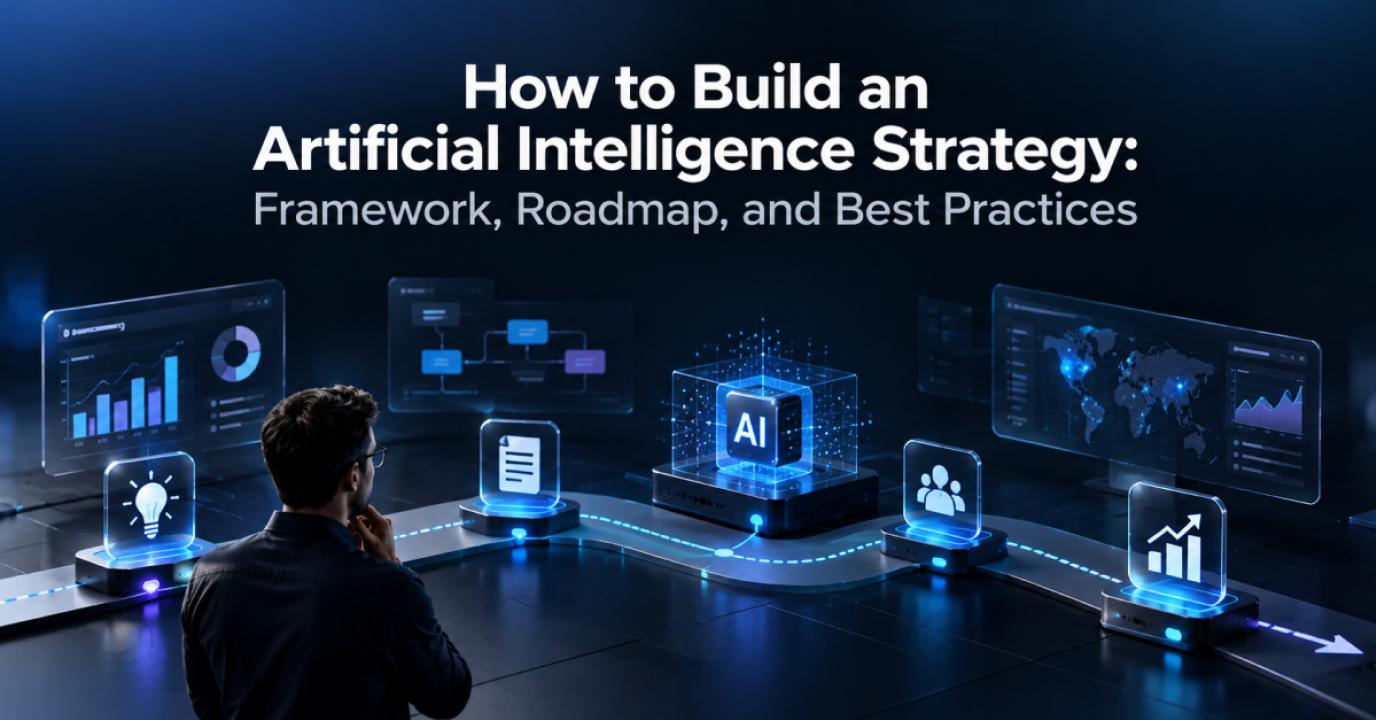
Artificial intelligence is becoming a strategic priority for organizations looking to improve efficiency, strengthen decision-making, automate processes, and create new digital experiences. But identifying opportunities is only the beginning. Without a clear plan for selecting use cases, preparing data, choosing technologies, managing risks, and measuring outcomes, AI initiatives can remain stuck in experimentation. A well-defined artificial intelligence strategy connects business objectives with practical AI initiatives and turns ideas into an executable roadmap.
The goal is not to implement AI everywhere. It is to determine where AI can create measurable business value, what capabilities are required, and how those capabilities can be implemented and scaled responsibly.
This guide explains a practical framework for building an AI strategy, from assessing organizational readiness to defining an implementation roadmap and measuring results.
What Is an Artificial Intelligence Strategy?
An artificial intelligence strategy is a structured plan that defines how an organization will use AI to achieve specific business objectives. It connects business priorities with AI use cases, data, technology, talent, governance, investment, and performance measurement.
A comprehensive strategy should answer questions such as:
Which business problems should AI solve?
Which AI use cases should be prioritized?
Is the organization's data ready?
Which AI technologies and platforms are appropriate?
Should capabilities be built, purchased, or developed with a partner?
What security, privacy, and governance controls are required?
How will AI investments generate measurable business value?
What needs to happen to move from pilot projects to production?
This approach keeps AI aligned with business outcomes instead of treating technology adoption as the primary objective.
Why Businesses Need an AI Strategy Before Implementation
Many organizations are experimenting with generative AI, automation, predictive analytics, and AI agents. However, experimentation does not automatically translate into enterprise-scale value.
McKinsey's 2025 State of AI survey found that nearly two-thirds of respondents said their organizations had not yet begun scaling AI across the enterprise, despite widespread experimentation and growing adoption of AI agents.
This gap often occurs when organizations launch disconnected AI projects without a common strategy.
A structured AI strategy can help businesses:
Align AI initiatives with strategic goals
Avoid duplicating technology investments
Identify data and infrastructure gaps
Prioritize high-value use cases
Establish governance before deployment
Define ownership and accountability
Create a repeatable implementation process
Measure business impact consistently
The objective is to move from AI experimentation to deliberate execution.
The 8-Step Framework for Building an AI Strategy
1. Assess Your AI Readiness
Before selecting an AI solution, understand your organization's current capabilities.
An AI readiness assessment should examine:
Existing technology infrastructure
Data availability and quality
Current software and business systems
AI and technical capabilities
Security and compliance requirements
Existing automation initiatives
Leadership alignment
Available budget and resources
For example, an organization may have strong cloud infrastructure but fragmented business data. Another may have high-quality data but lack the technical capabilities required to develop and operate AI applications.
The purpose of a readiness assessment is to identify these gaps early and incorporate them into the strategy.
2. Define Business Goals and AI Opportunities
The next step is to identify the business outcomes AI should support.
Instead of starting with, "Where can we use AI?", start with questions such as:
Which processes consume significant employee time?
Where are operational costs increasing?
Which decisions could benefit from better predictions?
Where are customers experiencing friction?
Which processes involve large volumes of documents or data?
Which products could benefit from intelligent capabilities?
What strategic goals must be achieved over the next one to three years?
Potential AI business solutions can include intelligent customer support, predictive forecasting, recommendation systems, document processing, fraud detection, intelligent search, workflow automation, and AI-powered decision support.
Starting with business problems makes it easier to identify AI opportunities that have a measurable purpose.
3. Identify and Prioritize AI Use Cases
Organizations can usually identify more AI opportunities than they can realistically implement.
That makes prioritization essential.
Evaluate each potential use case based on:
Business impact
Technical feasibility
Data availability
Implementation complexity
Risk level
Expected time to value
Scalability
Strategic importance
You can then organize initiatives into three broad groups:
Quick wins: Lower-complexity initiatives that can demonstrate value relatively quickly.
Strategic initiatives: Larger opportunities with significant operational, financial, or customer impact.
Future opportunities: Promising use cases that require additional data, infrastructure, skills, or technology maturity.
This approach helps organizations invest resources where they can create meaningful value instead of pursuing AI projects simply because the technology is available.
4. Evaluate Data Readiness
Data is a core foundation of any successful AI initiative.
Before implementation, assess:
Data sources and ownership
Data quality and consistency
Data accessibility
Structured and unstructured data
Data privacy requirements
Data governance
Metadata and lineage
Integration requirements
For generative AI and AI agents, the assessment should also consider how AI systems will securely access enterprise documents, databases, applications, APIs, and other sources of business context.
If significant data gaps exist, data preparation should become part of the AI roadmap rather than an afterthought.
5. Evaluate Technology and Architecture
Once priority use cases and data requirements are established, select the technology architecture needed to support them.
Depending on the business problem, this could involve:
Machine learning
Generative AI
Large language models
AI agents
Retrieval-augmented generation
Computer vision
Predictive analytics
Cloud AI platforms
Data platforms
Model evaluation and monitoring
AI application infrastructure
Technology selection should consider performance, cost, scalability, security, integration, vendor dependencies, and long-term maintenance.
Not every AI initiative requires a custom model. An existing foundation model or managed AI platform may be sufficient for one application, while another may require specialized models, enterprise data integration, or custom development.
When organizations need support across architecture, development, integration, and deployment, working with an experienced ai development company can help accelerate implementation while aligning technical decisions with business requirements.
6. Decide What to Build, Buy, or Partner For
Build-versus-buy decisions are an important part of an AI strategy.
Build
Develop internally when the capability is strategically important, requires significant customization, or can create proprietary differentiation.
Buy
Use an existing product or AI platform when a mature solution already addresses the business requirement.
Partner
Work with an external provider when specialized expertise, faster implementation, or additional engineering capacity is required.