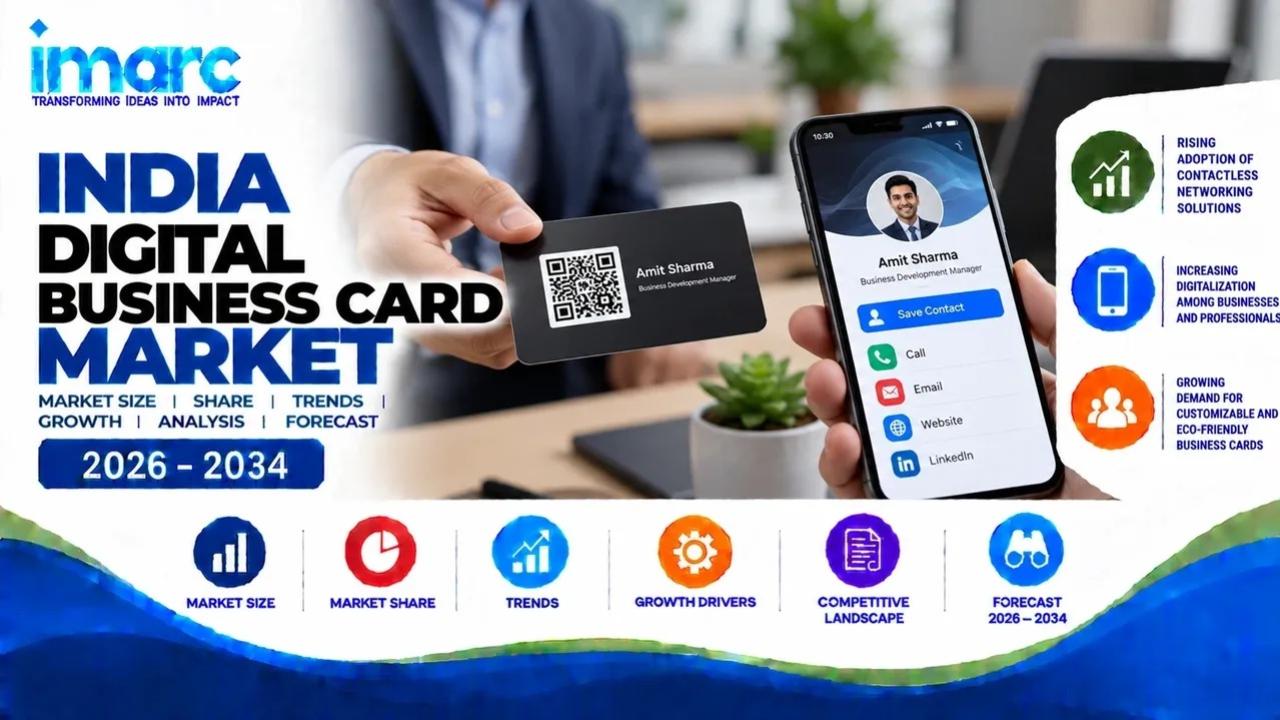
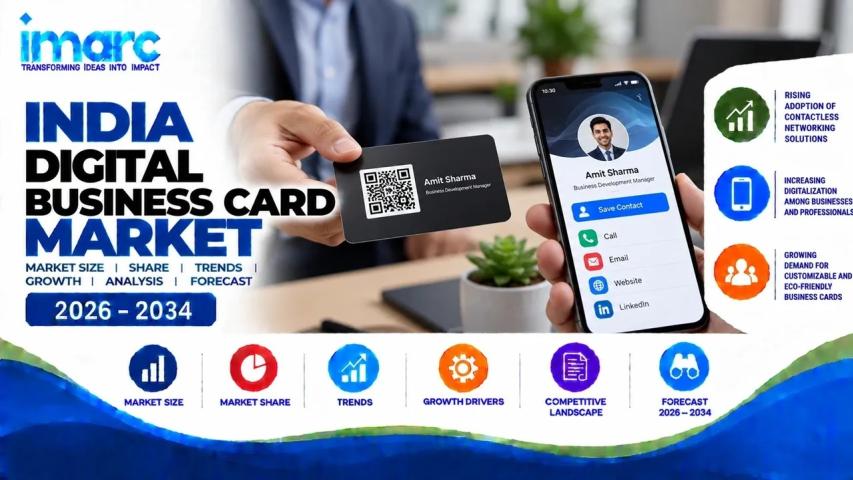
According to IMARC Group’s report titled “India Digital Business Card Market Size, Share, Trends, and Forecast by Platform, User Type, Vertical, and Region, 2026-2034”, the report offers a comprehensive analysis of the industry, including market share, forecast, growth and regional insights.
The India digital business card market size reached USD 6.3 Billion in 2025 to USD 7.0 Billion in 2026. Looking forward, IMARC Group expects the market to reach USD 13.1 Billion by 2034, exhibiting a growth rate (CAGR) of 8.20% during 2026-2034.
India's enterprise operations are experiencing a decisive structural transition toward automated, contactless networking protocols as corporate entities seek to eliminate administrative friction and lower overhead costs. Large-scale business frameworks are systematically replacing legacy, paper-based contact methodologies with unified software solutions to achieve real-time lead optimization and secure communications across regional economic hubs.
- Massive Industrial Onboarding: Leverage rapid customer onboarding across a massive startup environment, which includes more than 123,900 certified entities registered under the Department for Promotion of Industry and Internal Trade (DPIIT).
- Corporate Cost Optimization: Capture heavy B2B demand as corporate organizations leverage app-based solutions and specialized software-as-a-service (SaaS) capital injections, such as the USD 31.2 Million investment secured by domestic developers to reduce physical printing expenses.
What are the Key Developments and Emerging Shifts in the India Digital Business Card Market?
- Enterprise SaaS and CRM Ingestion Integration: The domestic networking ecosystem is executing a massive structural shift away from static vCards toward fully integrated Software-as-a-Service (SaaS) platforms. By heavily integrating digital business cards directly with enterprise CRM systems (like Salesforce and HubSpot), corporate entities systematically eliminate manual data entry, instantly converting networking tap-interactions into qualified, tracked sales leads across the overall market.
- Near Field Communication (NFC) Standardization: Driven by the urgent need for frictionless data exchange, manufacturers are rapidly standardizing NFC-embedded physical cards that act as bridges to dynamic digital profiles. This technological intervention drastically reduces the friction of QR-code scanning, guaranteeing immediate, high-volume contact sharing during corporate events and trade shows continuously.
- Corporate ESG & Zero-Paper Mandates: Stringent corporate Environmental, Social, and Governance (ESG) mandates are actively forcing the mass elimination of single-use paper business cards. By adopting digital networking architectures, major enterprises systematically slash recurring printing expenditures and carbon footprints, structurally upgrading their baseline sustainability metrics.
- Real-Time Analytics and Engagement Tracking: The rapid penetration of premium subscription tiers heavily formalizes the tracking of networking ROI. By seamlessly offering backend analytics—such as link-click rates, profile views, and geo-tagged interaction data—digital card providers drastically enhance visibility into sales team performance, securing continuous institutional procurement from marketing agencies and B2B enterprises.
- Security and Access Control Architectures: As digital cards increasingly house sensitive corporate contact directories, enterprise-grade providers are aggressively deploying SOC-2 compliance, single sign-on (SSO), and role-based access controls. This security transition ensures that corporate IT departments retain absolute authority over employee branding and data sharing protocols continuously.
What Factors are Driving Growth in the India Digital Business Card Market?
- The aggressive expansion of India's startup ecosystem and entrepreneurial workforce acts as a massive primary structural growth catalyst. Supported by initiatives like Startup India, agile businesses actively force the mass integration of cost-effective, easily updatable digital solutions to streamline continuous networking without incurring recurring print costs.
- Intense demographic shifts defined by skyrocketing smartphone penetration (exceeding 46% of the national population) heavily incentivize the adoption of mobile-first networking. The structural capability to instantly receive and store digital cards natively in smartphone wallets compels massive urban demographics to transition away from physical Rolodexes entirely.
- The widespread execution of hybrid and remote work models heavily dictates the structural evolution of B2B sales. With massive reliance on virtual meetings via Zoom and Microsoft Teams, digital business card links seamlessly embedded in email signatures and video-call backgrounds rapidly translate into immense institutional demand continuously.
- Surging structural modernization within the IT and Telecommunication verticals heavily stimulates premium adoption. Tech-forward conglomerates systematically create a highly structured demand pipeline for advanced digital networking tools to project technological competence and streamline complex B2B sales cycles.
➤ Request Sample Report – TOC, Charts & Key Insights: https://www.imarcgroup.com/india-digital-business-card-market/requestsample
India Digital Business Card Market Segmentation:
The market report offers a comprehensive analysis of the segments, highlighting those with the largest India digital business card market share. It includes forecasts for the period 2026-2034 and historical data from 2020-2025 for the following segments.
Platform Insights:
- Android
- iOS
- Windows
User Type Insights:
- Business User
- Enterprise User
- Individual User
Vertical Insights:
- IT and Telecommunication
- Marketing Agencies
- BFSI
- Sales Entrepreneurs
- Others
Regional Insights:
- North India
- South India
- East India
- West India
By the IMARC Group, the Top Competitive Landscape & their Positioning:
Covering an in-depth analysis of the competitive landscape, market structure, key player positioning, competitive dashboards, top winning strategies, and detailed profiles of all major industry participants you will gain access to all these exclusive insights within the full research report.
Note: If you need specific information that is not currently within the scope of the report, we can provide it to you as a part of the customization.
➤ Request Report Customization: https://www.imarcgroup.com/request?type=report&id=30092&flag=E
Frequently Asked Questions (FAQs)
Q1: What is the current value and projected growth of the India Digital Business Card Market?
A1: According to IMARC Group, the India digital business card market size reached USD 6.3 Billion in 2025. Looking forward, IMARC Group expects the market to reach USD 13.1 Billion by 2034, exhibiting a growth rate (CAGR) of 8.20% during 2026–2034.
Q2: Which primary platform segments divide the domestic technology architecture?
A2: The technology architecture is systematically divided across Android, iOS, and Windows platforms, with Android and iOS commanding dominant market shares due to high mobile device penetration among corporate users and independent professionals.
Q3: How are data protection guidelines influencing product development inside this vertical?
A3: Strict sovereign data regulations require platform developers to incorporate advanced encryption protocols, clear consent verification steps, and secure localized cloud storage options to protect enterprise data and corporate identities.
Q4: What specific user category commands the largest revenue share in the Indian market?
A4: The market is segmented into business users, enterprise users, and individual users, with the enterprise user category representing the primary demand segment due to large-scale, centralized deployments across multinational organizations.
Q5: Which industry verticals show the highest adoption rates for digital business cards?
A5: Consumption density is primarily led by the IT and Telecommunication, Marketing Agencies, and BFSI sectors, alongside independent sales entrepreneurs who rely heavily on efficient contact exchange and rapid CRM data integration.
Strategic Insight & Verdict:
The institutional transition away from legacy paper networks toward secure digital identity layers creates a highly lucrative environment for commercial software providers and enterprise capital investors. Based on comprehensive data analysis, we at IMARC Group have observed that the accelerating transition toward low-carbon enterprise software options, supported by firm government startup incentives and massive data protection directives, guarantees long-term asset value. Strategic capital allocations must be directed toward specialized corporate SaaS architectures, enterprise-grade CRM integrations, and advanced wireless tracking hardware to maximize long-term investment performance.