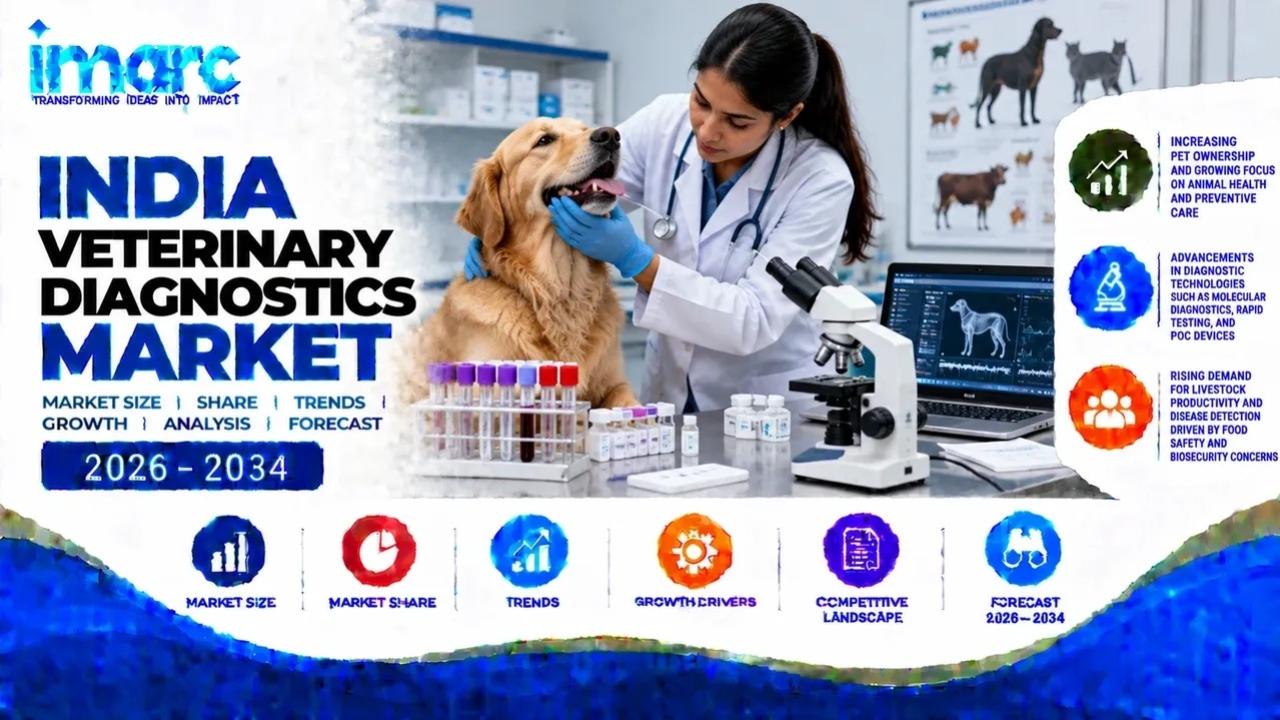
According to IMARC Group’s report titled “India Veterinary Diagnostics Market Size, Share, Trends and Forecast by Product, Technology, Animal Type, Disease Type, End User, and Region, 2026-2034“, the report offers a comprehensive analysis of the industry, including market forecast, growth and regional insights.
How Big is the India Metal Fabrication Market?
The India veterinary diagnostics market size reached USD 248.2 Million in 2025. Looking forward, IMARC Group expects the market to reach USD 443.1 Million by 2034, exhibiting a growth rate (CAGR) of 6.45% during 2026-2034. The market is driven by a vast livestock population, increasing pet ownership, government initiatives like NADCP, advancements in diagnostic technology, rising awareness about zoonotic diseases, escalating demand for quality animal healthcare, expansion of veterinary research facilities, and digital platforms enhancing accessibility to diagnostic services across urban and rural areas.
What are the Key Developments and Emerging Shifts in the India Veterinary Diagnostics Market?
- Point-of-Care (PoC) and AI Diagnostics Integration: The domestic clinical ecosystem is executing a massive structural shift toward decentralized testing. By aggressively integrating AI-powered, screenless hematology analyzers and rapid viscoelastic testing at the point of care, veterinary clinics drastically reduce sample turnaround times. This technological intervention eliminates the reliance on central laboratories for critical cases, ensuring immediate clinical decision-making.
- Rapid Expansion of Immunodiagnostics & Molecular Testing: Driven by the urgent need to detect complex viral and bacterial pathogens early, reference laboratories are heavily pivoting toward advanced molecular diagnostics (PCR) and immunodiagnostic kits. This structural upgrade ensures unparalleled diagnostic precision and drastically minimizes the risk of false positives during large-scale livestock screenings.
- Zoonotic Disease Surveillance Networks: The government and research institutions are actively establishing dedicated reference laboratories (such as the recent ICAR-NIVEDI upgrades). By systematically upgrading biocontainment facilities and standardizing diagnostic protocols, the state actively fortifies the national defense against zoonotic pathogen transmission between livestock and human populations.
- Digital Tele-Pathology and Cloud Services: The market is rapidly formalizing remote diagnostics. By seamlessly integrating cloud-based diagnostic software, rural veterinarians can instantly transmit blood work and imaging data to specialized pathologists in urban centers. This digital networking structurally bridges the immense healthcare gap in remote agricultural nodes.
- Consolidation of Private Veterinary Clinics: The commercial pet healthcare sector is experiencing massive corporate consolidation. By establishing highly organized, multi-specialty veterinary hospital chains equipped with in-house diagnostic suites, corporate entities systematically capture the lucrative urban companion animal demographic, ensuring continuous, high-volume reagent procurement.
What Factors are Driving Growth in the India Veterinary Diagnostics Market?
- The aggressive expansion of companion animal adoption (dogs and cats) among the affluent urban middle class acts as a massive primary structural growth catalyst. The humanization of pets heavily incentivizes owners to pursue advanced preventive healthcare, driving continuous procurement of routine diagnostic panels.
- The widespread execution of government livestock health initiatives (such as the National Animal Disease Control Programme - NADCP) aggressively dictates structural commercial demand. The state mandate to eradicate foot-and-mouth disease (FMD) and brucellosis actively forces the mass integration of diagnostic screening across the massive national cattle and swine populations.
- Intensive corporate capital deployment into the commercial poultry and dairy sectors actively catalyzes localized demand. With strict export quality standards and food safety mandates, agribusinesses continuously rely on diagnostic testing to ensure disease-free meat and milk production, preventing catastrophic flock or herd wipeouts.
- Surging structural modernization of veterinary education and clinical training heavily dictates market adoption. As veterinary colleges aggressively prioritize hands-on experience with advanced diagnostic tools, novice professionals enter the workforce viewing diagnostics as mandatory rather than optional, systematically expanding the baseline user market.
➤ Request Sample Report – TOC, Charts & Key Insights: https://www.imarcgroup.com/india-veterinary-diagnostics-market/requestsample
Deep-Dive Segment Insights:
Product Insights:
- Instruments
- Kits and Reagents
- Software and Services
Technology Insights:
- Immunodiagnostics
- Clinical Biochemistry
- Molecular Diagnostics
- Hematology
- Others
Animal Type Insights:
- Companion Animals
- Dogs
- Cats
- Others
- Livestock Animals
- Cattle
- Swine
- Poultry
- Others
Disease Type Insights:
- Infectious Diseases
- Non-Infectious Diseases
- Hereditary, Congenital and Acquired Diseases
- General Ailments
- Structural and Functional Diseases
End User Insights:
- Reference Laboratories
- Veterinary Hospitals and Clinics
- Others
Regional Insights:
- North India
- South India
- East India
- West India
Recent Market Developments
- The DAHD aggressively expanded financial allocations under the LHDCP and NADCP, rapidly securing immense capital pipelines to heavily boost massive domestic procurement of specialized seromonitoring kits nationwide.
- ICAR-NIVEDI strictly activated modernized zoonotic disease reference laboratories, such as the new leptospirosis laboratory dedicated in January 2025, fundamentally securing highly localized diagnostic compliance ecosystems to support massive nationwide disease control continuously.
- CDSCO rigorously enforced updated regulatory standards for localized veterinary reagents, legally mandating superior diagnostic accuracy to systematically accelerate the mass deployment of safe, reliable animal healthcare testing completely.
Competitive Landscape & Key Player Positioning:
Covering an in-depth analysis of the competitive landscape, market structure, key player positioning, competitive dashboards, top winning strategies, and detailed profiles of all major industry participants you will gain access to all these exclusive insights within the full research report.
Customization Note: If you require any specific information not covered within this report's scope, we will provide it as part of the customization.
➤ Request Report Customization: https://www.imarcgroup.com/request?type=report&id=31045&flag=E
Frequently Asked Questions (FAQs)
1. How big is the India veterinary diagnostics market?
According to IMARC Group, the India veterinary diagnostics market size reached USD 248.2 Million in 2025.
2. What is the expected market growth by 2034?
IMARC Group expects the market to reach USD 443.1 Million by 2034, exhibiting a CAGR of 6.45% during 2026-2034.
3. Which technologies define the market?
According to IMARC Group, key technologies in this sector include immunodiagnostics, clinical biochemistry, molecular diagnostics, and hematology.
4. Which animal segments represent the primary end-users?
IMARC Group states that the market is broadly categorized into diagnostics for companion animals (such as dogs and cats) and livestock animals (including cattle, swine, and poultry).
5. What are the key factors driving the market?
According to IMARC Group, the market is primarily driven by rising pet adoption, increasing livestock farming, heightened zoonotic disease awareness, and massive government disease eradication initiatives like the NADCP.
Strategic Insight & Verdict
The India veterinary diagnostics market is executing a massive structural expansion fundamentally engineered by government-backed zoonotic surveillance (NADCP) and the rapid urbanization of companion animal healthcare. As AI hematology analyzers enter mainstream clinical use and large-scale commercial dairy farms rigorously enforce preventive screening, historical reliance on fragmented, reactive treatments is permanently vanishing across the overall market. For corporate stakeholders, state-backed livestock formalization and digital clinical modernization successfully secure a highly lucrative, permanently optimized environment for premium, real-time diagnostic tech investments.
➤ For latest news & reports, follow "IMARC - Indian Market Research" on LinkedIn!