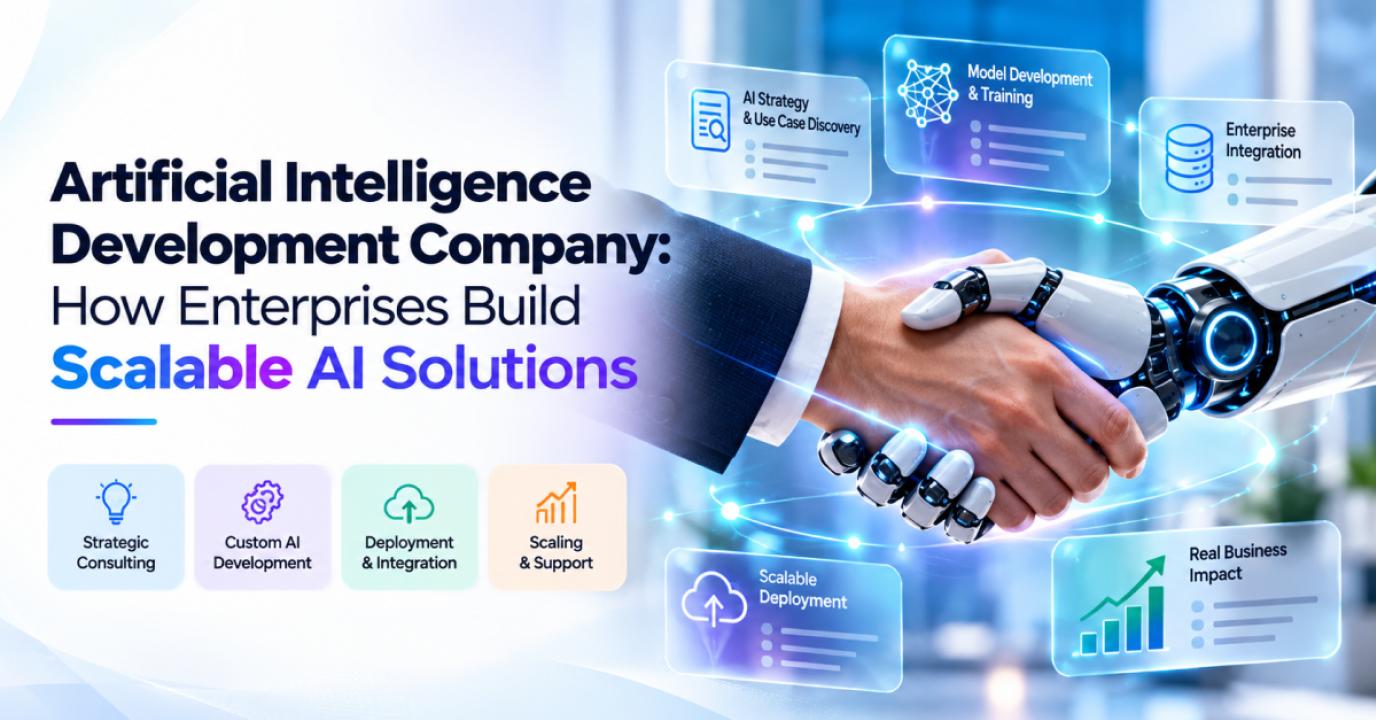
Enterprise AI has moved beyond isolated experiments and proof-of-concepts. Organizations now want to integrate AI into core applications, workflows, data platforms, and decision-making systems without creating another disconnected technology layer. An experienced artificial intelligence development company can help enterprises design AI systems around their existing technology, data, security requirements, and scalability goals.
The challenge is moving from an AI prototype that works in a controlled environment to a production system that operates reliably across users, departments, data sources, and enterprise workloads.
What Does Enterprise AI Development Require?
Enterprise AI development involves several interconnected layers, including:
AI strategy and business objectives
Enterprise AI architecture
Data infrastructure
Machine learning and generative AI
AI applications and agents
Legacy-system integrations
Cloud infrastructure
Security and governance
MLOps and LLMOps
Monitoring and observability
ROI measurement
These components cannot be designed independently. Data architecture affects AI performance, security controls determine how AI systems access enterprise resources, and infrastructure decisions influence scalability and cost. Enterprise AI should therefore be treated as a complete technology ecosystem.
1. Start With AI Strategy and Business Objectives
Enterprises often have numerous potential AI use cases. The priority is identifying which ones can deliver meaningful business value.
Common opportunities include:
Intelligent customer support
Predictive analytics
Demand forecasting
Document intelligence
Fraud detection
Knowledge management
AI-powered search
Process automation
Software engineering assistance
Intelligent decision support
Each opportunity should be evaluated based on business value, technical feasibility, data availability, risk, complexity, and operating cost. Enterprises can use AI business solutions to align AI initiatives with business processes and prioritize use cases that can move from experimentation to measurable outcomes.
The objective is not simply to adopt advanced AI. It is to solve the right business problem.
2. Build a Scalable Enterprise AI Architecture
Scalability starts with architecture. A production AI environment typically separates business applications, AI services, model infrastructure, enterprise data, integrations, and governance controls.
A simplified architecture can follow:
Business applications → AI orchestration layer → Models and AI services → Enterprise data and systems
Supporting layers may include authentication, authorization, API management, model routing, retrieval, vector search, evaluation, observability, and governance.
A modular architecture makes it easier to introduce new models, scale workloads, add AI capabilities, and replace individual components without rebuilding the entire platform.
Enterprises should also plan for failure. AI systems can experience latency, provider outages, unexpected outputs, or model changes. Production environments therefore need validation, timeouts, fallbacks, human escalation, and recovery mechanisms.
3. Prepare Enterprise Data for AI
AI systems are only as effective as the data and context they can access. Enterprise data is often distributed across databases, warehouses, SaaS platforms, documents, APIs, and legacy systems.
A reliable AI data foundation should address:
Data quality and governance
Metadata and data lineage
Access controls
Structured and unstructured data
Data integration
Knowledge retrieval
Real-time and batch data
Generative AI applications may require retrieval architectures that process and index enterprise documents before retrieving relevant information at runtime. AI agents may need access to several systems during one workflow, making data architecture even more important.
4. Integrate AI With Existing Enterprise Systems
Legacy integration is one of the biggest differences between an AI prototype and a production solution.
AI applications may need to interact with ERP systems, CRM platforms, databases, payment systems, supply chain applications, HR systems, data warehouses, and internal APIs.
Instead of replacing every existing system, enterprises can use APIs, middleware, event-driven architecture, and controlled service interfaces to connect AI capabilities with existing infrastructure.
The goal is to make AI part of the enterprise ecosystem while maintaining existing security and access boundaries.
5. Choose the Right AI Technology
Enterprise AI is not limited to generative AI. Traditional machine learning remains valuable for forecasting, classification, recommendation, anomaly detection, fraud prevention, and predictive maintenance.
Generative AI is more suitable for language, content generation, knowledge retrieval, reasoning, and natural-language interaction.
Many enterprises will therefore use multiple AI technologies rather than relying on one model. The key question is not which model is most advanced, but which AI capability best fits the business problem.
6. Move From AI Assistants to AI Agents
Enterprise AI is increasingly moving toward systems that can perform multi-step tasks rather than simply respond to users.
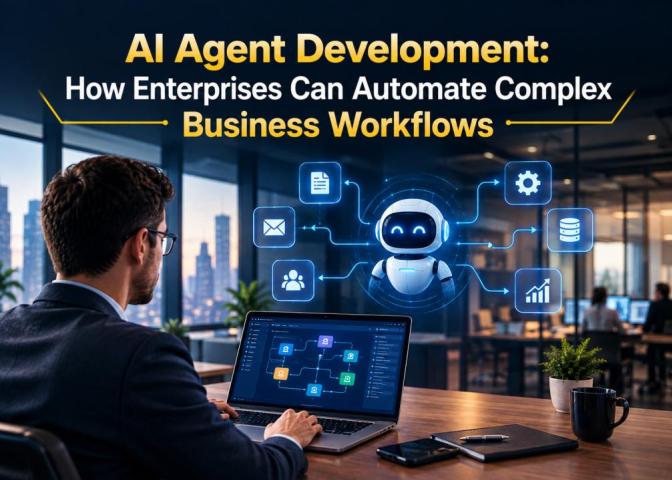
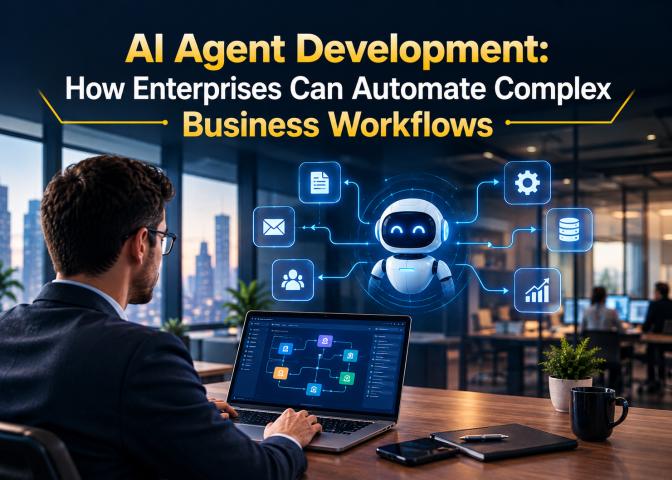
AI agents can interpret requests, retrieve information, select tools, call APIs, execute workflow steps, validate results, and escalate exceptions.
This makes agents valuable for operational automation. However, they also require stronger controls, including identity management, defined permissions, tool boundaries, monitoring, evaluation, and human oversight.
For organizations implementing these workflows, AI agent solutions can be designed around specific business processes while connecting agents with approved enterprise tools and systems.
7. Build Security, Governance, and Operations Into AI
Enterprise AI should not treat security as a final deployment checklist. Controls should be incorporated throughout the development lifecycle.
Important considerations include:
Identity and access management
Least-privilege access
Data encryption
API security
Audit logging
Sensitive-data protection
Model access controls
Prompt and output controls
Human approval workflows
Governance should also define who can build, approve, deploy, monitor, and modify AI systems.
Production operations are equally important. MLOps helps manage model training, versioning, testing, deployment, monitoring, and retraining. Generative AI applications introduce additional LLMOps requirements such as prompt versioning, model evaluation, retrieval evaluation, token-cost monitoring, guardrails, tracing, and feedback collection.
For AI agents, observability must extend across the complete execution path so teams can identify which models, tools, data sources, and actions contributed to an outcome.
8. Deploy and Scale AI in Production
A practical enterprise AI lifecycle can follow:
Development → Testing → Evaluation → Staging → Production → Monitoring → Optimization
Before production, teams should validate model performance, security, integration reliability, latency, scalability, cost, failure handling, and compliance requirements.
Scalability planning should also consider concurrent users, request volume, data volume, API limits, compute requirements, storage, and inference costs.
Enterprises can improve scalability through caching, asynchronous processing, queue-based workflows, workload isolation, model routing, and reusable shared AI services.
9. Measure AI ROI
Technical metrics such as accuracy, latency, and model cost matter, but enterprise leadership also needs to understand business impact.
AI ROI can be measured through:
Reduced operational costs
Employee productivity gains
Faster processing
Increased conversions
Lower support volume
Improved customer satisfaction
Reduced errors
Increased revenue
Faster decision-making
For example, an AI customer support system can be measured through resolution time, escalation rates, customer satisfaction, and cost per interaction—not response quality alone.
What Should Enterprises Look for in an AI Development Partner?
An enterprise AI partner should understand more than AI models. The right partner should have expertise across enterprise architecture, cloud infrastructure, data platforms, legacy integrations, security, governance, application development, MLOps, LLMOps, and production operations.
The ability to build a working prototype is only the beginning. The larger requirement is creating an AI system that operates reliably within the organization's existing technology and business environment.
Final Thoughts
The next phase of enterprise AI is about building scalable AI systems that work reliably in real business environments.
Enterprises need architectures that support multiple AI capabilities, data infrastructure that provides trusted context, integrations that connect modern and legacy systems, governance that manages risk, and operational processes that keep AI systems observable and maintainable.
As AI agents become more capable of interacting with tools, data, and enterprise systems, identity, permissions, evaluation, security, and observability become increasingly important.
For enterprises planning their next AI initiative, the goal should not simply be to deploy an AI model. It should be to build an AI capability that can scale with the business, integrate with existing systems, remain secure, and deliver measurable business value.