Artificial intelligence is becoming a strategic priority for businesses looking to automate operations, improve customer experiences, and make faster decisions. However, investing in AI development without a clear plan can result in high costs, disconnected systems, and solutions that fail to deliver measurable value. Businesses exploring artificial intelligence services should first understand where AI can create business value, whether their organization is ready, and how the technology will support long-term objectives.
A well-defined AI strategy provides this direction. It connects business goals with practical AI opportunities and creates a roadmap for moving from an initial idea to a scalable implementation.
Why Businesses Need an AI Strategy Before Development
AI development should not begin simply because a technology is trending. Businesses need to understand the problem they want to solve and the outcome they expect.
Without a strategy, organizations may invest in an AI solution that lacks quality data, has limited adoption, or cannot integrate with existing systems. A strategy helps decision-makers evaluate opportunities before committing significant development resources.
It also creates alignment between business teams, technology teams, and leadership. Everyone understands what the AI initiative should achieve, how success will be measured, and what resources are required.
For businesses that need support defining AI opportunities and implementation priorities, AI strategy consulting can help connect business objectives with practical AI initiatives.
1. Start With Business Goals, Not AI Technology
The first step is to identify business problems where AI can create measurable impact.
Look at processes that involve repetitive work, large amounts of data, frequent customer interactions, forecasting, decision-making, or manual analysis. For example, an organization might use AI to automate document processing, improve demand forecasting, personalize recommendations, or enhance customer support.
Instead of asking, “Where can we use AI?” ask:
What business problem is costing us time or money?
Which processes could become more efficient?
Where can better predictions improve decisions?
What customer experience needs improvement?
Which opportunities could generate measurable revenue?
This business-first approach prevents organizations from investing in AI solutions without a clear purpose.
2. Identify and Prioritize AI Use Cases
Once business goals are clear, create a list of potential AI use cases. Not every opportunity should move directly into development.
Evaluate each use case based on:
Expected business impact
Implementation complexity
Data availability
Integration requirements
Estimated cost
Security and compliance considerations
Potential for future scalability
A simple impact-versus-effort framework can help organizations identify quick wins while separating complex initiatives that require deeper planning.
Starting with a focused use case also allows businesses to validate AI's value before expanding the technology across multiple departments.
3. Assess Your Data and Technology Readiness
AI systems depend heavily on the quality and availability of business data. Before development begins, organizations should review their existing data sources, applications, infrastructure, APIs, and security requirements.
This assessment should answer questions such as:
Is the required data available?
Is the data accurate and consistent?
Where is the data stored?
Can existing systems provide the required information?
What integrations will the AI solution need?
Are there privacy or regulatory requirements?
A business does not necessarily need perfect data before starting an AI initiative. However, identifying data gaps early helps teams estimate the actual effort required and avoid unexpected development challenges.
4. Choose the Right AI Approach
Different business problems require different AI approaches. Depending on the use case, an organization may consider machine learning, generative AI, natural language processing, computer vision, predictive analytics, or AI agents.
The technology should follow the business requirement.
For example, a company looking to summarize internal documents may need a generative AI solution, while a business forecasting demand may require predictive machine learning. A workflow involving multi-step reasoning and interaction with business systems could benefit from agentic AI.
For such workflows, AI agent development services can help businesses build systems capable of reasoning through tasks, interacting with tools, and taking actions across connected applications.
5. Define Your AI Investment and ROI Framework
AI investment should be evaluated beyond the initial development cost. Businesses need to consider the complete lifecycle of the solution.
Potential cost areas include:
AI development and engineering
Data preparation
Cloud infrastructure
Model or API usage
System integration
Security
Testing and deployment
Monitoring and maintenance
At the same time, define measurable business outcomes. These could include reduced operational costs, faster processing times, increased conversions, improved customer satisfaction, or higher employee productivity.
Clear KPIs make it easier to determine whether an AI initiative is delivering the expected return.
6. Decide Whether You Need an AI Development Partner
After defining the strategy and validating the opportunity, businesses can determine whether they have the internal expertise to execute the project.
An ai development company can be useful when an organization needs specialized AI engineering, data science, integration, or deployment capabilities. When evaluating an artificial intelligence company, consider its technical expertise, experience with similar use cases, integration capabilities, security practices, and ability to support the solution after launch.
The right artificial intelligence development company should also understand business requirements rather than simply recommend a particular model or technology.
The goal is to find a partner that can translate the strategy into a practical, scalable solution.
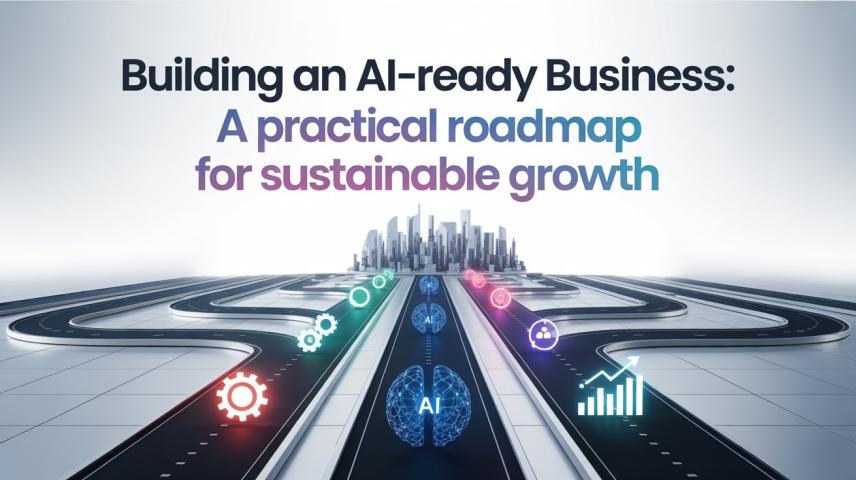
7. Create a Phased AI Implementation Roadmap
AI implementation becomes more manageable when divided into clear phases.
A typical roadmap can include:
Phase 1: AI strategy and discovery
Phase 2: Use-case validation
Phase 3: Proof of concept
Phase 4: AI development and system integration
Phase 5: Production deployment
Phase 6: Monitoring and optimization
Phase 7: Scaling across additional workflows
This phased approach reduces unnecessary risk and allows organizations to validate results before making larger investments.
8. Plan for AI Governance, Security, and Continuous Improvement
AI strategy should also address what happens after deployment. Businesses need processes for monitoring performance, protecting sensitive data, evaluating model outputs, and managing potential risks.
Security, privacy, responsible AI practices, and human oversight should be considered during planning rather than added after development.
Continuous monitoring is equally important because business data, customer behavior, and operational requirements change over time. AI systems may require optimization, retraining, or model updates to maintain performance.
Final Takeaway
Successful AI adoption does not begin with choosing a model or immediately hiring developers. It begins by identifying the right business problems, assessing organizational readiness, estimating potential ROI, and creating a practical implementation roadmap.
Once these foundations are established, businesses can confidently invest in ai development services or broader artificial intelligence development services that align with their objectives.