Choosing the right blockchain is an important decision for US businesses planning to build decentralized applications, smart contracts, tokenization platforms, or enterprise blockchain solutions. The network you select affects development costs, transaction fees, security, scalability, and long-term maintenance. Before you hire blockchain developers, compare available platforms against your business goals, technical requirements, and budget. A well-informed decision can help reduce development risks and avoid costly architectural changes as your product grows.
Define Your Business Requirements Before Hiring Blockchain Developers
Start by identifying what your blockchain application needs to accomplish. The right network for a decentralized finance (DeFi) platform may not be suitable for an enterprise supply chain application or a digital asset management system.
Consider your business use case, expected transaction volume, security requirements, scalability needs, and available budget. For example, an application that processes frequent transactions may prioritize predictable transaction costs and performance. A business managing sensitive information may place greater emphasis on access controls, privacy, and governance.
You should also consider the application's long-term maintenance requirements. The availability of experienced developers, development tools, and third-party integrations can affect how easily your product evolves.
When you hire blockchain developers, look for professionals who can translate these business requirements into technical decisions. They should explain the trade-offs between different networks instead of recommending a platform solely because they have experience using it.
Compare Blockchain Platforms for Your Project
Different blockchain platforms offer different development environments, operating models, and capabilities. Comparing their strengths and limitations can help you shortlist options for your application.
| Blockchain platform | Potential use cases | Key considerations |
|---|---|---|
| Ethereum | DeFi, smart contracts, tokenization, and decentralized applications | Transaction fees, ecosystem compatibility, and scaling options |
| Solana | Trading applications and consumer-facing blockchain products | Development tools, program architecture, and application requirements |
| Polygon PoS | Ethereum-compatible applications and blockchain transactions | Network security assumptions, integrations, and ecosystem support |
| Hyperledger Fabric | Enterprise networks, supply chain systems, and permissioned applications | Participant governance, identity management, and infrastructure |
These platforms are not interchangeable, and none is suitable for every project.
Ethereum may be worth considering when an application depends on established smart contract standards and ecosystem integrations. Solana may suit applications with demanding transaction throughput requirements. Polygon PoS can be relevant for Ethereum-compatible applications, while Hyperledger Fabric supports permissioned business networks where participation and access rights need to be managed.
Before choosing a platform, evaluate its current capabilities, limitations, security model, developer tooling, and compatibility with your planned application.
Choose Between Public and Permissioned Blockchains
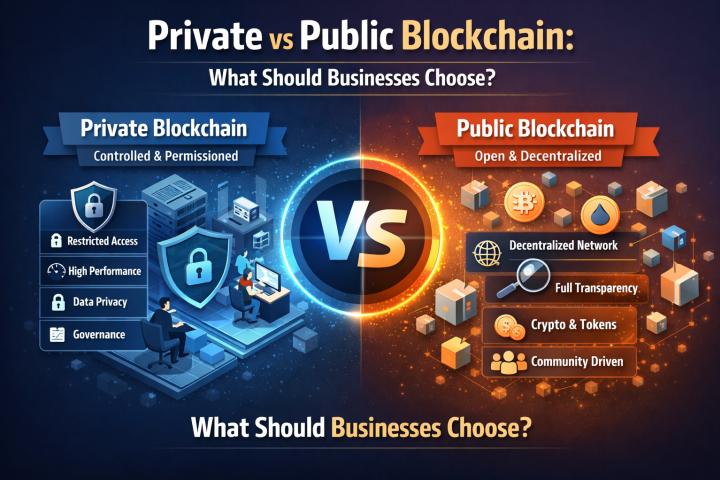
Businesses must also decide whether their application needs a public blockchain or a permissioned network.
Public blockchains allow participants to interact with the network without requiring approval from a central organization. They can suit applications involving publicly accessible smart contracts, decentralized finance, and digital assets.
Permissioned blockchains restrict participation or specific actions according to defined permissions. They may be appropriate for businesses that need controlled access, known participants, or coordinated operations between organizations.
For example, a startup developing a public token platform may evaluate public blockchain networks. A group of companies sharing supply chain records may instead consider a permissioned architecture.
The decision should account for governance, transparency, privacy, participant responsibilities, and operational costs. Permissioned networks do not automatically guarantee compliance or confidentiality, so businesses must assess those requirements separately.
When you hire blockchain experts, look for developers who can explain the practical differences between these models and recommend an approach that aligns with your business objectives.
Evaluate Blockchain Development Costs and Technical Support
The cost of building a blockchain application depends on more than the network itself. Developer availability, technical complexity, integrations, security requirements, and maintenance can all influence the total budget.
Before making a decision, assess the availability of developers experienced with the required programming languages and frameworks. Also examine the quality of development tools, testing frameworks, documentation, and deployment utilities. These factors can affect development efficiency and ongoing maintenance.
Consider the costs of connecting the blockchain to existing systems, including wallets, APIs, payment providers, and databases. Your budget should also account for network fees, infrastructure, monitoring, security reviews, and post-launch support.
Businesses searching for blockchain developers for hire should evaluate candidates based on relevant experience with the chosen network, not just general blockchain knowledge.
If you need ongoing engineering support for an established product roadmap, you may want to hire dedicated blockchain developers. If your project requires several specializations, such as smart contracts, backend development, frontend engineering, and quality assurance, it may be more practical to hire a blockchain development team.
Compare the proposed team structure, deliverables, security practices, and maintenance arrangements before choosing a hiring model.
Final Thoughts
Choosing a blockchain requires balancing business goals with technical requirements. Before you hire blockchain developers in the USA, evaluate platform capabilities, transaction costs, security needs, developer availability, and long-term support.
The right development partner should help you compare alternatives, identify technical limitations, and select an architecture that fits your product rather than recommending the same technology for every use case. Making this decision before development begins can help your business define a clearer scope, manage costs, and prepare for future growth.