Artificial intelligence is no longer limited to experimental projects or isolated automation tasks. Businesses are using AI to improve customer experiences, optimize operations, analyze data, automate workflows, and create new digital products. However, adopting AI without a clear direction can result in disconnected projects, rising costs, poor adoption, and limited business value.
The right AI strategy connects technology investments with measurable business objectives. AI strategy consulting can help organizations evaluate their current capabilities, identify valuable opportunities, prioritize initiatives, and create a practical path from experimentation to implementation.
What Is an AI Strategy?
An AI strategy is a structured plan for determining how an organization will use artificial intelligence to achieve specific business outcomes. It goes beyond selecting AI tools or models.
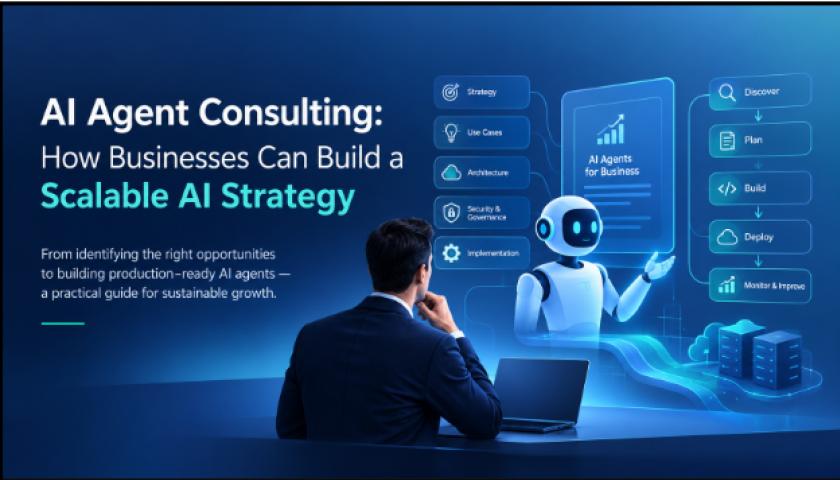
A strong artificial intelligence strategy considers business objectives, data readiness, technology infrastructure, workforce capabilities, security, governance, investment requirements, and long-term scalability.
The goal is not to implement AI everywhere. It is to identify where AI can create meaningful value and determine how those initiatives can be implemented responsibly.
6 Key Factors to Consider Before Choosing an AI Strategy
1. Define Your Business Goals
Start with business problems rather than technology.
Determine whether your priorities include reducing operational costs, improving customer service, increasing revenue, accelerating decision-making, or automating repetitive work. Clear objectives make it easier to identify relevant AI business solutions and measure their impact.
2. Evaluate Data Readiness
AI depends heavily on reliable data. Before investing in models or applications, assess whether your organization has sufficient, accessible, accurate, and properly governed data.
Look at data quality, storage, integration, privacy, and governance requirements. Poor data foundations can limit even technically advanced AI initiatives.
3. Assess Your Technology Infrastructure
Review your existing applications, APIs, cloud environment, databases, security architecture, and integration capabilities.
Your AI strategy should fit your current technology ecosystem wherever possible. This reduces unnecessary complexity and makes future scaling easier.
4. Understand Your Budget and Resources
AI initiatives require more than development costs. Consider infrastructure, data preparation, talent, model usage, integration, testing, monitoring, security, and ongoing maintenance.
You should also determine whether your internal teams have the expertise required to execute the strategy or whether external specialists are needed.
5. Measure Organizational Readiness
Successful AI adoption requires collaboration between technical and business teams. Assess your organization's AI skills, leadership support, change-management capabilities, and willingness to adapt existing workflows.
A technically strong solution can still fail if employees do not understand how or why they should use it.
6. Plan for Security and Governance
AI introduces new considerations around privacy, access control, model reliability, compliance, and responsible use.
Build governance into your strategy from the beginning. This is particularly important for enterprises handling sensitive customer, financial, healthcare, or operational data.
Which AI Strategy Approach Is Right for Your Business?
There is no universal AI strategy. The right approach depends on your business model, resources, data maturity, and objectives.
AI-First Strategy
An AI-first approach works well for businesses where AI is central to the product or service. Examples include intelligent recommendation platforms, AI-powered research products, and applications built around generative AI.
AI-Powered Process Optimization
Businesses that already have established processes can use AI to improve repetitive and resource-intensive workflows. Applications may include intelligent document processing, forecasting, customer support automation, and operational decision support.
For more complex workflows, AI agent development can help organizations build systems capable of interacting with tools, handling multi-step tasks, and supporting process automation.
Customer Experience-Focused AI Strategy
Organizations can focus their AI investments on improving customer interactions through personalization, intelligent search, recommendation engines, conversational interfaces, and automated support.
This approach is particularly valuable when customer experience directly affects retention, engagement, or revenue.
Data-Driven AI Strategy
Organizations with large volumes of structured or unstructured data can prioritize predictive analytics, forecasting, anomaly detection, recommendation systems, and intelligent decision support.
This approach turns existing data assets into actionable business intelligence.
Enterprise AI Transformation Strategy
Large organizations may need an enterprise-wide strategy that connects multiple AI initiatives across departments. This requires stronger governance, shared infrastructure, standardized processes, and clear prioritization.
How to Evaluate the Best AI Strategy for Your Business
Once you understand your options, use a structured evaluation process.
Step 1: Define measurable objectives. Identify the business outcomes you want AI to influence.
Step 2: Identify high-value opportunities. Look for processes where AI can produce measurable improvements.
Step 3: Assess readiness. Review data, infrastructure, talent, security, and organizational capabilities.
Step 4: Prioritize use cases. Rank initiatives based on potential value, feasibility, risk, and implementation effort.
Step 5: Estimate ROI. Compare expected business benefits against development, infrastructure, and operational costs.
Step 6: Create an implementation strategy. Determine which initiatives should begin with a proof of concept, pilot, or direct production deployment.
Step 7: Establish success metrics. Define KPIs before implementation so you can measure whether each initiative delivers the expected value.
At this stage, businesses may also benefit from AI development services to turn prioritized use cases into scalable applications and integrate them with existing systems.
Common Mistakes When Choosing an AI Strategy
Businesses often make the mistake of starting with a technology instead of a business problem. Other common issues include attempting too many AI projects simultaneously, overlooking data quality, underestimating integration requirements, and failing to establish measurable ROI.
Another mistake is treating AI as a one-time implementation. AI capabilities, models, regulations, and business requirements continue to evolve. Your strategy should therefore support continuous evaluation, optimization, and scaling.
When Should You Consider AI Strategy Consulting?
You should consider professional guidance when your organization has multiple potential AI opportunities but lacks clarity about where to invest first.
An experienced consulting partner can help evaluate AI readiness, prioritize use cases, define an implementation strategy, establish governance, and create a roadmap aligned with business objectives. This can reduce the risk of investing heavily in projects that deliver limited value.
The right strategy should ultimately give your business a clear answer to three questions: Where can AI create the most value? What will it take to implement it? And how will success be measured?
Conclusion
Choosing the right AI strategy requires more than following the latest technology trend. Businesses need to evaluate their goals, data, infrastructure, people, budget, risks, and long-term priorities before committing to major AI investments.
A practical strategy starts with high-value business opportunities, validates feasibility, establishes measurable outcomes, and creates a clear path toward implementation. With the right approach, AI can move from isolated experiments to a scalable capability that supports sustainable business growth.