
The pricing model you pick shapes more than your invoice. It affects how much flexibility you have, how closely you work with the team, and how painful (or painless) changes are mid-project. Most buyers only think about this after signing, which is backwards.
Here’s what actually changes between the three common models.
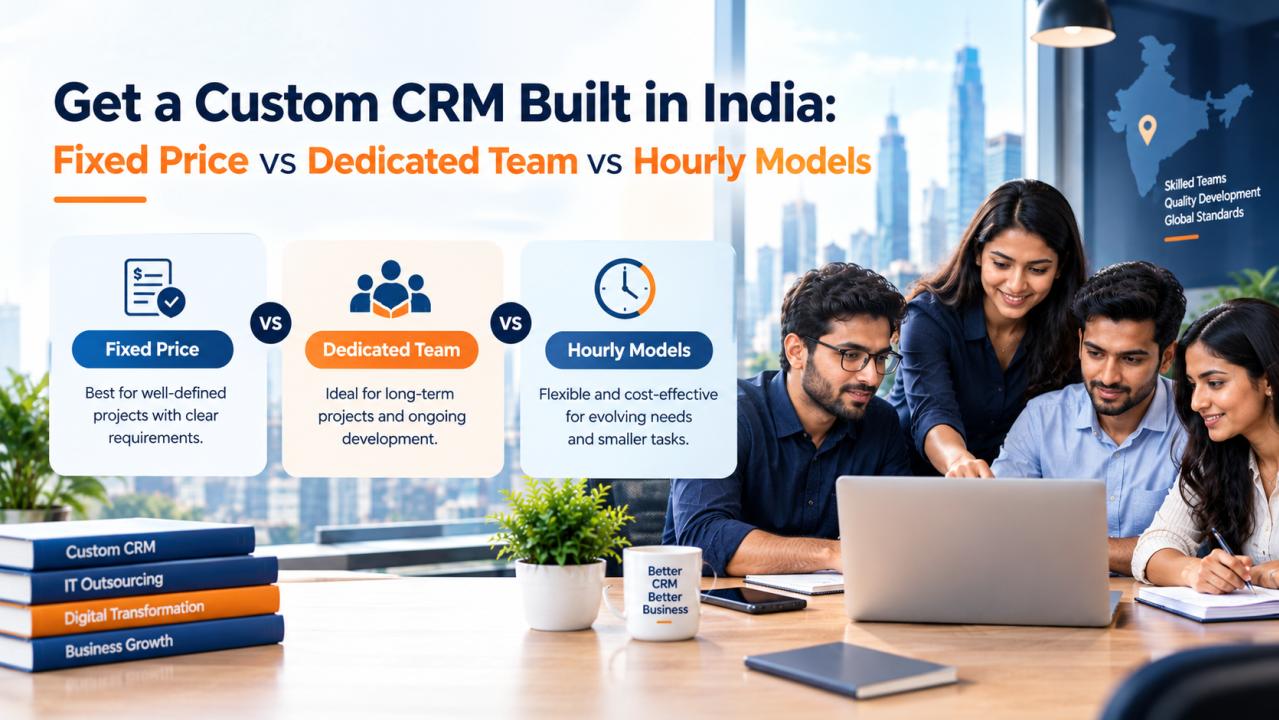
Fixed Price: Predictable, But Rigid
You agree on scope and cost upfront. The vendor builds to spec, and the price doesn’t move unless the scope does.
Works well when:
- Requirements are clear and unlikely to change
- You have a hard budget ceiling
- The project is relatively small or well-defined
Where it gets painful:
- Any requirement change usually means a new quote and delay
- Vendors sometimes pad estimates to cover scope risk
- Discovery often happens after the price is locked, which can mean mismatched expectations later
A crm software development company in India offering fixed price should still run a proper discovery phase before quoting. If they price it off a single call, treat that number as a guess.
Dedicated Team: Flexible, But Needs Management
You get a team — developers, a QA person, maybe a project lead — working exclusively on your project for an agreed period. You direct the priorities.
Works well when:
- Requirements will evolve as you learn more about user needs
- You want ongoing development, not a one-off build
- You’re building something complex enough to need steady, continuous attention
Where it gets painful:
- You need someone internally (or a strong project manager) to direct the team
- Costs are ongoing, not a one-time number
- Less predictable monthly spend if scope grows faster than planned
Tailored CRM software development through a dedicated team tends to suit businesses planning multiple phases, not just an initial launch.
Hourly: Maximum Flexibility, Least Predictability
You pay for actual hours worked, with no fixed scope or team size commitment.
Works well when:
- You need small, ongoing changes rather than a full build
- Scope is genuinely unclear and you want to figure it out as you go
- You’re testing an idea before committing to a bigger engagement
Where it gets painful:
- Costs can run higher than expected without tight oversight
- Harder to budget for upfront
- Easy for scope to drift without someone tracking hours against outcomes
This model fits maintenance and small enhancements better than a ground-up CRM build.
How to Match the Model to Your Project
Ask yourself a few honest questions before choosing:
- Do we know exactly what we need? Fixed price fits best here.
- Will requirements change as we go? A dedicated team handles that better.
- Is this a small, ongoing need rather than a full build? Hourly usually makes more sense.
- How much internal time can we spend managing this? Fixed price needs the least; dedicated teams need the most.
What to Ask Any Vendor, Regardless of Model
- How do you handle scope changes once work has started?
- What happens if a fixed-price estimate turns out to be wrong?
- How do you report progress and hours for dedicated or hourly work?
- Who owns the code and documentation under each model?
Reliable CRM software development services should be transparent about these answers regardless of which pricing model you choose. Vague answers here are a bigger warning sign than the pricing model itself.
There’s No Universally “Best” Model
Fixed price isn’t automatically safer, and hourly isn’t automatically riskier. What matters is matching the model to how clear your requirements are and how much change you expect along the way.
If you’re still unsure which fits your project, it’s worth walking a potential partner through your requirements and asking them to recommend a structure, rather than picking blind.
FAQs
Can I switch pricing models partway through a CRM project?
Yes, many vendors allow this, especially moving from fixed price to a dedicated team once initial scope is delivered and ongoing work becomes clearer.
Which pricing model is cheapest for CRM development?
None is inherently cheapest. Fixed price can cost more if scope changes are frequent; hourly can cost more without oversight. The cheapest option depends on how well your requirements match the model.
Do dedicated teams cost more than fixed-price projects?
Not necessarily. For ongoing or evolving projects, a dedicated team often costs less long-term than repeatedly re-scoping fixed-price contracts.