Choosing the wrong mobile development approach can create extra work later in testing, integrations, maintenance, and future feature development.
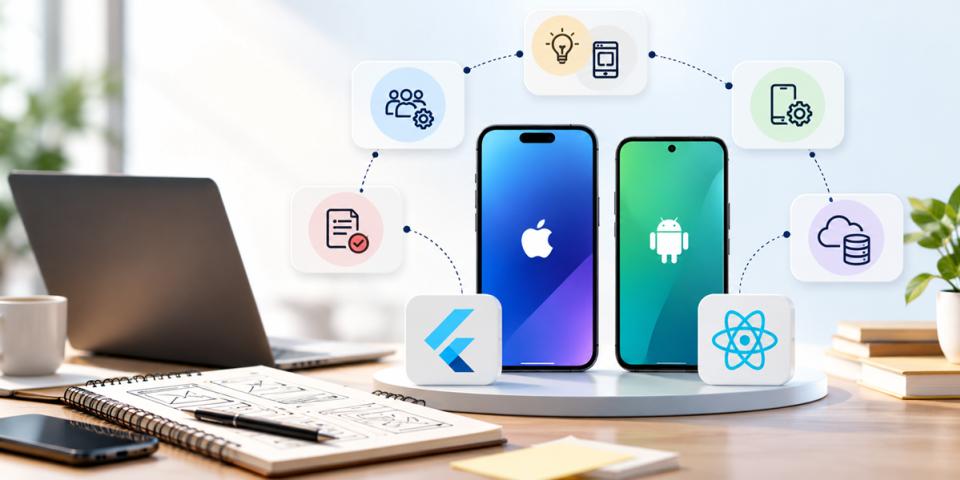
For startups, cross-platform app development can be a practical option when the product needs both iOS and Android, the MVP has a clear scope, and the required native integrations are well supported.
However, it is not the right choice for every app.
The decision should be based on product requirements, technical constraints, team skills, backend architecture, and long-term maintenance.
1. You Need iOS and Android From the Start
If a startup plans to launch on both iOS and Android, cross-platform development can reduce some duplicated work across the two platforms.
This approach may suit apps with common workflows such as:
- user registration
- login and authentication
- dashboards
- payments
- profile management
- notifications
- API-based features
Even with shared code, both platforms still need proper testing because device behavior, permissions, and operating-system requirements can differ.
2. Your MVP Has a Clear Scope
Cross-platform development can work well when the first version of the product has a focused set of features.
A typical MVP may include:
- authentication
- core user workflows
- backend APIs
- payment integration
- notifications
- event tracking
- crash reporting
The goal of an MVP is to validate the product idea without adding unnecessary complexity.
If the first release depends on advanced hardware, complex offline workflows, or specialized native behavior, more technical evaluation may be needed before choosing the framework.
3. Native Integrations Are Understood Early
Many mobile apps use standard device features such as:
- camera
- GPS
- biometric authentication
- push notifications
More advanced requirements may include Bluetooth Low Energy, sensors, background services, or vendor-specific SDKs.
These integrations should be checked before development begins.
For example, if an app depends on BLE hardware or a specialized SDK, building a small proof of concept can help confirm compatibility before the startup commits to a framework.
4. Your Team Can Maintain the Framework
The framework should fit the skills of the people who will build and maintain the app.
If the development team already works with React, JavaScript, or TypeScript, React Native may fit more naturally into the existing workflow.
If the team has Flutter and Dart experience, Flutter may be a practical option.
If you are comparing both frameworks, this detailed Flutter vs React Native comparison covers UI, performance, MVP development, cost, native integrations, backend architecture, and long-term maintenance.
The important question is not which framework is more popular. It is which one the team can support reliably over time.
5. Plan the Backend Alongside the Mobile App
A mobile app is usually only one part of the full product.
The backend may need to manage:
- authentication
- business logic
- databases
- payments
- APIs
- notifications
- third-party integrations
- admin systems
The mobile framework and backend should be planned together so that the app, APIs, database, and integrations work as one system.
If you are planning the complete product, reviewing the Mobile App Development Services process can help connect frontend development, backend architecture, testing, and release planning.
When Cross-Platform May Not Be the Best Choice
Cross-platform development may need more evaluation when:
- the app depends heavily on specialized native SDKs
- the product requires very platform-specific user experiences
- advanced background processing is essential
- the company already has a mature native codebase
- important integrations are not well supported
- In these situations, native development may be worth considering.
Final Thoughts
Cross-platform app development can be a good fit for startups when the product requirements, native integrations, team skills, and maintenance plan all support the approach.
The safest way to choose is to define the product first, test the most difficult technical requirements early, and then select the framework that fits the real needs of the app.
The framework should support the product strategy, not become the strategy itself.