
The financial health of any
business is the cornerstone of its survival and growth. However, for many small
and medium-sized enterprises (SMEs) and startups, hiring a full-time Chief
Financial Officer (CFO) is often expensive and, at times, unnecessary during
the early stages. This is where Virtual CFO (vCFO) services come into play. A
Virtual CFO offers businesses the strategic financial expertise of a
traditional CFO but at a fraction of the cost, and often with greater
flexibility.
In today’s highly dynamic and
competitive business world, Virtual CFO services have become a practical
solution for companies seeking expert financial leadership without the
overheads of employing a full-time executive.
What are Virtual CFO Services?
A Virtual CFO is an outsourced
professional or team of financial experts who perform the role of a CFO
remotely or on a part-time basis. Just like an in-house CFO, they manage
financial planning, forecasting, compliance, risk management, and fundraising
strategies.
Virtual CFOs provide the
advantage of high-level financial insights while adapting to the specific needs
of the business. Their role extends beyond bookkeeping or accounting they
function as strategic partners who help businesses make data-driven decisions
and prepare for long-term success.
Why Businesses Need Virtual
CFO Services
Many organizations, especially
startups and growing enterprises, face financial challenges that require
professional oversight. A Virtual CFO bridges the gap between financial
operations and strategic decision-making. Here’s why these services are gaining
popularity:
- Cost-Effective Solution: Hiring
a full-time CFO involves high salaries, bonuses, and other benefits. A
Virtual CFO provides the same level of expertise but at a significantly
lower cost.
- Scalability and Flexibility: Businesses
can scale Virtual CFO services according to their growth stage.
Early-stage startups might need limited support, while established SMEs
may require more in-depth financial guidance.
- Expertise on Demand: Virtual
CFOs often bring years of multi-industry experience, providing companies
with tailored financial advice based on best practices.
- Focus on Core Business: Entrepreneurs
and business owners can focus on operations, sales, and innovation while
the Virtual CFO takes charge of financial planning and compliance.
- Strategic Growth Partner: A
Virtual CFO does not merely manage finances but also helps in developing
business models, evaluating funding opportunities, and improving
profitability.
Key Functions of a Virtual CFO
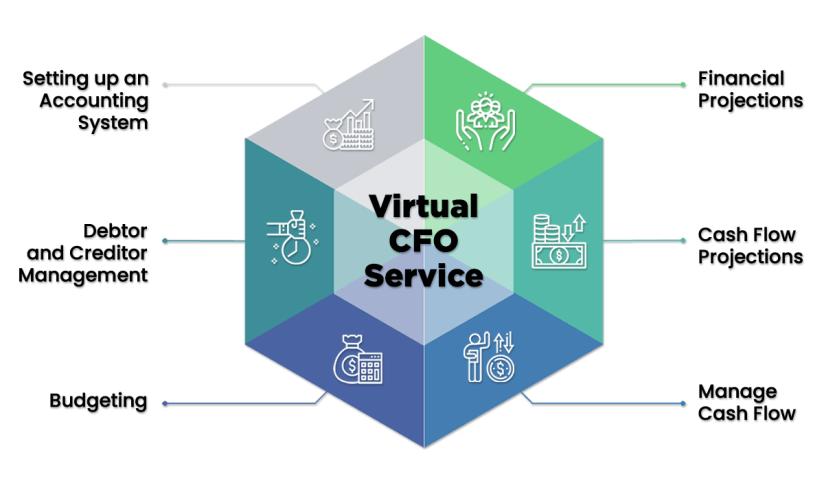
A Virtual CFO provides a wide
range of services, depending on the needs of the business. The primary
functions include:
1. Financial Planning and
Analysis (FP&A)
They prepare detailed
financial forecasts, budgets, and performance reports. This helps the
management make informed decisions and track progress against goals.
2. Cash Flow Management
Virtual CFOs monitor inflows
and outflows, ensuring that the company maintains sufficient liquidity. They
design strategies to optimize working capital and avoid cash crunches.
3. Risk Management
From regulatory risks to
market uncertainties, Virtual CFOs develop strategies to identify, assess, and
mitigate financial risks that may impact business stability.
4. Compliance and Governance
They ensure the business meets
all statutory compliance requirements, including taxation, audit, and corporate
governance standards.
5. Fundraising and Investor
Relations
Virtual CFOs assist startups
and SMEs in preparing pitch decks, financial projections, and business
valuations to attract investors or secure bank funding.
6. Cost Optimization
Through in-depth financial
reviews, they identify areas of unnecessary spending and create strategies for
reducing costs while improving efficiency.
7. Performance Monitoring
They design dashboards and
KPIs to monitor business performance, helping management identify strengths and
weaknesses in real time.
Benefits of Virtual CFO
Services
The advantages of hiring a
Virtual CFO extend well beyond financial management:
- Affordable Access to Expertise:
Businesses get access to top-level financial skills without the high
expense of a permanent CFO.
- Objective Insights:
As an external professional, a Virtual CFO brings unbiased financial
analysis and recommendations.
- Time Savings:
Owners and managers save valuable time by delegating financial
complexities to experts.
- Technology-Driven Solutions:
Virtual CFOs leverage digital tools like cloud accounting, AI-based
forecasting, and ERP systems for efficiency.
- Enhanced Investor Confidence:
Startups with structured financials managed by a Virtual CFO are more
likely to gain investor trust.
- Strategic Long-Term Focus:
They ensure businesses are not only surviving day-to-day but also working
toward sustainable growth.
Difference Between a
Traditional CFO and a Virtual CFO
|
Aspect |
Traditional CFO |
Virtual CFO |
|
Employment |
Full-time executive within
the organization |
Outsourced or part-time
professional |
|
Cost |
High (salary, benefits,
bonuses) |
Flexible and cost-effective |
|
Accessibility |
Dedicated, in-house presence |
Remote access, on-demand
support |
|
Expertise |
Focused on one business |
Brings multi-industry
expertise |
|
Scalability |
Fixed role regardless of
business size |
Scales up or down based on
requirements |
Industries Benefiting from
Virtual CFO Services
- Startups:
Need financial discipline and guidance in raising funds.
- Small and Medium Enterprises (SMEs):
Require structured financial management without full-time costs.
- E-commerce:
High transaction volumes demand robust cash flow monitoring and risk
management.
- Manufacturing:
Requires budgeting, inventory control, and capital expenditure planning.
- Technology Companies:
Seek Virtual CFOs for handling complex valuations, global expansion, and
compliance.
Challenges of Virtual CFO
Services
While Virtual CFOs offer
numerous benefits, some challenges include:
- Limited On-Site Presence:
Their remote nature may restrict immediate accessibility.
- Data Security Concerns:
Businesses must ensure proper systems to protect sensitive financial data.
- Dependency on Communication Tools:
Effective collaboration requires efficient digital platforms.
- Resistance to Change:
Traditional businesses may be hesitant to adopt virtual financial
leadership.
Future of Virtual CFO Services
The future of Virtual CFO
services is promising. With digitization, cloud accounting, and AI-driven
analytics, the role of a Virtual CFO is expanding rapidly. Businesses are
increasingly preferring outsourced financial expertise due to its
cost-efficiency, scalability, and technological edge.
Moreover, with the rise of
remote work and global collaboration, the Virtual CFO model is set to become
mainstream, especially among startups, SMEs, and even large corporations
seeking specialized support.
How to Choose the Right
Virtual CFO Service Provider
When selecting a Virtual CFO,
businesses should consider:
- Experience:
Look for professionals with proven experience across industries.
- Technology Skills:
Ensure they are proficient with digital tools and cloud accounting
software.
- Customization:
Services should align with the specific needs and size of the business.
- Reputation:
Check client testimonials, references, and success stories.
- Communication:
The provider must ensure transparency and proactive reporting.
Conclusion
Virtual CFO services are
revolutionizing financial management by making high-level expertise accessible,
affordable, and flexible. They act not only as financial controllers but also
as strategic advisors who align financial goals with business objectives.
For startups, SMEs, and even
growing corporates, a Virtual CFO can be the game-changer that bridges the gap
between financial complexity and strategic clarity. As the business landscape
continues to evolve, embracing Virtual CFO services is no longer an option it
is a necessity for organizations aiming for sustainable growth and long-term
success.