The global Immersion Cooling Market is undergoing rapid growth driven by escalating demand for efficient thermal management solutions in data centers, telecommunications, and high-performance computing applications. Immersion cooling involves submerging electronic components directly into thermally conductive dielectric fluids to dissipate heat more effectively than traditional air cooling. This technology enhances energy efficiency, reduces cooling infrastructure costs, and enables higher server densities, aligning with sustainability goals and cost reduction imperatives in IT operations.
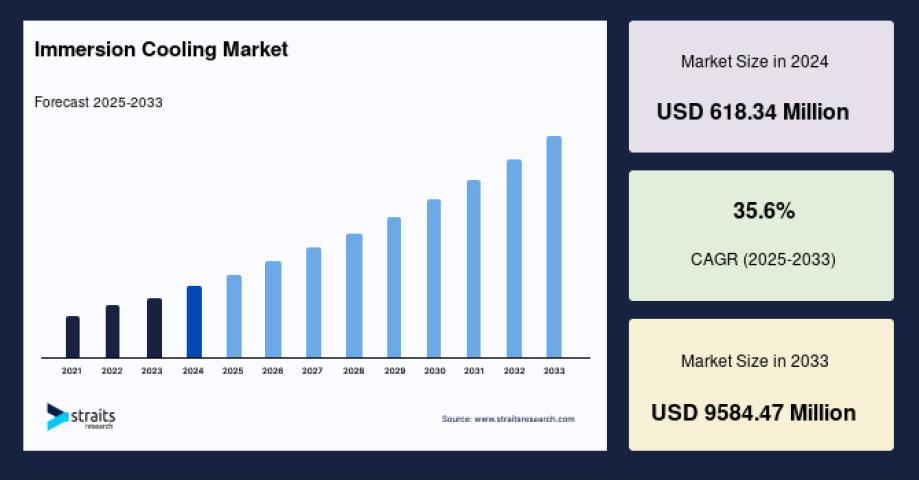
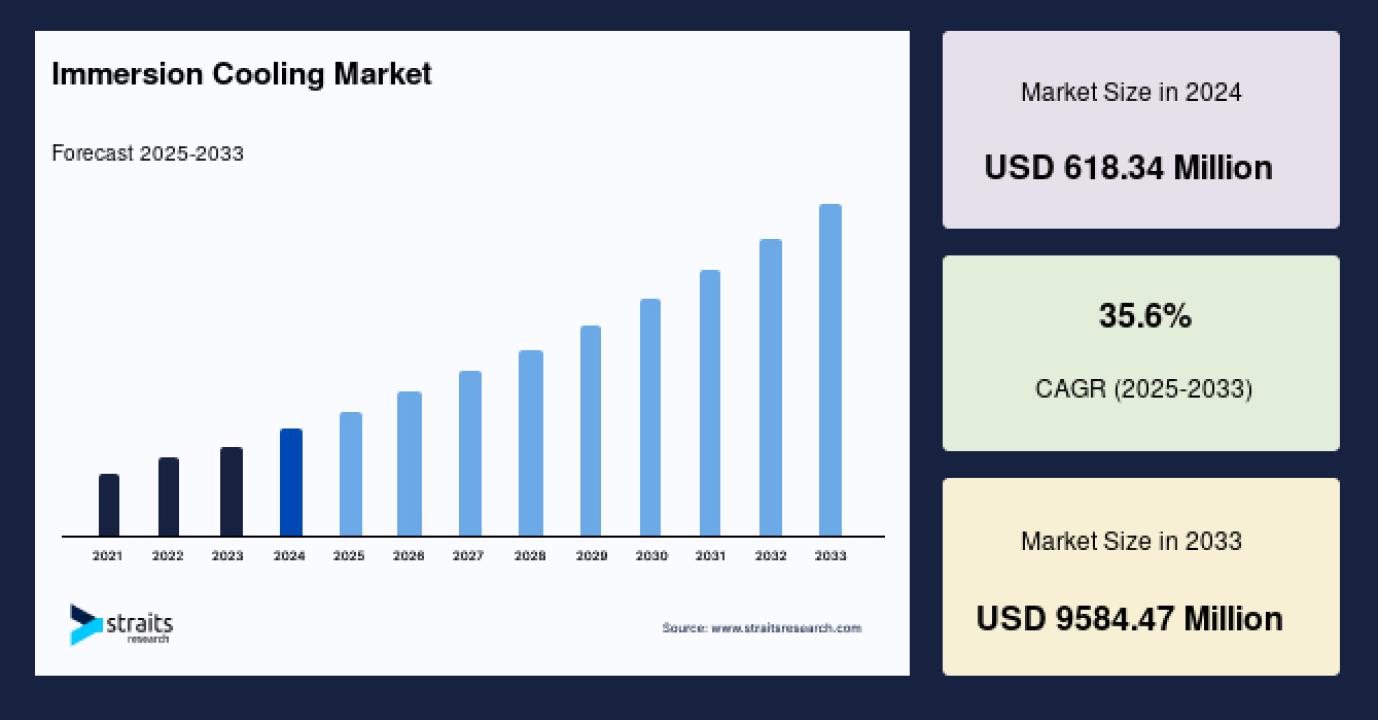
Market Size 2024 – USD 618.34 million
Market Size 2025 – USD 838.48 million
Market Size 2033 – USD 9584.47 million
CAGR (2025–2033) – 35.6%
For detailed market insights and forecasts, request the sample report at https://straitsresearch.com/report/immersion-cooling-market/request-sample
Market Drivers
The explosion of data volumes, fueled by cloud computing, AI, and IoT deployments, significantly increases data center energy consumption and heat generation. Immersion cooling offers superior thermal conductivity, enabling data centers to operate at higher compute densities without proportional increases in power usage or cooling capacity.
Environmental regulations and corporate sustainability commitments drive operators to adopt energy-efficient cooling technologies that reduce carbon footprint and water usage compared to traditional air-cooled systems. Immersion cooling reduces chiller loads and eliminates the need for large-scale HVAC equipment.
Advancements in dielectric fluids, such as biodegradable, non-toxic, and non-flammable formulations, improve safety and reduce environmental impact. Growing interest in cryptocurrency mining operations, which require high-density and continuous computing, propels demand for immersion cooling systems.
Government incentives and R&D investments support innovation, making immersion cooling increasingly economically viable for various enterprises.
Market Challenges
High upfront costs for immersion cooling infrastructure tanks, pumps, fluid handling, and retrofitting can be prohibitive for SMEs and legacy data centers. Limited awareness and expertise in managing liquid cooling systems create adoption barriers.
Concerns regarding long-term equipment reliability, fluid maintenance, and compatibility with existing hardware slow market penetration. Regulatory uncertainties related to dielectric fluid disposal remain a challenge.
Integration complexities between immersion cooling and IT operations necessitate close collaboration among hardware vendors, cooling providers, and data center operators.
Market Segmentation
By Cooling Type:
- Single-phase Immersion Cooling: Involves submerging servers in dielectric fluid without phase change; simpler and widely adopted.
- Two-phase Immersion Cooling: Utilizes fluid boiling to extract heat, offering enhanced cooling efficiency; gaining traction in high-performance clusters.
By Component:
- Hardware: Cooling tanks, pumps, heat exchangers, sensors.
- Services: Installation, maintenance, consulting, and monitoring.
By Application:
- Data Centers: The largest end-user, seeking energy-efficient cooling.
- Telecom Infrastructure: Cooling 5G network equipment and edge computing nodes.
- HPC and AI Workloads: Necessitating advanced thermal management for GPUs and accelerators.
- Others: Cryptocurrency mining, industrial automation.
By Region:
- North America: Dominates with early adoption and availability of advanced infrastructure.
- Europe: Significant growth driven by environmental policies and sustainability mandates.
- Asia-Pacific: Fastest growing due to booming data center construction and digitalization.
- Latin America and Middle East & Africa: Emerging markets focusing on modernizing IT facilities.
For comprehensive segmentation and report purchase, visit https://straitsresearch.com/buy-now/immersion-cooling-market
Top Players Analysis
Leading companies driving the immersion cooling market include:
- Submer Technologies, S.L.
- GRC (Green Revolution Cooling, Inc.)
- 3M Company
- Engineerica Systems
- Calefactio
- Iceotope Technologies Ltd.
- Midas Green Technologies
- Vertical Systems
- Dual Computing
- LiquidStack
These players focus on innovation in fluid technologies, system design, and service differentiation. Collaborative projects with hyperscalers and cloud providers validate immersion cooling benefits and accelerate adoption. Continuous R&D aims to enhance scalability, reliability, and cost-effectiveness.
Conclusion
The immersion cooling market is set for exponential growth as data center operators seek sustainable, efficient thermal management solutions. Overcoming adoption challenges through education, standardization, and cost reductions will enable wider penetration across industries. Technological advancements and strategic partnerships are key to capturing this dynamic market opportunity.
About Us
Straits Research is a market intelligence company providing comprehensive business reports and consulting services worldwide. Our blend of quantitative forecasting and trend analysis delivers actionable insights for informed decision-making and optimizing ROI.
Frequently Asked Questions
Q) What is the global immersion cooling market size and forecast?
Market Size 2024 – USD 618.34 million Market Size 2025 – USD 838.48 million Market Size 2033 – USD 9584.47 million CAGR (2025–2033) – 35.6%
Q) What drives immersion cooling market growth?
Increasing data center energy demands, environmental regulations, and advances in dielectric fluids.
Q) Which cooling type dominates?
Single-phase immersion cooling, due to ease of adoption.
Q) What are the main applications?
Data centers, telecom infrastructure, HPC/AI clusters, and cryptocurrency mining.
Q) Who are the leading companies?
Submer, GRC, 3M, Engineerica, Calefactio, Iceotope, Midas Green Technologies.