In today’s interconnected enterprise environments, secure
and reliable wide-area networks (WANs) are critical for global operations.
Organizations with distributed offices, data centers, and cloud resources
require VPN solutions that offer high performance, scalability, and resilience.
FortiGate firewalls, with their advanced IPSec and BGP capabilities, provide a
robust platform for building carrier-grade VPN architectures that meet these
demanding requirements.
For Fortinet NSE 8 Course professionals, understanding how to
design and implement IPSec and BGP VPNs on FortiGate devices is essential. By
combining these technologies, engineers can create highly available, scalable,
and secure WAN backbones that support enterprise growth while maintaining
stringent security standards.
Understanding IPSec and BGP VPNs
IPSec VPN
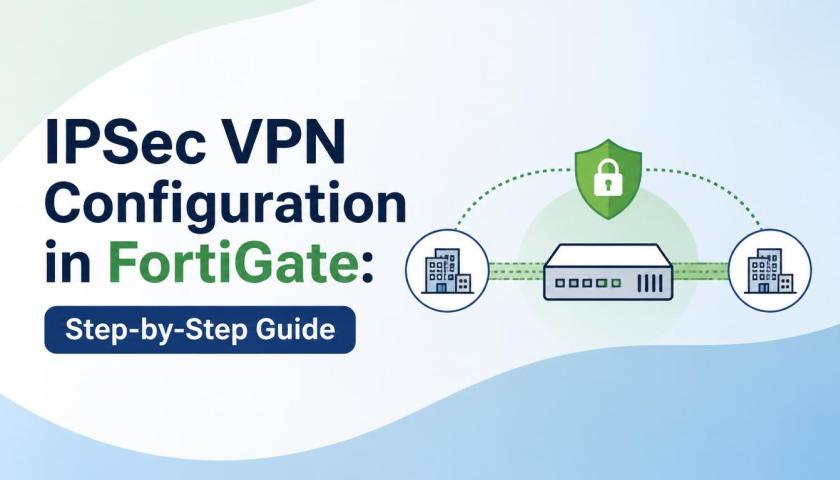
IPSec (Internet Protocol Security) VPNs establish encrypted
tunnels between sites, ensuring confidentiality, integrity, and authenticity of
data traversing public networks. IPSec supports multiple encryption and
authentication methods, making it suitable for secure site-to-site or remote
access connections.
BGP VPN
Border Gateway Protocol (BGP) is the de facto standard for
dynamic routing across WANs and the internet. BGP VPN architectures allow
enterprises to scale networks by dynamically exchanging routing information
between geographically dispersed sites, reducing the complexity of static
routing and enhancing network resilience.
By combining IPSec encryption with BGP routing,
organizations can achieve both security and scalability in their global WAN
backbones.
Designing Carrier-Grade VPN Architectures on FortiGate
Building a carrier-grade VPN architecture requires careful
consideration of both network design and security policies. Key design
principles include:
1. High Availability and Redundancy
Deploy redundant FortiGate devices at each site using
Active-Passive or Active-Active HA configurations. Ensure that IPSec tunnels
are established to multiple peer devices to provide failover in case of link or
device failure.
2. Dynamic Routing with BGP
Implement BGP for dynamic route advertisement across IPSec
VPNs. BGP enables automatic failover and load balancing, reduces manual
configuration errors, and supports multi-homed WAN topologies for maximum
resilience.
3. Segmentation and Security Zones
Use FortiGate’s security zones and VLAN segmentation to
isolate traffic by application, department, or sensitivity level. This approach
enforces security policies while allowing flexible routing between zones over
VPN tunnels.
4. Performance Optimization
Enable hardware acceleration for IPSec encryption to reduce
CPU load and increase throughput. Optimize MTU and fragmentation settings to
prevent packet loss and latency issues across global links.
5. Monitoring and Analytics
Integrate FortiAnalyzer or FortiSIEM for centralized
logging, monitoring, and analytics. Proactive monitoring helps detect
anomalies, optimize traffic patterns, and maintain compliance with enterprise
policies and regulatory requirements.
Best Practices for Global WAN VPN Deployments
To ensure a robust, scalable, and secure WAN backbone,
enterprises should follow these best practices:
- Plan
IP addressing and routing carefully: Avoid conflicts and ensure
consistent route advertisement across sites.
- Regularly
test failover scenarios: Validate HA and BGP convergence to ensure
uninterrupted connectivity.
- Encrypt
critical traffic selectively: Prioritize sensitive data for IPSec
protection while optimizing performance for less-critical traffic.
- Document
VPN policies and configurations: Maintain configuration standards to
simplify troubleshooting and audits.
- Keep
FortiGate firmware updated: Apply security patches and firmware
upgrades to address vulnerabilities.
Adhering to these practices enhances network resilience,
simplifies management, and ensures secure global connectivity.
Role of Fortinet NSE 8 Professionals
For Fortinet NSE 8 engineers, designing carrier-grade IPSec
and BGP VPN architectures is a critical skill. Enterprises increasingly rely on
secure, high-performance WANs to support global operations, cloud integrations,
and business continuity initiatives. NSE 8 professionals can:
- Architect
scalable and resilient VPN topologies.
- Optimize
IPSec encryption and BGP routing for performance and reliability.
- Ensure
security compliance and protect enterprise data across global links.
By mastering these capabilities, Fortinet NSE 8 engineers
deliver networks that meet both operational and security requirements at scale.
Conclusion
Building carrier-grade IPSec and BGP VPN architectures using
FortiGate is essential for enterprises seeking secure, scalable, and resilient
global WAN backbones. For Fortinet NSE 8 Certification professionals, understanding how to
integrate dynamic routing with encrypted tunnels ensures high availability,
optimized performance, and robust security. By leveraging FortiGate’s advanced
features, organizations can maintain seamless connectivity across
geographically dispersed sites, protect critical data, and future-proof their
enterprise WAN infrastructure against evolving network and security challenges.